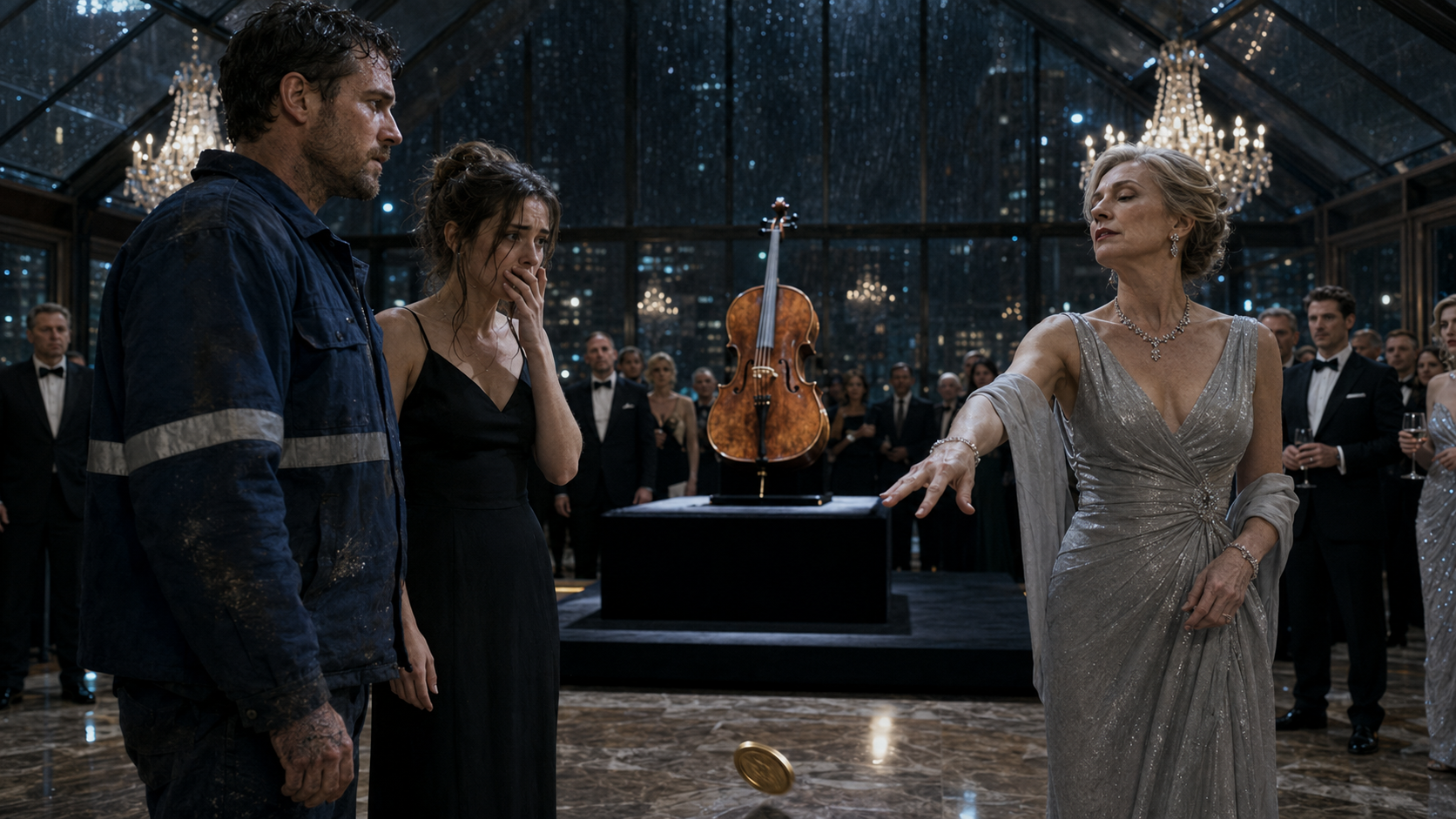
Vivienne’s voice sharpened.
“You have no idea what you’re destroying.”
“I know exactly what I’m ending.”
The ballroom doors opened again.
This time, more than a dozen people entered.
An elderly violinist walked with a cane. A young man carried a faded photograph of a trumpet. A mother held the hand of a little girl whose grandfather’s harp had vanished from a conservatory during a renovation.
They were families of musicians, craftsmen, teachers, and collectors.
People whose stolen instruments had passed through Aurelia warehouses.
Elias looked at them before turning back to the crowd.
“Every recovered instrument will be returned,” he said. “When the original owner is gone, it will go to the family. When no family can be found, it will be placed in a public music program under the owner’s name.”
The room remained silent.
Mara approached the cello.
Her fingers hovered over the carved sun but did not touch it.
“My father built this during the last year of his life,” she said. “He wanted me to perform with it.”
“Then you should,” Elias replied.
“I haven’t played in years.”
“That doesn’t mean the music is gone.”
The investigator signaled to the officers.
They moved toward Vivienne.
She looked at the guests who had praised her only minutes earlier.
None of them met her eyes.
As an officer reached for her arm, Vivienne looked at Elias with pure hatred.
“You think returning a few old instruments makes you noble?”
“No.”
He took the golden token from the evidence pouch after the investigator photographed it.
Then he placed it carefully in Vivienne’s palm.
“It only makes them returned.”
Her fingers closed around it automatically.
The officers led her away.
Outside, the rain began to weaken.
The first pale line of morning appeared beyond the city towers.
Mara sat on the edge of the auction platform and lifted the cello between her knees. The strings were old, and the bow needed restoration, but when she drew it across them, a low, imperfect note filled the ballroom.
It trembled through the chandeliers.
It moved across the marble.
It silenced every whispered excuse.
Mara played a second note.
Then a third.
Elias stood nearby in his wet railway jacket, listening.
The guests who had mocked his clothes now watched him with uncertainty, wondering how much he had heard, how much he knew, and whether their own names might be hidden somewhere in the recovered ledgers.
Elias did not look at them.
He looked only at Mara.
“Why didn’t you tell me who you were?” she asked when the final note faded.
He thought for a moment.
“Because everyone behaved differently when they knew.”
“And now?”
“Now you know.”
Mara studied his tired face, the grease on his sleeve, and the rainwater still shining on his shoulders.
She reached down, took his rough hand, and placed it against the carved wooden sun.
“My father used to say an instrument remembers every hand that protects it.”
Elias smiled.
“Do you believe that?”
“I do now.”
Behind them, the glass roof closed slowly over the waking city.
The chandeliers dimmed.
The cameras were lowered.
And for the first time in eleven years, the cello was no longer an auction item, an investment, or a secret locked inside a warehouse.
It was home.