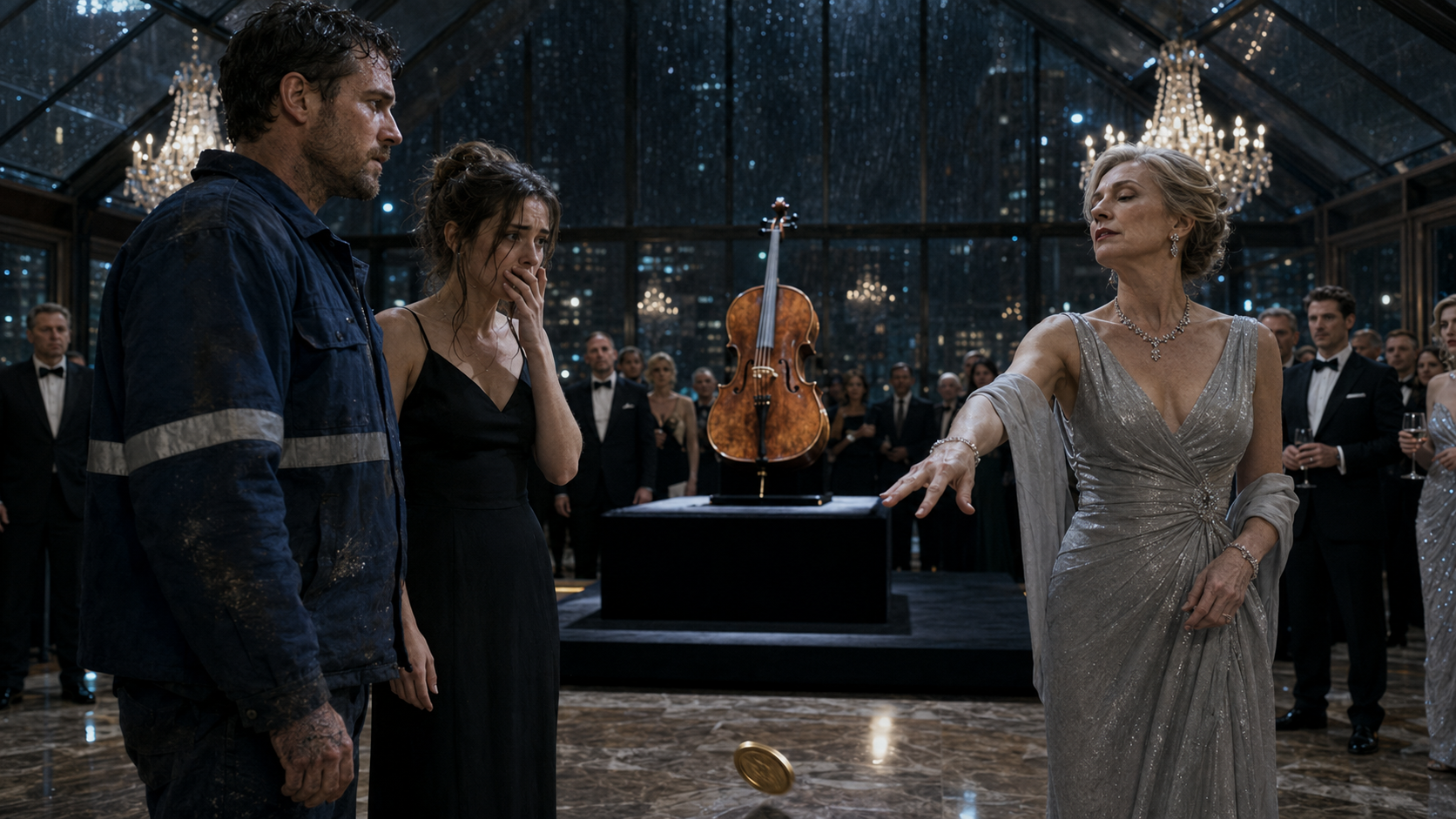
Rain hammered the glass roof of the Aurelia Conservatory, turning the city lights above it into rivers of gold and silver.
Inside, however, nothing looked touched by the storm.
Crystal chandeliers floated over a ballroom filled with politicians, collectors, celebrities, and heirs to fortunes old enough to have their own legends. Waiters moved silently between the guests, carrying narrow glasses of champagne. A string quartet played beneath a wall of white orchids while cameras followed anyone whose name might appear in tomorrow’s society pages.
At the center of the ballroom stood a circular platform covered in black velvet.
Resting upon it was a cello.
Its dark wooden body shone under the lights. Fine silver lines curled around its edges, and a small sun had been carved beneath the bridge.
The auction catalogue described it as an anonymous eighteenth-century masterpiece.
Mara Solis knew better.
“That’s my father’s cello,” she whispered.
Beside her stood Elias Reed, still wearing the navy work jacket from his evening shift. A reflective stripe crossed his chest. Rain darkened his shoulders, and a faint streak of machine grease marked one sleeve.
He looked more prepared to repair a subway signal than attend the most exclusive charity auction in the city.
“Are you certain?” he asked.
Mara stared at the carved sun.
“He made that mark himself. He said every instrument needed one secret that belonged only to its maker.”
Her voice trembled.
The cello had disappeared eleven years earlier, shortly after her father died. Mara had been seventeen. Creditors had emptied his workshop, and a private dealer had purchased most of the remaining instruments before she even understood what was happening.
She had spent years searching.
Then, three days ago, the Aurelia Foundation announced the cello as the final attraction of its annual auction.
Mara had received an invitation from an unknown sender.
Elias had insisted on coming with her.
“You should have changed clothes,” she said quietly.
“I came straight from work.”
“You knew what kind of people would be here.”
“I know exactly what kind of people are here.”
Mara studied him.
Elias worked nights maintaining the automated rail system beneath the eastern district. He rarely discussed his past. He lived in a small apartment above a bakery, fixed broken radios for his neighbors, and refused to buy anything he could repair.
He had never appeared uncomfortable around wealth.
He simply seemed uninterested in it.
A woman in a silver evening gown turned toward them.
Her name was Vivienne Kade, president of the Aurelia Foundation and host of the auction. Diamonds circled her throat, and her white hair was cut with geometric precision. Two younger women stood beside her, both holding champagne and watching Mara with theatrical curiosity.
Vivienne’s gaze traveled slowly from Mara’s plain black dress to Elias’s wet work jacket.
“I’m afraid the service entrance is downstairs,” she said.
Elias looked behind him.
“I don’t see any service workers.”
One of the younger women laughed into her glass.
Vivienne’s smile tightened.
“I was speaking to you.”
“So was I.”
Mara touched Elias’s arm.
“We’re invited guests.”
Vivienne lifted one eyebrow.
“Guests?”
Mara opened her small handbag and produced the ivory invitation. Vivienne glanced at it but did not take it.
“How fascinating,” she said. “We sent those only to donors, collectors, and patrons.”
“Then perhaps your office made an exception.”
“My office does not make exceptions.”
Several nearby guests had begun listening.
The younger woman in emerald earrings whispered, loudly enough to be heard, “Maybe they found it on the pavement.”
Her companion giggled.
Mara’s face flushed.
Elias remained still.
Vivienne stepped closer to him.
“What exactly do you do?”
“I keep trains from crashing.”
The young women laughed again.
Vivienne reached into a small jeweled purse and removed a round golden cloakroom token.
“You must be exhausted,” she said. “Why don’t you take the evening off?”
She flicked the token toward Elias.
It struck his jacket, fell onto the marble floor, and rolled in a wide circle between the guests.
The quartet continued playing for several seconds before the first violinist noticed the silence in the room.
The music stopped.
The token spun beneath the chandelier.
Vivienne smiled.
“There,” she said. “Perhaps that will cover your journey home.”
Someone raised a phone.
Then another.
Mara stepped forward, but Elias gently caught her hand.
“Don’t,” he said.
The token wobbled and fell flat.
Vivienne waited for him to pick it up.
Instead, Elias looked toward the cello.
“How did you acquire that instrument?” he asked.
Vivienne’s expression changed almost imperceptibly.
“The foundation received it from a private European collection.”