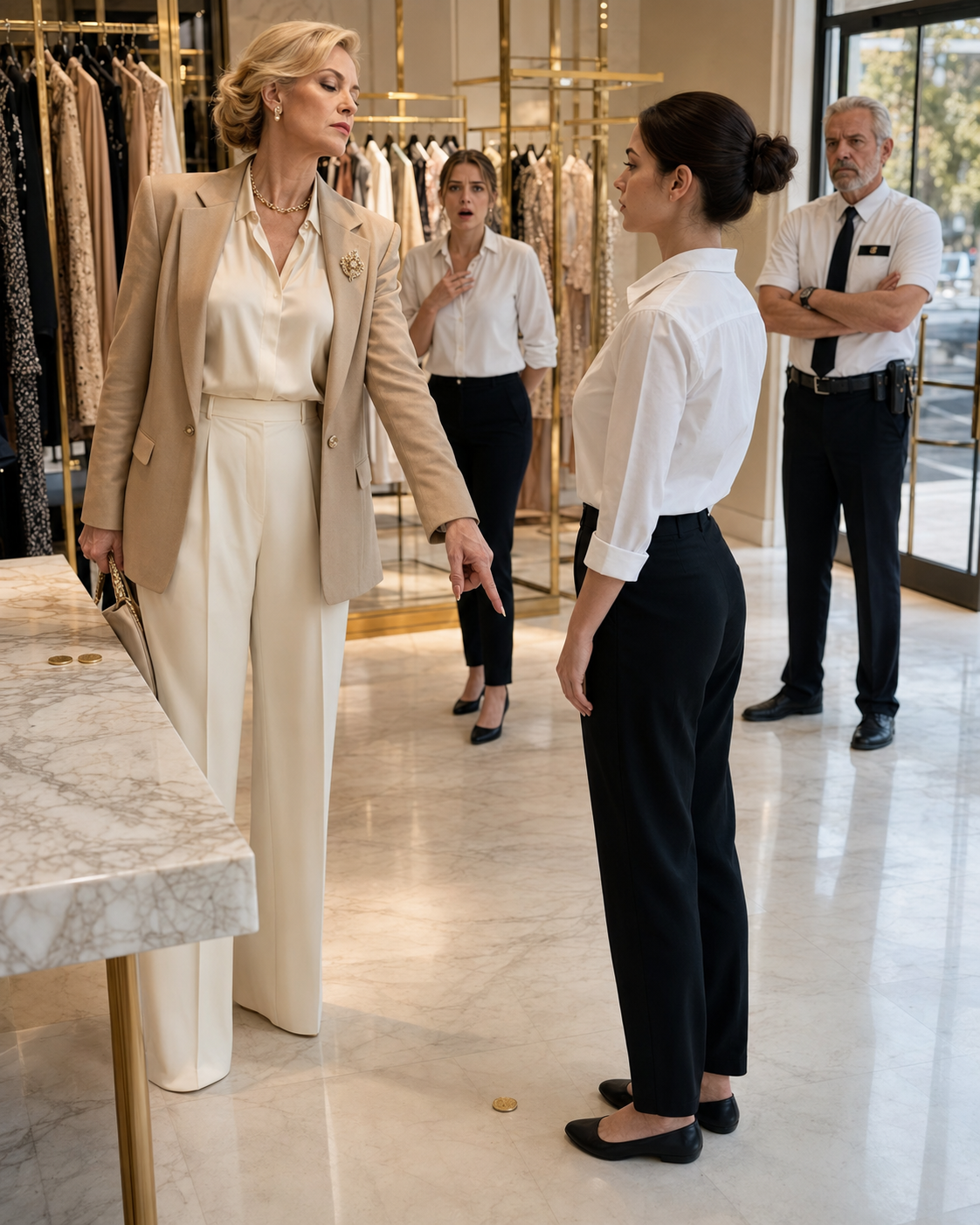
The Woman Who Scattered Coins at Her Feet Had No Idea Who She Was Insulting

On Tuesday afternoons, the Bellamy House boutique was usually quiet enough to hear the faint ticking of the antique brass clock above the fitting rooms.

The store occupied the ground floor of a restored building in the most expensive shopping district in the city. Its tall windows displayed silk dresses, sculpted handbags, and carefully arranged mannequins dressed in colors that changed with every season. Inside, warm light reflected from cream-colored walls and polished stone floors. Nothing was placed casually. Even the distance between the clothing racks had been measured to make each garment feel rare.

Customers did not simply enter Bellamy House to buy clothes.

They came to be noticed buying them.

That afternoon, thirty-two-year-old Evelyn Hart stood behind the marble counter, folding a charcoal-gray jacket with slow, practiced care.

She wore a simple black blouse, tailored trousers, and flat shoes. There was no visible jewelry except for a narrow silver ring on her right hand. Her dark hair was gathered into a low knot, and although her clothes were modest compared with the pieces surrounding her, everything fit with unusual precision.

To most customers, she looked like another sales assistant.

That was exactly what Evelyn wanted.

Near the back of the store, twenty-year-old Mia Lawson was helping an elderly customer choose a scarf. Mia had been working at Bellamy House for less than a month and still became nervous whenever someone asked a question she could not answer immediately.

At the entrance stood Mr. Bernard Cole, the boutique’s sixty-eight-year-old security attendant. He had retired from hotel management years earlier but disliked staying home. He greeted every customer with the same courtesy, whether they arrived in a chauffeured car or stepped in merely to escape the rain.

The afternoon had been uneventful until a black luxury sedan stopped outside.

A moment later, the glass door opened.

The woman who entered wore cream-colored trousers, pointed heels, oversized sunglasses, and a structured ivory blazer. A glossy handbag rested on her arm. Her perfume reached the counter before she did.

She removed her sunglasses without acknowledging Mr. Cole’s greeting.

“Where is the new collection?” she asked.

There was no hello.

No smile.

Not even a glance in his direction.

Evelyn stepped from behind the counter.

“The central display, ma’am. We received several new pieces this morning. I’d be happy to show you.”

The woman looked Evelyn over, pausing briefly at her flat shoes.

“I can see the display,” she replied. “I asked where the complete collection is.”

“Some pieces are arranged by size along the east wall. The limited editions are in the private fitting area.”

“Then why didn’t you say that first?”

Evelyn kept her expression neutral.

“My apologies. Please follow me.”

The customer’s name was Claudia Whitmore, though Evelyn did not learn it until much later, when the woman handed over her credit card.

Claudia moved through the boutique as if expecting the room to rearrange itself for her. She touched fabrics without returning them to their hangers, dropped a cashmere sweater across the back of a chair, and handed dresses to Evelyn without looking at her.

“This one.”

“And this.”

“Not that color. Are you trying to make me look tired?”

“No, ma’am.”

“Then bring the blue.”

Evelyn brought the blue.

Claudia disappeared into the largest fitting room with twelve garments and emerged several minutes later wearing a dark green dress.

“It gathers at the waist,” she said sharply.

“That design is intended to create a softer line,” Evelyn explained. “I can bring you the next size or suggest a different cut.”

Claudia stared at herself in the mirror.

“I don’t need a larger size.”

“I understand. A different silhouette might be more comfortable.”

“Comfortable?”

Claudia turned toward her.

“Do I look as though I came here to buy comfortable clothes?”

Mia glanced over from the scarf display.

Evelyn noticed and gave her a small reassuring nod.

“No, ma’am,” Evelyn said. “I’ll bring another style.”

For the next forty minutes, she remained composed.

She fetched dresses in different sizes. She adjusted the lighting around the mirror. She found shoes that matched a silk gown Claudia had decided she might wear to a charity dinner. She brought mineral water, then replaced it when Claudia complained that it was not cold enough.

Nothing satisfied her for long.

A hem was too conservative.

A sleeve was too wide.

A fabric was too ordinary.

A price was unexpectedly low, which apparently made the garment suspicious.

When Mia offered to carry several discarded pieces away, Claudia snapped her fingers.

“You. Girl.”

Mia stopped.

“Yes, ma’am?”

“Don’t pile them together. That silk wrinkles easily.”

“I’ll be careful.”

“You should have been careful before touching it.”

Mia’s face reddened.

Evelyn stepped closer and gently took the garments from her.

“I’ll handle these,” she said.

Claudia watched the exchange with faint amusement.

“Is she new?”

“Yes.”

“It shows.”

Mia lowered her eyes.

Evelyn placed the dresses over her arm.

“She’s learning quickly.”

“Then perhaps someone should teach her that customers in places like this expect a certain level of service.”

Mr. Cole shifted slightly near the door.

Evelyn met Claudia’s eyes.

“We expect every member of our staff to be treated respectfully as well.”

The sentence was quiet.

Claudia blinked, as though surprised that a sales assistant had said anything beyond yes, ma’am.

Then she smiled.

It was not a warm smile.

“Of course,” she said. “How noble.”

She returned to the fitting room.

Mia waited until the door closed.

“I’m sorry,” she whispered.

“You have nothing to apologize for,” Evelyn replied.

“I should have known about the silk.”

“You did nothing wrong.”

“She hates everything I do.”

“She arrived unhappy. Some people bring their unhappiness into a room and expect everyone else to carry it for them.”

Mia looked toward the fitting room.

“How do you stay so calm?”

Evelyn glanced down at the jacket in her hands.

“Practice.”

Claudia eventually selected seven items: two dresses, a wool coat, a silk blouse, a leather handbag, a pair of shoes, and the ivory blazer she had entered wearing.

The blazer was from a young fashion label called Arden Row. It had sharp shoulders, fabric-covered buttons, and a distinctive diagonal seam running from the collar to the left pocket.

Claudia had apparently purchased it elsewhere.

Evelyn recognized it immediately.

She had drawn the first version of that seam on the back of a restaurant receipt four years earlier.

At the counter, Evelyn folded Claudia’s purchases in tissue paper and placed each item inside a cream-colored box.

Claudia stood across from her, scrolling through her phone.

“How long is this going to take?”

“I’m nearly finished.”

“You said that several minutes ago.”

“These fabrics need to be packed carefully.”

“They are clothes, not museum pieces.”

Evelyn tied a ribbon around the final box.

“The total is six thousand eight hundred and forty dollars.”

Claudia finally looked up.

“For seven items?”

“Yes, ma’am.”

“I was told there was a private-client reduction.”

“That applies to registered members.”

“I have shopped here before.”

“I can check the account. What name would it be under?”

Claudia sighed heavily.

“Whitmore. Claudia Whitmore.”

Evelyn searched the customer records.

“I’m afraid I don’t see an active membership.”

“That’s impossible.”

“There is an older profile, but it expired last year.”

Claudia leaned closer.

“Then reactivate it.”

“I can ask the manager to contact you about renewal, but I cannot apply a membership reduction before it is active.”

“You cannot?”

“No, ma’am.”

Claudia placed both hands on the marble counter.

“I have spent more money in this store than you probably earn in two years.”

The boutique became still.

Mia stopped folding a scarf.

Mr. Cole looked toward the counter.

Another customer, who had been examining earrings near the window, slowly lowered the pair she was holding.

Evelyn did not flinch.

“The total remains six thousand eight hundred and forty dollars.”

Claudia laughed once.

“You people are remarkable.”

Evelyn waited.

Claudia pulled a card from her purse and dropped it onto the counter.

“Run it.”

Evelyn processed the payment.

Approved.

She returned the card with the receipt.

“Would you like the receipt inside one of the bags?”

“No. Give it to me.”

Evelyn extended it.

Claudia took the receipt, looked at the total again, and shook her head.

Then she reached into the bottom of her handbag.

“I suppose you’re waiting for your reward.”

Evelyn frowned slightly.

“I’m sorry?”

“A tip.”

“That isn’t necessary.”

“Oh, don’t pretend. Everyone expects something now.”

Claudia removed three coins from her purse.

She placed one on the counter.

Then another.

The third rolled from her fingertips, struck the marble, and fell to the floor.

The metallic sound seemed unnaturally loud.

Claudia looked down at it.

Then she looked at Evelyn.

“Pick it up,” she said.

Mia inhaled sharply.

The customer near the earrings turned fully toward them.

Mr. Cole took one step away from the door.

Evelyn remained where she was.

Claudia lifted an eyebrow.

“I said, pick it up.”

Evelyn rested both palms lightly against the counter.

“No.”

The answer was not loud.

It did not need to be.

Claudia’s expression changed.

“What did you say?”

“I said no.”

“You’re refusing to clean your own floor?”

“That coin belongs to you.”

“I gave it to you.”

“You threw it at my feet.”

“I dropped it.”

“Then you may pick it up.”

Mia stared at Evelyn with wide eyes.

Claudia slowly removed her sunglasses from the top of her head.

“Do you have any idea who you are speaking to?”

Evelyn’s face remained calm.

“No. But I know how you’ve spoken to everyone in this boutique.”

Claudia glanced around, suddenly aware that every person in the store was listening.

“This is unbelievable. Get your manager.”

“The manager is in a meeting.”

“Then call her.”

“She is unavailable.”

Claudia pointed toward the coin.

“You are going to pick that up, apologize, and carry my bags to the car.”

Evelyn looked at the ivory blazer.

Its diagonal seam was perfectly aligned.

The covered buttons had been sewn by hand.

The inner lining carried a pattern inspired by rain falling across a train window.

Evelyn knew every stitch.

“May I ask you a question?” she said.

Claudia gave an impatient laugh.

“You may ask while picking up the coin.”

“Do you know who designed your blazer?”

The question caught Claudia off guard.

She looked down at herself.

“What?”

“Your blazer. Do you know the designer?”

“It’s from Arden Row.”

“Yes.”

“My stylist found it. Why?”

Evelyn walked around the counter.

She did not move toward the coin.

Instead, she crossed the boutique to a framed display hanging between two mirrors. Inside the frame was the black-and-gold emblem of Arden Row: two fine lines forming an unfinished arch.

Beneath it, a small plaque identified the boutique as the label’s exclusive retailer in the city.

Below that appeared the name of its founder and creative director.

Evelyn Hart.

Evelyn raised one finger and touched the edge of the plaque.

No dramatic announcement.

No angry speech.

She simply waited.

Claudia looked at the display.

Then at Evelyn.

Then back at the name.

For several seconds, she said nothing.

The woman near the earrings covered her mouth.

Mia’s eyes widened even further.

Mr. Cole quietly folded his hands in front of him, but a satisfied smile appeared at the corners of his mouth.

Claudia’s lips parted.

“You’re—”

“The woman who designed your blazer,” Evelyn said.

The Beginning No One Had Seen

Arden Row had not begun in a glass office or a fashionable studio.

It had begun in a rented room above a bakery.

Every morning, before sunrise, the smell of warm bread drifted through the floorboards. Every night, after the bakery closed, the building’s old pipes groaned loudly enough to wake Evelyn from sleep.

At the time, she worked three jobs.

She served breakfast at a hotel café from six until eleven. She altered clothes at a dry cleaner in the afternoon. Four evenings a week, she waited tables at a restaurant near the train station.

She saved for eighteen months before purchasing a secondhand industrial sewing machine.

The machine arrived scratched, heavy, and missing one of its original knobs.

To Evelyn, it looked magnificent.

She sketched during lunch breaks, on receipts, paper napkins, delivery invoices, and the blank backs of restaurant menus that had been thrown away.

Her first collection contained only nine pieces.

She photographed them against a white wall using a borrowed camera. A friend modeled the dresses. Another helped build a basic online shop.

For weeks, almost no one visited it.

Then one jacket sold.

A few days later, a second order arrived.

Evelyn packed both herself, walking nearly two miles to the post office because she did not want to spend money on a taxi.

She applied for investment fourteen times.

Fourteen people rejected her.

One said the clothes looked too serious.

Another said her background would make luxury customers “difficult to convince.”

A third advised her to find a more glamorous public face for the company.

Evelyn kept every rejection letter.

Not because she wanted to remain bitter.

Because she wanted proof that failure could speak confidently and still be wrong.

Two years later, an independent fashion editor discovered one of her jackets at a weekend design market. She wrote a short article praising the cut, the hand-finished details, and the way the fabric moved.

Orders doubled.

Then tripled.

The first Arden Row collection to receive national attention sold out in less than three weeks.

Bellamy House became the brand’s first major retail partner.

By the time Claudia Whitmore entered the boutique, Arden Row clothing was being shipped to customers in six countries. Three larger stores had requested distribution rights. A prominent online retailer was negotiating for an exclusive capsule collection.

Evelyn no longer needed to work on the sales floor.

She chose to.

Every Tuesday, she came to Bellamy House without announcing her position.

She helped customers try on jackets.

She listened when women complained about pockets that were too shallow or sleeves that restricted movement.

She watched how real bodies changed the appearance of a garment.

She spoke with the sales staff about what customers loved and what they returned.

She believed a designer who stopped listening eventually began designing only for mirrors.

Most customers never learned who she was.

Evelyn preferred it that way.

She did not want kindness offered because of a title.

She wanted to see how people behaved when they believed titles did not matter.

On that particular Tuesday, Claudia Whitmore had provided a very clear answer.

Back in the Boutique

Claudia stared at the plaque on the wall.

The confidence that had filled her voice minutes earlier disappeared.

“I didn’t realize,” she said.

Evelyn lowered her hand.

“That is precisely the problem.”

Claudia’s cheeks turned pink beneath her makeup.

“I was frustrated. There was confusion about the membership.”

“You criticized Mia before that.”

“I didn’t criticize her. I told her how luxury garments should be handled.”

“You embarrassed her for trying to help you.”

Claudia glanced at Mia.

The young assistant immediately looked down.

“And you ignored Mr. Cole when he welcomed you,” Evelyn continued. “You spoke to me as though courtesy were something I had to earn from you.”

“I was having a difficult afternoon.”

“So was everyone else after you arrived.”

The customer near the earrings looked away to hide a smile.

Claudia straightened her shoulders.

“You’re humiliating me in front of strangers.”

Evelyn’s expression did not change.

“No, Mrs. Whitmore. I am answering you in front of the same people you chose to belittle.”

Claudia looked as though she wanted to argue, but no words came.

Evelyn returned to the counter.

She slid the shopping bags forward with the same care she had shown before the truth was revealed.

“Your purchases are packed. Your payment has been approved.”

Claudia approached slowly.

Evelyn handed her the card.

“Have a pleasant afternoon, Mrs. Whitmore.”

The use of her full name was neither threatening nor cruel.

It was simply precise.

Claudia took the bags.

For the first time since entering the boutique, she appeared unsure of what to do with her hands.

She turned toward the door.

When she reached it, Evelyn spoke again.

“Your coins.”

Claudia stopped.

One coin still lay on the floor. Two remained on the marble counter.

“You may take them,” Evelyn said. “Or you can place them in the donation box beside the register. The money supports a neighborhood meal program.”

Beside the payment terminal sat a small ceramic house with a narrow opening in its roof.

Claudia looked at the box.

Then at the coin on the floor.

Everyone waited.

Finally, she set down her bags.

Still wearing her expensive shoes, cream trousers, and the blazer designed by the woman she had just ordered to kneel, Claudia bent down.

She picked up the coin.

She walked back to the counter and placed all three coins into the ceramic house, one at a time.

The first landed with a faint clink.

Then the second.

Then the third.

Claudia did not look at Evelyn.

She collected her bags, crossed the boutique, and opened the glass door.

Before leaving, she paused.

“I am sorry,” she said.

The apology was quiet and awkward.

It was not graceful enough to erase what had happened.

But it was real enough for the room to hear.

Evelyn gave a slight nod.

Claudia stepped outside, and the door closed behind her.

The silence lasted three seconds.

Then Mia covered her face with both hands.

“I thought I was going to faint.”

The customer near the earrings began laughing.

Mr. Cole applauded once.

The sound echoed across the boutique.

Mia looked at Evelyn.

“You own Arden Row?”

“I founded it.”

“You never told me.”

“You never asked.”

“I thought you were a sales assistant.”

“I am helping customers on the sales floor. That makes me a sales assistant today.”

Mia shook her head, still stunned.

“But why would you let her talk to you like that for so long?”

Evelyn’s smile faded.

“I wasn’t waiting for the right moment to reveal who I was.”

“What were you waiting for?”

“To see whether she would correct herself before knowing.”

The woman near the earrings stepped closer.

“My name is Natalie Brooks,” she said. “I write for a culture and design magazine.”

Evelyn looked at her.

Natalie raised both hands.

“I am not asking for gossip. But what happened here was about more than a rude customer.”

“I don’t want Mrs. Whitmore publicly attacked.”

“Neither do I.”

Natalie glanced at the ceramic donation box.

“I want to write about why you refused to use your title as protection.”

Evelyn was silent for a moment.

Then she looked toward Mia, who was carefully rehanging the silk dress Claudia had criticized her for touching.

“All right,” Evelyn said. “But the story should include everyone.”

What Happened Next

Natalie’s article appeared four days later.

It did not identify Claudia.

It did not describe her car, her family, or any details that could invite strangers to search for her.

Instead, it told Evelyn’s story.

It included photographs of the room above the bakery, the damaged sewing machine, and the earliest Arden Row sketches drawn on restaurant receipts.

It included excerpts from several rejection letters.

One investor had written that Evelyn’s designs lacked “the effortless confidence expected by the luxury market.”

Natalie placed that sentence beside a photograph of Evelyn standing calmly in Bellamy House, surrounded by clothing she had created.

The article also included Mia, who spoke about beginning her first job and learning that nervousness did not make her incompetent.

Mr. Cole described the importance of greeting everyone with the same dignity.

The headline did not mention humiliation or revenge.

It read:

THE DESIGNER WHO REFUSED TO PROVE SHE DESERVED RESPECT

Within twenty-four hours, the article had been shared tens of thousands of times.

Arden Row’s online inventory sold out three days later.

The waiting list for the next collection grew so quickly that Evelyn’s business manager called her after midnight, convinced the website had malfunctioned.

It had not.

Messages arrived from nurses, cleaners, restaurant workers, drivers, security guards, teachers, store assistants, hotel employees, and office receptionists.

Some wrote only a few sentences.

Others told stories they had carried silently for decades.

They described customers who had clicked their fingers instead of learning their names.

Managers who became polite only after discovering someone had important connections.

Strangers who judged intelligence by clothing, dignity by income, and worth by occupation.

One message came from a woman who cleaned offices at night.

She wrote that the article was the first thing she had ever sent to her teenage daughter with the words, “This is what I’ve been trying to explain.”

Evelyn read that message three times.

Late one evening, after the last employee had left the studio, she sat alone beside the old sewing machine she had refused to replace.

It no longer handled production work.

Newer machines filled the main workshop now, operated by skilled cutters and seamstresses. But Evelyn kept the original one near her desk.

The scratches were still visible.

So was the missing knob.

She placed her hands in her lap and began to cry.

Not because of Claudia.

Not because of the coins.

She cried for every morning she had risen before dawn.

For the nights she had fallen asleep over unfinished sketches.

For the fourteen rejection letters stored in a box beneath her bed.

For every time someone had advised her to find a respectable career.

For every moment she had entered an elegant room and instinctively tried to make herself smaller.

The tears came quietly.

When they stopped, Evelyn washed her face, opened a new sketchbook, and began drawing.

The next Arden Row collection was called Equal Measure.

Its garments were inspired by uniforms and working clothes: the clean structure of a hotel jacket, the deep pockets of a shop apron, the strong seams of a mechanic’s shirt, the graceful lines of an old railway conductor’s coat.

Every piece contained a small stitched message inside the lining.

Not visible from the outside.

Not designed for display.

It read:

Your dignity is not a reward.

Months later, Natalie interviewed Evelyn again.

During their conversation, she asked the question readers had repeated most often.

“Why didn’t you tell Claudia who you were as soon as she began treating you badly?”

Evelyn leaned back in her chair.

“Because then she might have become polite for the wrong reason.”

“What would the wrong reason be?”

“My position. My company. The price of the clothes I designed.”

Natalie waited.

Evelyn continued.

“If I had said, ‘Be careful, I am the founder,’ I would have been suggesting that founders deserve more respect than sales assistants.”

She looked through the studio window at the cutting tables below.

“That isn’t true.”

She gestured toward the workshop.

“I deserved respect when I was serving breakfast at a hotel. I deserved it when I altered trousers at the dry cleaner. I deserved it when I carried plates through a crowded restaurant.”

She paused.

“Mia deserves respect while she is learning. Mr. Cole deserves respect while he stands at the door. The person who cleans this studio at night deserves respect even when no one is here to see the work being done.”

Natalie closed her notebook for a moment.

“Then what did you want Claudia to understand?”

“That no one should need to reveal a hidden importance before being treated like a human being.”

Those words became the most widely shared passage from the interview.

Not because they were clever.

Because too many people understood them immediately.

Nearly everyone remembered a moment when someone had looked through them instead of at them.

A moment when their job, clothing, accent, age, address, or lack of influence had placed them into a smaller category.

And nearly everyone had wished, at least once, for the story to turn.

For the ignored employee to own the company.

For the dismissed stranger to hold the answer.

For the person ordered to kneel to remain standing.

Little was heard about Claudia Whitmore afterward.

One employee at Bellamy House claimed she called several weeks later and apologized again.

Another believed she never did.

Someone else thought they had seen her name on the waiting list for the Equal Measure collection.

Evelyn neither confirmed nor denied any of it.

When asked whether Claudia would be permitted to shop at Bellamy House again, Evelyn gave the same answer every time.

“The boutique is open from Monday through Saturday.”

Then she added:

“And every customer will receive the same thoughtful service.”

That was the principle behind Arden Row.

It appeared in the construction of every jacket.

In the careful packaging of every order.

In the way customers were welcomed at the door.

And in the way employees were expected to welcome one another.

The label was never only about clothing.

It was about the person wearing it.

And the people standing beside them.

The Woman Who Scattered Coins at Her Feet Had No Idea Who She Was Insulting
The man of my dreams