Everyone Thought the Old Watch Was Worthless—Until It Started Ticking After Twenty-Four Years

The watch lay beneath a walnut cabinet in the oldest corridor of Ravensmere House, hidden behind a curtain of dust and a row of faded winter roses.

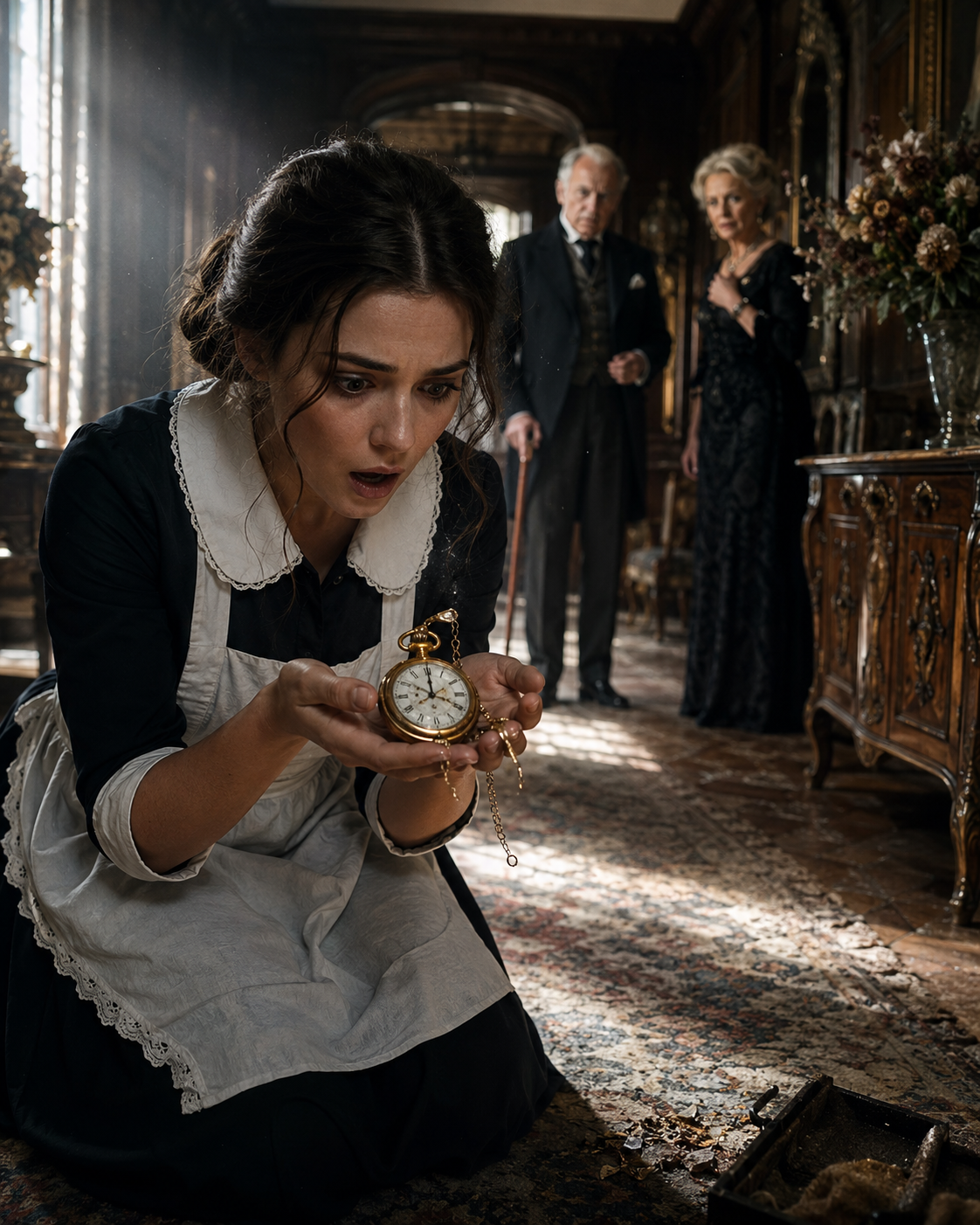
Nora Bennett noticed it only because the morning sunlight struck something metallic under the furniture. She lowered herself onto one knee, reached into the narrow space, and pulled out a heavy gold pocket watch attached to a broken chain.

For several seconds, she simply stared at it.

The case was scratched, and one edge had turned dark with age, yet the object still carried the unmistakable weight of something expensive. A small bird had been engraved on the front, its wings spread above a circle of tiny stars.

Nora rubbed the glass with the corner of her apron.

The hands were frozen at eleven forty-seven.

She had been working at Ravensmere House for only four months, but she already knew that nothing in the mansion was ever truly forgotten. Every portrait had a story. Every locked door concealed an argument. Every member of the Ashcombe family seemed to live beneath the shadow of something no one was permitted to discuss.

Nora placed the watch carefully on her cleaning cart.

She intended to take it directly to Mrs. Dalton, the head housekeeper.

Then the watch began to tick.

Nora froze.

The sound was faint but clear.

Tick.

Tick.

Tick.

The hands remained motionless, yet the mechanism inside had awakened after what looked like decades of silence.

“Where did you get that?”

The voice came from behind her.

Nora turned sharply.

Sir Henry Ashcombe stood at the end of the corridor, one hand resting on his walking cane. He was seventy-two, tall despite his age, with silver hair and an expression that made even confident people lower their voices.

Beside him stood his nephew, Julian Ashcombe.

Julian was nearly fifty, elegantly dressed and always smiling as though he knew something everyone else did not. He managed most of the family’s business affairs and was expected to inherit much of the estate.

But he was not smiling now.

His eyes were fixed on the watch.

“I found it under the cabinet, sir,” Nora explained. “I was going to give it to Mrs. Dalton.”

Sir Henry walked toward her.

“You found it here?”

“Yes.”

“That is impossible.”

Nora glanced at the watch.

“I’m sorry, sir. I don’t understand.”

Julian reached the cart first and picked it up.

His fingers tightened around the gold case.

“You expect us to believe this was lying beneath a cabinet?”

“It was covered in dust.”

“Dust can be placed on anything.”

Nora felt heat rise into her face.

“I did not steal it.”

Julian turned the watch over and examined the engraving.

“You have been inside this house for four months. Long enough to learn which objects might be valuable.”

“I have never entered a private room without permission.”

Sir Henry stopped in front of her.

“Do you know who owned this watch?”

Nora shook her head.

“My daughter.”

The corridor seemed to grow colder.

Nora had heard stories about Sir Henry’s daughter, Rosalie Ashcombe. The older servants spoke her name only when they believed no one was listening.

Rosalie had disappeared twenty-four years earlier.

Some claimed she had escaped with a young musician. Others insisted she had stolen money and fled abroad. A former gardener once told Nora that Rosalie had been seen crying near the north gate on the night she vanished.

No one knew what had truly happened.

And the northern wing of Ravensmere House had remained locked ever since.

“Rosalie was wearing this watch on the night she left,” Sir Henry said. “It was never recovered.”

Nora looked from him to Julian.

“Then perhaps someone hid it here.”

Julian’s expression hardened.

“Or perhaps someone found it elsewhere and brought it into this house.”

“Why would I do that?”

“To create confusion. To gain attention. Perhaps to demand money.”

“I don’t want your money.”

Julian gave a quiet laugh.

“Everyone wants something.”

He turned to Sir Henry.

“We should search her room.”

Nora stepped back.

“You have no right.”

“We have every right,” Julian replied. “You live beneath this family’s roof.”

Two staff members appeared at the far end of the corridor. They had clearly heard the raised voices, but neither dared to come closer.

Sir Henry lifted his hand.

“Search the room.”

“No.”

The word came from the doorway behind them.

Everyone turned.

Lady Eleanor Ashcombe stood beneath the carved archway leading to the music room. She wore a dark blue dress and leaned upon a silver-handled cane, but there was nothing weak about her expression.

At seventy, she still possessed the quiet authority of someone accustomed to being obeyed.

“No one is entering that young woman’s room,” she said.

Julian moved toward her.

“Aunt Eleanor, this watch disappeared with Rosalie.”

“I heard you.”

“She may have stolen it.”

“Or she may be telling the truth.”

Julian lowered his voice.

“You are upset. You should sit down.”

Eleanor’s gaze sharpened.

“Do not tell me what I should do.”

She extended her hand.

“Give me the watch.”

Julian hesitated.

“Now.”

He placed it in her palm.

For a moment, Eleanor did not move.

Her fingers traced the engraved bird. Her face lost its color, and her lips parted as if she had forgotten how to breathe.

“This was Rosalie’s,” she whispered.

Sir Henry looked away.

Eleanor pressed the small button on the side.

The watch opened.

Inside the lid was a miniature painting of a young woman with dark hair and bright, determined eyes.

Nora recognized her immediately.

Not because she had seen the portrait before.

Because the woman looked like her.

The same narrow chin.

The same curve of the eyebrows.

The same small mark beside the left eye.

Eleanor noticed Nora’s reaction.

“What is it?”

“Nothing.”

“You recognized her.”

Nora swallowed.

“She looks like someone.”

“Who?”

“My mother.”

Silence filled the corridor.

Julian stared at her.

Sir Henry’s grip tightened around his cane.

Eleanor stepped closer.

“What was your mother’s name?”

“Lily Bennett.”

“Where was she born?”

“I don’t know. She never spoke about her childhood.”

“And your father?”

“I never knew him.”

Eleanor continued studying Nora’s face.

“How old are you?”

“Twenty-four.”

Julian suddenly closed the watch.

“This proves nothing. Many people resemble one another.”

But Eleanor took it back from him.

She pressed her thumb against the engraved bird and twisted it slightly.

A section of the inner case moved.

Nora leaned closer.

Hidden beneath the painting was a tiny brass key.

Sir Henry’s eyes widened.

“I never knew that was there.”

“I did,” Eleanor said.

She lifted the key into the light.

“Rosalie showed it to me when she was seventeen. She said she had created a hiding place that no one else would ever find.”

Julian forced a smile.

“A key without a lock tells us nothing.”

“It opens her music cabinet.”

“That cabinet was removed years ago.”

“No,” Eleanor replied. “It is still in the north room.”

Sir Henry looked at her.

“The north wing has been sealed.”

“Then it is time we opened it.”

“No.”

His answer came too quickly.

Eleanor turned toward him.

For the first time, Nora saw fear in the old man’s face.

“Why not?” Eleanor asked.

“The rooms are unsafe.”

“They were inspected last year.”

“The floorboards—”

“Are perfectly sound.”

Julian stepped between them.

“This is becoming ridiculous. A servant finds a watch, invents a resemblance, and suddenly we are reopening rooms that have been closed for decades.”

Nora looked directly at him.

“I never said I was related to anyone.”

“You did not need to.”

Eleanor placed the key in Nora’s hand.

“You found the watch. You will come with me.”

The northern wing began beyond a pair of oak doors at the end of the second floor.

Mrs. Dalton brought the master key, but her hands shook so badly that Nora had to unlock the doors herself.

Cold air escaped from the darkness beyond.

The rooms smelled of old fabric, polished wood and years without human breath.

Dust sheets covered the furniture. Rosalie’s bedroom remained almost exactly as she had left it. A blue dress hung behind a folding screen. Books stood in uneven rows beside the window. A dried ribbon had been tied around the bedpost.

On the far side of the room stood a narrow rosewood cabinet.

Eleanor approached it slowly.

“She played the violin,” she said. “Badly at first. Then beautifully.”

Sir Henry remained near the doorway.

Julian stood beside him, watching Nora rather than the cabinet.

The brass key entered the lock perfectly.

Nora turned it.

Nothing happened.

She tried again.

A quiet click sounded inside the wood.

The front of the cabinet opened, revealing several empty shelves.

Julian exhaled.

“There is nothing here.”

Eleanor ran her fingers along the inside frame.

“Rosalie never trusted obvious hiding places.”

Nora noticed a small engraved bird near the bottom shelf—the same bird that appeared on the watch.

She pressed it.

A hidden panel sprang open.

Inside lay a velvet pouch, a silver music cylinder and half of a broken pendant.

Nora stopped breathing.

She reached beneath her collar and removed the necklace she had worn since childhood.

Her pendant was the missing half.

When the two pieces were placed together, they formed the same bird and circle of stars engraved upon the watch.

Eleanor covered her mouth.

Sir Henry sank into a chair.

Julian moved toward the cabinet.

“This has been arranged.”

Nora stepped between him and the objects.

“By whom?”

“By you.”

“I didn’t even know this room existed.”

“You could have learned about it from a servant.”

Eleanor picked up the silver cylinder.

“This belonged to Rosalie’s recording machine.”

On the desk stood an old mechanical phonograph designed for personal voice recordings. Mrs. Dalton cleaned the dust from it while Eleanor inserted the cylinder.

Sir Henry rose unsteadily.

“Eleanor, don’t.”

She ignored him.

The machine turned.

Static filled the room.

Then a young woman’s voice emerged from the horn.

“Mother, I don’t know whether you will ever hear this.”

Eleanor gripped the edge of the desk.

The recording continued.

“Father discovered I was expecting a child. He says the family cannot survive the shame. He has arranged for me to leave before sunrise.”

Nora felt the floor shift beneath her.

Rosalie’s voice trembled, but she kept speaking.

“I am not running away. I am not abandoning you. Julian knows where they are taking me. He heard everything outside the library.”

Everyone turned toward him.

Julian’s face had become pale.

The voice from the machine continued.

“I gave him my watch and begged him to bring it to you. The key will open this cabinet. Inside is half of my pendant. I will keep the other half for my child.”

The recording crackled.

“If my baby is a girl, I will name her Nora.”

Nora’s knees nearly gave way.

Eleanor reached for her hand.

On the cylinder, Rosalie took a broken breath.

“Please find us. And please do not believe them when they say I left willingly.”

The recording ended.

Only the soft turning of the machine remained.

Julian backed toward the door.

Eleanor looked at him.

“You had the watch.”

He shook his head.

“I was young.”

“You were twenty-three.”

“My uncle told me Rosalie needed time away.”

“The recording says she begged you for help.”

“I was afraid.”

Sir Henry spoke at last.

“I told him that if he interfered, he would be removed from the family.”

Eleanor turned slowly toward her husband.

“What did you do to our daughter?”

“I sent her somewhere private.”

“Where?”

“A residence in Scotland. She was supposed to remain there until the child was born.”

“And afterward?”

Sir Henry stared at the floor.

“She escaped.”

“You told me she had run away with a musician.”

“I believed she would return.”

“You allowed me to search for her under a false name for twenty-four years.”

“I was protecting this family.”

Eleanor’s voice dropped to a whisper.

“You destroyed this family.”

Julian reached for the door handle.

Mrs. Dalton blocked his way.

“The police are already coming,” she said.

Julian stared at her.

“You had no authority to call them.”

“I heard the recording.”

He looked toward the open window as though considering another exit.

Nora watched him carefully.

“Why did you hide the watch beneath the cabinet?”

“I didn’t.”

“You were holding it when it disappeared.”

“I gave it to your grandfather.”

Sir Henry looked up.

“No. You told me you had thrown it into the river.”

Julian closed his eyes.

The truth seemed to leave him all at once.

“I couldn’t destroy it,” he admitted. “I hid it in the corridor. I thought no one would ever find it.”

“Why there?” Eleanor asked.

“Because the cabinet was never moved.”

Nora glanced at the watch.

“Until the floor was repaired last month.”

The workers must have shifted the cabinet just enough for the object to slide into view.

Twenty-four years of silence had ended because someone had moved a piece of furniture a few inches.

The authorities arrived before sunset.

The recording, the watch and the pendant were taken for examination. Records from a former maternity residence in Scotland were requested. Several weeks later, investigators discovered that a young woman calling herself Lily Bennett had arrived at a hospital in Whitby with an infant daughter twenty-four years earlier.

Her original name had been Rosalie Ashcombe.

She had lived quietly under a new identity, too frightened and too ill to return to Ravensmere. She died when Nora was six, leaving behind only the broken pendant and instructions that her daughter should never be taken to the Ashcombe family.

Rosalie had believed the people who controlled the estate still controlled her fate.

She had never known that Eleanor had spent years searching for her.

The final proof came through a family DNA test.

Nora Bennett was Nora Rosalie Ashcombe.

The missing granddaughter of Ravensmere House.

Julian was charged with concealing evidence and obstructing the original investigation. Sir Henry was questioned about the unlawful confinement and transportation of his daughter. His age did not erase the choices he had made, nor did the reputation of the Ashcombe name protect him from public disgrace.

Eleanor never asked Nora to forget what had happened.

She did not beg for immediate forgiveness.

Instead, she gave Nora the truth, the legal records and the freedom to decide whether Ravensmere would ever become her home.

For several months, Nora continued working alongside the staff.

Not because anyone required it.

She simply refused to behave as though honest work had become shameful because she had inherited a famous surname.

Eventually, Eleanor transferred the northern wing to her granddaughter. Together, they transformed Rosalie’s abandoned rooms into a small foundation that helped young mothers without families or financial support.

The old pocket watch was repaired.

The hands no longer remained frozen at eleven forty-seven.

On the first anniversary of the truth being discovered, Nora stood beside Eleanor in the restored music room and listened as the watch marked midnight.

Eleanor looked at her.

“Your mother wanted you to be found.”

Nora closed the gold case gently.

“She made certain I would be.”

For twenty-four years, everyone at Ravensmere had believed the watch was nothing more than a lost family treasure.

They were wrong.

It was a promise.

And it had continued waiting beneath the dust until someone the family barely noticed finally bent down far enough to uncover the truth.

Everyone Thought the Old Watch Was Worthless—Until It Started Ticking After Twenty-Four Years
10 of the most epic red carpet falls ever