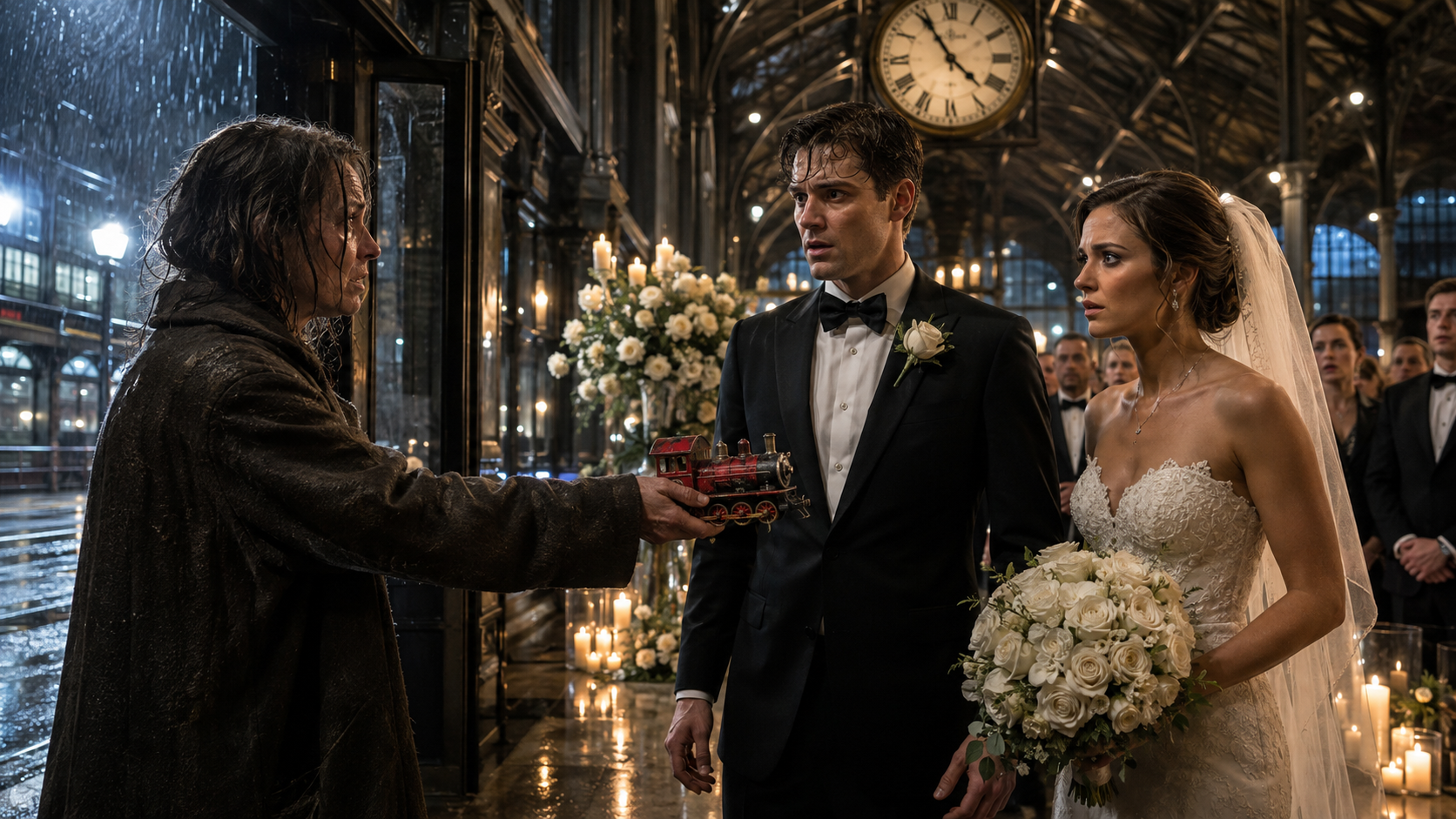
In those dreams, he was sitting beneath a kitchen table while rain struck the windows. A girl with long dark hair pushed a red train toward him. Somewhere nearby, a woman was singing.
He had experienced the same dream since childhood.
By morning, most of it always disappeared.
Only the train remained.
Miriam held it against her chest.
“You called it Rocket,” she said.
Elliot stared at her.
Celia touched his arm.
“Elliot?”
He barely heard her.
“How do you know that?”
Miriam’s lips trembled.
“Because I gave it to you.”
Richard struck his cane against the floor.
“That is enough.”
“No,” Elliot said.
The sharpness of his own voice surprised him.
The terminal fell silent.
Elliot stepped closer to Miriam.
“Tell me who you are.”
She opened her mouth, but no words came.
Instead, she turned the golden key.
A mechanism clicked inside the train.
For a moment, nothing happened.
Then a woman’s faint voice emerged through the crackling speaker hidden inside the toy.
“Sleep now, little fox. Morning always finds us.”
The recording lasted only a few seconds.
When it ended, the station seemed unnaturally quiet.
Elliot felt the floor shift beneath him.
Little fox.
Nobody had called him that in years.
Nobody he could remember.
Yet the words opened something inside him.
A narrow apartment.
A yellow kitchen.
A woman singing beside a window.
A girl kneeling on the floor.
A red train moving between them.
Elliot pressed a hand against his forehead.
“What is this?”
Miriam took an unsteady breath.
“It was our mother’s voice.”
“Our mother?”
Miriam nodded.
“I’m your sister.”
The words traveled through the terminal like an electrical current.
Celia covered her mouth.
Vivian Marlowe sank into the chair behind her.
Richard remained standing.
Elliot shook his head.
“I don’t have a sister.”
“You did.”
Miriam reached into her bag again and removed a plastic envelope. Inside was an old instant photograph.
She held it out.
Elliot hesitated before taking it.
The picture showed a teenage girl sitting on the steps of a small brick apartment building. A baby rested in her arms. The baby wore a knitted cap with two pointed ears, like a fox.
Beside the girl sat the red train.
On the white border beneath the image, someone had written:
Miriam and Eli, three weeks before the fire.
Elliot read the sentence twice.
“Eli?”
“That was your name,” Miriam said. “Elias Cade.”
He looked at her face, searching for a resemblance.
The same narrow chin.
The same dark eyes.
A faint crescent-shaped mark near her left eyebrow mirrored a smaller mark near his own.
Miriam pointed toward the photograph.
“I was thirteen. You were eleven months old.”
Elliot’s voice became quiet.
“What fire?”
Miriam looked past him, as though she could see something burning at the far end of the terminal.
“Our building caught fire during a winter storm. The wiring was old. The landlord had been warned, but he never repaired it.”
She swallowed.
“Our mother was trapped upstairs. She passed you through a bathroom window to a firefighter. I tried to reach her, but part of the ceiling collapsed.”
Elliot looked down at the photograph again.
“What happened to you?”
“I woke up in a hospital two days later. They told me our mother was dead.”
Miriam’s voice cracked.
“They also told me my baby brother had died.”
A murmur spread through the guests.
Elliot turned toward Richard.
His adoptive father looked away.
Miriam continued.
“I believed them for sixteen years. Then I found a box of documents in an old municipal storage room. Your name was on a transfer record.”
Richard raised his head.
“You obtained confidential records illegally.”
Miriam stared at him.
“So you do remember me.”
Richard said nothing.
Elliot walked toward him.
“What transfer record?”
Richard glanced at the guests.
“This is neither the time nor the place.”
“My wedding has already stopped,” Elliot said. “I think the place is no longer the problem.”
Vivian began crying.
Richard looked at her with irritation.
“Control yourself.”
That command changed something in Elliot.
He had heard Richard speak to employees that way. He had heard him dismiss waiters, drivers, and junior executives with the same cold impatience.
But never Vivian.
Not in public.
“Mother,” Elliot said, “what does she know?”
Vivian pressed a trembling hand against her lips.
Richard stepped between them.
“Your mother is emotional.”
“Then you answer.”
Richard’s face hardened.
“You were placed for adoption after a tragedy. Your biological family had no surviving adult capable of caring for you.”
“Miriam was alive.”
“She was a child.”
“She was my sister.”
“She was thirteen.”
“And you told her I was dead?”
Richard did not answer.
Miriam’s voice rose.