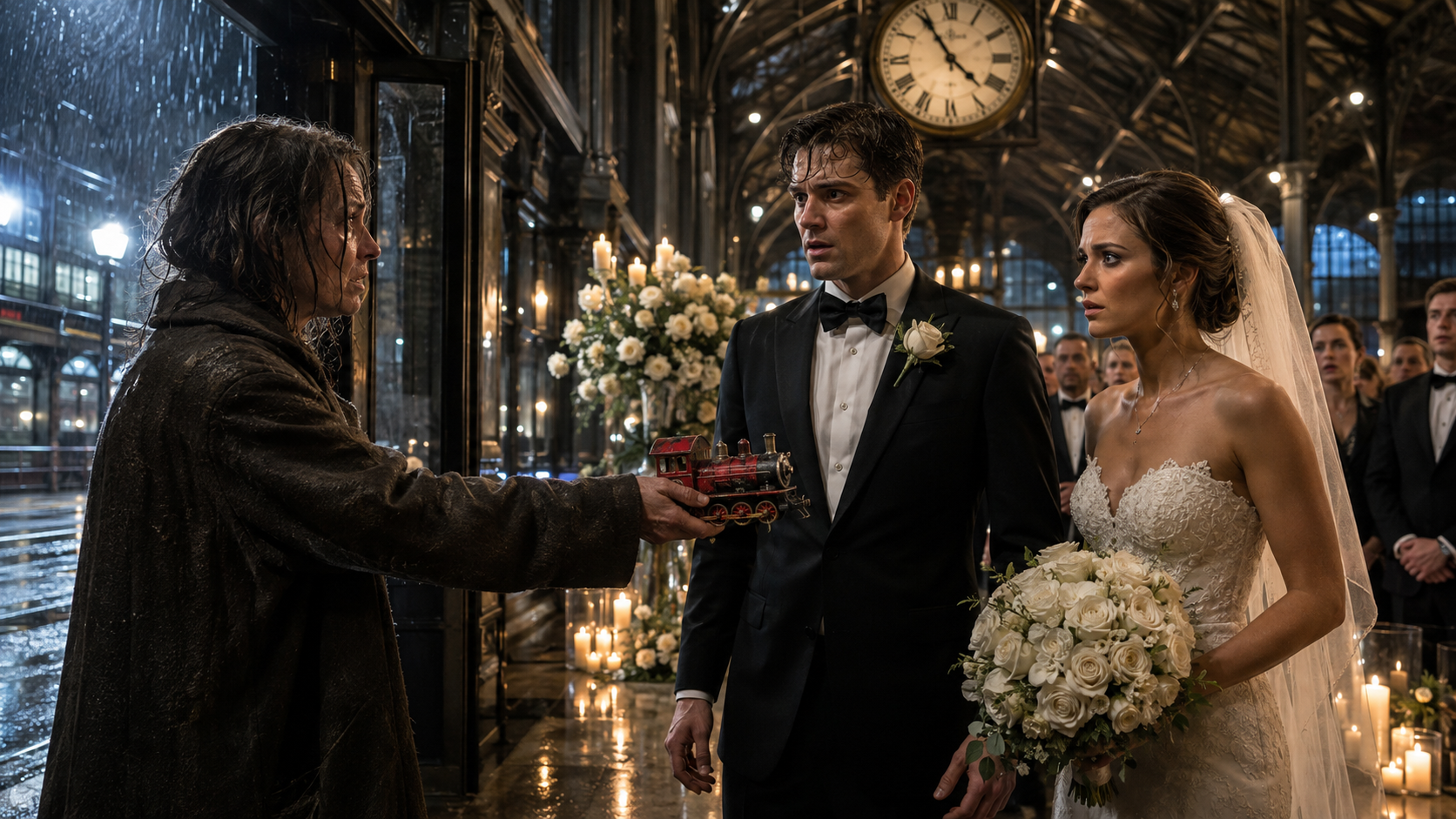
The Woman Who Arrived Before the Last Train

By sunset, the old railway terminal looked nothing like the abandoned building it had once been.

Hundreds of candles glowed beneath the iron arches. White roses climbed the stone pillars, and crystal lamps hung above the polished platform where trains had carried soldiers, merchants, and families nearly a century earlier.

Now the terminal belonged to Elliot Marlowe.

At least for the evening.

Elliot had rented the entire station for his wedding to Celia Harrow, the daughter of one of the most respected families in the city. Every newspaper had called it the event of the season. Business leaders, politicians, actors, and distant relatives filled the rows of velvet-covered chairs.

Even the rain seemed to understand that it was not welcome.

It stopped moments before the ceremony began.

Celia appeared beneath the great station clock in a silk gown that moved like water around her feet. Her mother, Margaret, walked beside her, holding her arm tightly.

At the opposite end of the platform, Elliot waited.

He was thirty-two, successful, confident, and perfectly dressed. His charcoal suit had been tailored in Milan. A silver watch gleamed beneath his cuff. Beside him stood his adoptive father, Richard Marlowe, whose construction company had made the family enormously wealthy.

Richard leaned closer.

“Smile,” he whispered. “Every camera in the city is pointed at you.”

Elliot smiled.

For most of his life, he had done exactly what Richard expected.

He had attended the right schools, accepted the right position in the family company, purchased the right apartment, and chosen a woman whom his parents considered worthy of the Marlowe name.

But marrying Celia was not an obligation.

He loved her.

When she reached him, she took his hand and whispered, “You look terrified.”

“I’m standing in front of four hundred people.”

“You negotiate contracts in front of rooms full of lawyers.”

“Lawyers don’t expect me to describe my feelings.”

Celia laughed softly.

The ceremony began.

The terminal grew quiet as the officiant spoke about loyalty, truth, and the courage required to build a life with another person.

Elliot listened carefully.

Truth.

The word stayed with him longer than the others.

He had grown up in a house where appearances mattered more than explanations. His parents had never hidden the fact that he was adopted, but they refused to discuss the circumstances.

Whenever Elliot asked about his birth family, Richard gave the same answer.

“They were unable to care for you.”

His adoptive mother, Vivian, always added something gentler.

“You were meant to be ours.”

After years of unanswered questions, Elliot had stopped asking.

The officiant turned toward him.

“Elliot, do you take Celia—”

A metallic crash rang through the terminal.

Every head turned.

One of the side doors had been pushed open. Wind rushed inside, scattering rose petals across the floor. A woman stood in the doorway, breathing heavily.

Her wet coat was several sizes too large. Her dark hair, streaked with gray, clung to her face. One shoe was tied together with a piece of string, and a faded canvas bag hung from her shoulder.

A security guard hurried after her.

“Ma’am, you cannot be in here.”

The woman did not look at him.

Her eyes were fixed on Elliot.

“Is that him?” she asked.

The guard reached for her arm.

She pulled away.

“Please. I only need one minute.”

Guests began whispering. Several people raised their phones.

Richard stepped forward.

“Remove her.”

The woman flinched when she heard his voice.

Then she looked directly at him.

“You remember me.”

Richard’s expression did not change, but Elliot saw his father’s fingers tighten around the head of his walking cane.

“I have never seen you before.”

“Yes, you have.”

The confidence disappeared from Richard’s face for less than a second.

It was enough.

Elliot moved away from the officiant.

“Who are you?”

The woman looked at him again.

Her eyes filled with an emotion Elliot could not understand. It was not simply grief or relief. It was the expression of someone who had reached the end of a journey and was terrified that the destination might reject her.

“My name is Miriam Cade.”

Elliot waited.

The name meant nothing to him.

Richard turned to security.

“This woman is clearly disturbed.”

“I’m not here to hurt anyone,” Miriam said.

She slowly reached into her canvas bag.

The guard stepped between her and the wedding party.

“Keep your hands where I can see them.”

“It’s only a toy.”

Miriam removed a small red train.

The paint had faded from its metal body. One wheel was missing, and a thin golden key protruded from its side.

Elliot stopped breathing.

He had seen that train before.

Not in a photograph.

Not in his parents’ house.

He had seen it in dreams.

In those dreams, he was sitting beneath a kitchen table while rain struck the windows. A girl with long dark hair pushed a red train toward him. Somewhere nearby, a woman was singing.

He had experienced the same dream since childhood.

By morning, most of it always disappeared.

Only the train remained.

Miriam held it against her chest.

“You called it Rocket,” she said.

Elliot stared at her.

Celia touched his arm.

“Elliot?”

He barely heard her.

“How do you know that?”

Miriam’s lips trembled.

“Because I gave it to you.”

Richard struck his cane against the floor.

“That is enough.”

“No,” Elliot said.

The sharpness of his own voice surprised him.

The terminal fell silent.

Elliot stepped closer to Miriam.

“Tell me who you are.”

She opened her mouth, but no words came.

Instead, she turned the golden key.

A mechanism clicked inside the train.

For a moment, nothing happened.

Then a woman’s faint voice emerged through the crackling speaker hidden inside the toy.

“Sleep now, little fox. Morning always finds us.”

The recording lasted only a few seconds.

When it ended, the station seemed unnaturally quiet.

Elliot felt the floor shift beneath him.

Little fox.

Nobody had called him that in years.

Nobody he could remember.

Yet the words opened something inside him.

A narrow apartment.

A yellow kitchen.

A woman singing beside a window.

A girl kneeling on the floor.

A red train moving between them.

Elliot pressed a hand against his forehead.

“What is this?”

Miriam took an unsteady breath.

“It was our mother’s voice.”

“Our mother?”

Miriam nodded.

“I’m your sister.”

The words traveled through the terminal like an electrical current.

Celia covered her mouth.

Vivian Marlowe sank into the chair behind her.

Richard remained standing.

Elliot shook his head.

“I don’t have a sister.”

“You did.”

Miriam reached into her bag again and removed a plastic envelope. Inside was an old instant photograph.

She held it out.

Elliot hesitated before taking it.

The picture showed a teenage girl sitting on the steps of a small brick apartment building. A baby rested in her arms. The baby wore a knitted cap with two pointed ears, like a fox.

Beside the girl sat the red train.

On the white border beneath the image, someone had written:

Miriam and Eli, three weeks before the fire.

Elliot read the sentence twice.

“Eli?”

“That was your name,” Miriam said. “Elias Cade.”

He looked at her face, searching for a resemblance.

The same narrow chin.

The same dark eyes.

A faint crescent-shaped mark near her left eyebrow mirrored a smaller mark near his own.

Miriam pointed toward the photograph.

“I was thirteen. You were eleven months old.”

Elliot’s voice became quiet.

“What fire?”

Miriam looked past him, as though she could see something burning at the far end of the terminal.

“Our building caught fire during a winter storm. The wiring was old. The landlord had been warned, but he never repaired it.”

She swallowed.

“Our mother was trapped upstairs. She passed you through a bathroom window to a firefighter. I tried to reach her, but part of the ceiling collapsed.”

Elliot looked down at the photograph again.

“What happened to you?”

“I woke up in a hospital two days later. They told me our mother was dead.”

Miriam’s voice cracked.

“They also told me my baby brother had died.”

A murmur spread through the guests.

Elliot turned toward Richard.

His adoptive father looked away.

Miriam continued.

“I believed them for sixteen years. Then I found a box of documents in an old municipal storage room. Your name was on a transfer record.”

Richard raised his head.

“You obtained confidential records illegally.”

Miriam stared at him.

“So you do remember me.”

Richard said nothing.

Elliot walked toward him.

“What transfer record?”

Richard glanced at the guests.

“This is neither the time nor the place.”

“My wedding has already stopped,” Elliot said. “I think the place is no longer the problem.”

Vivian began crying.

Richard looked at her with irritation.

“Control yourself.”

That command changed something in Elliot.

He had heard Richard speak to employees that way. He had heard him dismiss waiters, drivers, and junior executives with the same cold impatience.

But never Vivian.

Not in public.

“Mother,” Elliot said, “what does she know?”

Vivian pressed a trembling hand against her lips.

Richard stepped between them.

“Your mother is emotional.”

“Then you answer.”

Richard’s face hardened.

“You were placed for adoption after a tragedy. Your biological family had no surviving adult capable of caring for you.”

“Miriam was alive.”

“She was a child.”

“She was my sister.”

“She was thirteen.”

“And you told her I was dead?”

Richard did not answer.

Miriam’s voice rose.

“He did more than that.”

She pulled a folded document from the plastic envelope.

“He helped change your identity.”

Richard’s cane struck the floor again.

“That paper proves nothing.”

“It has your signature.”

Elliot took it.

The document was damaged by water and age, but the typed words remained readable.

It authorized the emergency transfer of an unidentified male infant from Saint Orison Hospital to a private care facility.

At the bottom appeared the signature of a young legal representative:

Richard Marlowe.

Elliot felt suddenly cold.

“You were there.”

Richard’s jaw tightened.

“I was a junior attorney assigned to the hospital.”

“You signed this.”

“I signed hundreds of documents.”

“This one gave you a son.”

Richard looked around at the crowd.

Phones were recording from every direction. Reporters near the back of the terminal whispered into microphones.

“Elliot, think carefully. Everything we built can still be protected.”

Elliot stared at him.

“Protected from what?”

“From scandal.”

Miriam laughed once, without humor.

“He still thinks the scandal is the truth becoming public. Not what he did.”

Richard pointed his cane at her.

“You were living in shelters. You had been arrested.”

“I was arrested years later.”

“You were unstable.”

“I became unstable because I spent half my life searching for a brother everyone insisted was buried.”

Celia moved beside Elliot.

“Richard, did you know who the baby was when you adopted him?”

Richard said nothing.

Celia repeated the question.

“Did you know?”

A new voice answered from behind her.

“Yes.”

Celia turned.

Her mother, Margaret Harrow, stood near the first row of guests. Her face had lost all color.

Celia frowned.

“Mom?”

Margaret stepped onto the platform.

Richard’s expression darkened.

“Do not involve yourself.”

“I have been involved for thirty-one years.”

Miriam stared at Margaret.

Recognition slowly replaced confusion.

“You worked at the hospital.”

Margaret nodded.

“I was a records clerk.”

Celia looked between them.

“What are you saying?”

Margaret clasped her hands tightly.

“The night of the fire, the hospital was overcrowded. Several victims arrived without identification. Miriam was unconscious. The baby had no papers with him.”

She looked at Elliot.

“Richard came to the records office the next morning.”

Richard interrupted her.

“You were paid to process documents, not interpret decisions made above your position.”

Margaret turned toward him.

“I was twenty-three years old, frightened, and desperate to keep my job. That is the explanation I have given myself every day since then.”

“What did he ask you to do?” Elliot said.

Margaret closed her eyes.

“He asked me to list the baby as an unidentified orphan.”

Celia stepped away from her mother.

“You helped him?”

“I changed one form.”

“One form?” Miriam cried. “That form erased him.”

Margaret began to weep.

“I know.”

Richard’s voice became calm, almost reasonable.

“The child needed a home. Miriam had no relatives, no money, and no legal ability to care for an infant. Vivian and I had lost two pregnancies. We could provide everything.”

“You could have waited,” Miriam said. “You could have let me grow up. You could have told me he was alive.”

“And what kind of life would he have had?” Richard demanded. “Moving between temporary homes? Visiting you in shelters? Depending on strangers?”

Miriam’s eyes burned.

“Maybe it would have been difficult. But it would have been his life.”

Richard looked at Elliot.

“You had the finest education. You traveled. You inherited a company. You never went hungry.”

Elliot folded the document.

“You’re describing what you purchased.”

“I’m describing what I gave you.”

“You gave me comfort.”

Richard’s expression softened slightly.

“Yes.”

“But you took my name.”

Richard remained silent.

“You took my sister.”

“I made a decision.”

“You buried a living child and called it a decision.”

The terminal clock struck eight.

Its deep bell echoed beneath the iron roof.

Miriam looked up at it.

“I used to wait in stations,” she said quietly. “After I found the transfer record, I followed every address connected to your case. Most of them led nowhere. Sometimes I slept on platforms because I thought people who disappeared might eventually return by train.”

Elliot watched her grip the handle of her old canvas bag.

“How long have you known my name?”

“Seven months.”

“Why didn’t you contact me?”

“I tried.”

She glanced at Richard.

“Your office blocked my letters. Security removed me from your company building. Someone offered me money to leave the city.”

Every guest looked toward Richard.

He did not deny it.

Miriam continued.

“Then I saw the announcement about your wedding. The photograph showed the mark near your eyebrow. Our mother had the same one.”

She looked down at the red train.

“I knew it was you.”

Elliot’s anger began to give way to something heavier.

Thirty-one years stood between them.

Birthdays.

Illnesses.

Christmas mornings.

Ordinary afternoons that should have belonged to both of them.

He had spent his life surrounded by beautiful objects, convinced that an invisible family somewhere had chosen to abandon him.

Miriam had spent hers walking through offices, hospitals, shelters, and railway stations, looking for a brother who lived only a few miles away.

“Why are you here now?” he asked.

Miriam gave him a sad smile.

“Not for money.”

“I didn’t say that.”

“Other people will.”

Her eyes moved toward the guests.

“I’m here because you were about to promise someone a life built on truth. I thought you deserved to know your own before you made that promise.”

Celia began crying.

She reached for Elliot’s hand, but stopped before touching him.

“What do you want to do?” she asked.

Everyone waited for his answer.

The officiant stood silently beside the flower-covered arch. The musicians lowered their instruments. Outside the glass walls, rain began falling again.

Elliot looked at Celia.

“This was supposed to be our wedding.”

“It still is our life,” she said. “Those are not always the same thing.”

He glanced toward Margaret.

Celia followed his gaze.

Her mother whispered, “I am so sorry.”

Celia’s expression tightened.

“Sorry is the beginning of what you owe. Not the end.”

Margaret lowered her head.

Elliot removed the white flower pinned to his jacket and placed it on the table beside the marriage register.

Richard watched him.

“Do not destroy your future over the grievances of strangers.”

Elliot turned.

“She isn’t a stranger.”

“You have known her for ten minutes.”

“No. I knew her before I knew you.”

Richard’s face twisted with anger.

“You are my son.”

Elliot held his gaze.

“I may have been. But you never allowed me to decide what that meant.”

Vivian rose from her chair.

Unlike Richard, she appeared smaller than Elliot remembered. Her carefully arranged hair had begun to fall loose, and tears stained her makeup.

“I loved you,” she said.

Elliot’s anger faltered.

“I know.”

“I did not know everything at first.”

“But you learned.”

Vivian nodded.

“When?”

“When you were seven.”

“And you stayed silent.”

“I was afraid they would take you away.”

“Who?”

She looked toward Richard.

The answer was clear.

Elliot closed his eyes.

When he opened them, Miriam was turning toward the side door.

“Where are you going?” he asked.

She stopped.

“I said what I came to say.”

“You searched for me for sixteen years.”

“Longer.”

“And now you’re leaving?”

Miriam looked at her broken shoe and soaked coat.

“This is your world, Elliot. I don’t belong in it.”

He walked across the platform.

With every step, cameras followed him.

He stopped in front of her.

“My name was Elias.”

Miriam’s mouth trembled.

“Yes.”

“What did you call me?”

A tear rolled down her face.

“Little Fox.”

A memory struck him with such force that he nearly stumbled.

Miriam, young and laughing, crawling beneath a kitchen table.

A baby’s hands reaching for her.

A whispered promise during a thunderstorm:

Don’t be afraid, Little Fox. I’ll always find you.

Elliot stepped forward and wrapped his arms around her.

For a moment, Miriam did not move.

Then the red train slipped from her hand and landed on the carpet.

She held him as though the entire lost weight of her life had suddenly returned.

“I’m sorry,” Elliot whispered.

“No,” she cried. “None of this was your fault.”

“I stopped looking for you before I knew you existed.”

“You were a baby.”

“I believed you left me.”

“I never left.”

Behind them, guests lowered their phones.

Some began to cry.

Celia picked up the red train and carefully placed the missing wheel inside Miriam’s open bag. Then she approached them.

Miriam released Elliot and wiped her face.

“I didn’t come to ruin your wedding.”

Celia looked toward the decorated platform.

“You didn’t.”

She removed her veil.

“You stopped us from beginning our marriage inside someone else’s lie.”

Richard moved toward the exit.

Two uniformed officers entered through the side door before he reached it. One spoke quietly to him while the other examined the document in Elliot’s hand.

Richard looked back at his son.

“After everything I gave you, you would let them treat me like a criminal?”

Elliot studied the man who had raised him.

The man who had taught him to ride a bicycle, negotiated his first salary, attended every graduation, and lied to him every day.

“I’m not doing this to you,” Elliot said. “I’m refusing to protect you from what you did.”

Richard’s shoulders lowered.

For the first time in Elliot’s life, he looked old.

The officers led him toward a private room beside the platform.

No one tried to stop them.

The rain grew heavier.

Water streamed down the enormous station windows, blurring the lights of the city beyond them.

Celia turned to the guests.

“There will be no ceremony tonight.”

A wave of whispers spread through the terminal.

She raised her voice.

“But the kitchen has prepared dinner for four hundred people. The musicians are here. The flowers are here. And there are shelters across this city that will be cold before midnight.”

She looked at Miriam.

“Tonight should still bring people together.”

Within an hour, the wedding reception became something else.

Tables were opened to residents from nearby shelters. Volunteers packed meals into waiting vans. Guests who had arrived expecting champagne and speeches found themselves serving soup, carrying blankets, and rearranging chairs.

Some left immediately.

Most stayed.

Near midnight, Elliot sat with Miriam beneath the great clock.

Between them rested the red train.

Celia had found a small screwdriver in the station manager’s office and repaired the missing wheel herself.

Miriam pushed the train gently across the table.

It rolled toward Elliot.

He caught it.

“What was our mother’s name?” he asked.

“Rebecca.”

“What was she like?”

Miriam smiled.

“She sang when she was nervous. She burned almost everything she cooked. She believed plants understood compliments.”

Elliot laughed.

The sound surprised them both.

“Tell me everything.”

“It could take years.”

He looked across the terminal.

Celia was helping her mother load food containers into a van. Margaret would have to answer for what she had done, and Celia would have to decide whether forgiveness was possible.

Vivian sat alone near the ceremony platform, waiting for Elliot to speak with her.

Nothing had been repaired.

Not truly.

The wedding had not happened. His father was being questioned by police. His identity had been built from falsified documents. The woman beside him was both family and stranger.

But the truth was no longer hidden.

That had to count for something.

Elliot placed the train back on the table.

“Then we’ll take years.”

Miriam looked at him.

“You mean that?”

“Yes.”

The station clock moved past midnight.

The final passenger train of the evening approached the terminal, its light appearing through the rain.

Miriam watched it through the glass.

For decades, she had believed every arriving train might carry someone she had lost.

This time, she did not stand.

She did not search the windows.

She remained at the table beside her brother.

And when the train departed again, neither of them was waiting for anyone to return.

The Woman Who Arrived Before the Last Train
Geniuses of disguise: sly cats who don’t want to go to the vet