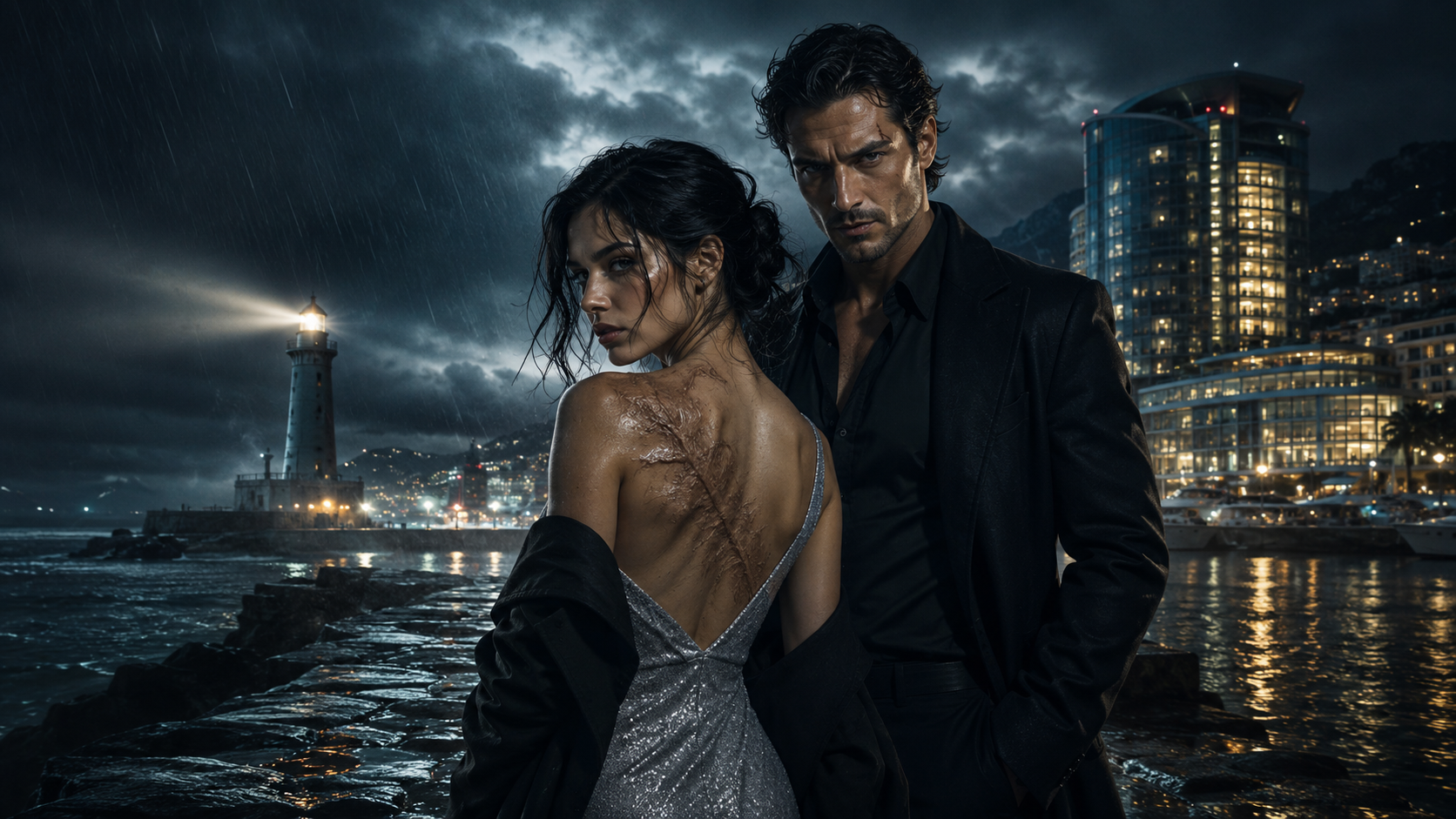
THE WOMAN THE CITY BURIED BEFORE MIDNIGHT

Rain struck the glass roof of the Halcyon Hotel hard enough to drown out the orchestra.

From the highest terrace, Vesper Bay looked like a city sinking beneath black water. Lightning illuminated the harbor cranes, the cathedral towers, and the white yachts rocking behind the sea wall. Inside the ballroom, four hundred guests drank champagne beneath chandeliers shaped like frozen waves.

They had come to witness the marriage of two empires.

Lucian Crowe controlled the country’s largest private energy network. Vivienne Ellison was the youngest daughter of the family that owned Bellweather Maritime, the shipping company responsible for nearly a third of the harbor’s commercial traffic.

Their wedding was scheduled for the following afternoon.

Tonight was only the masked rehearsal gala.

Mara Ellison stood behind a marble column and repaired her sister’s veil with a safety pin.

“Stop moving,” Mara said.

“I’m not moving.”

“You’re trembling.”

Vivienne’s laugh was thin. “That is technically different.”

The sisters wore matching silver gowns because a famous designer had decided symmetry would look dramatic in the photographs. Their faces were concealed behind delicate veils covered with tiny crystals. From a distance, the only obvious difference between them was that Vivienne wore diamonds around her throat while Mara wore nothing.

Mara had learned long ago that jewelry drew cameras.

Cameras led to questions.

Questions led to photographs from angles her father disliked.

She secured the torn fabric and stepped back.

“There.”

Vivienne touched the repaired veil. “You always fix everything.”

“No. I fix fabric. People are less cooperative.”

“You could still leave.”

Mara studied her sister through the veil.

“Leave the gala?”

“Leave the city.”

Vivienne glanced toward the ballroom entrance. Two men from Lucian’s security team stood there with their hands clasped in front of their jackets.

Mara lowered her voice.

“Why would I leave the city?”

Before Vivienne could answer, the lights went out.

The music stopped.

Someone screamed near the dance floor.

Emergency lamps flashed red along the walls, transforming the ballroom into a cavern of moving shadows. Guests pushed toward the exits while security guards shouted contradictory instructions.

Mara reached for her sister.

Her fingers closed around empty air.

“Vivienne?”

A gloved hand seized Mara from behind.

Something hard pressed against her ribs.

“Walk,” a man whispered.

She drove her heel backward.

Her attacker grunted but did not release her. Another man appeared through the darkness, caught her wrists, and pulled a black cloth over her veil.

Mara tried to shout.

A hand covered her mouth.

The attackers moved with terrifying coordination. They guided her through a service door, down a narrow staircase, and into a corridor smelling of bleach and wet stone.

She heard gunfire above them.

Not ceremonial fireworks.

Gunfire.

One of the men cursed.

“This is the bride?”

“Silver dress, silver veil, diamond clasp. She matches the photograph.”

Mara twisted against them.

The clasp in her veil tore loose and struck the floor.

No one noticed.

She was pushed through a metal door into the rain.

A vehicle waited beside the loading dock with its rear doors open.

Mara bit the hand covering her mouth.

The man shouted.

She managed one word before someone injected something into her neck.

“Wrong.”

The world folded inward.


Mara awakened beneath a painted ceiling.

A golden angel watched her from a cloud, one hand extended toward a heaven that had begun to peel away.

She lay on a narrow velvet couch in what appeared to be an abandoned theater. Dust covered the balconies. Torn curtains hung around the stage, and broken seats disappeared into the darkness below.

Her wrists were free.

Her shoes were gone.

A woman in a dark green suit stood beside a medical bag.

“You had a reaction to the sedative,” the woman said. “Do not sit up yet.”

Mara sat up.

Pain exploded behind her eyes.

She nearly fell from the couch.

The woman caught her shoulder.

“I specifically said not to do that.”

“Where is my sister?”

“I don’t know.”

“Who are you?”

“Dr. Amara Voss.”

“That answer is supposed to reassure me?”

“No. It is simply my name.”

Mara looked down.

The silver gown had been cut open along one side. A blanket covered her from the waist down, but the damaged fabric had fallen away from her left shoulder and back.

The scars were visible.

They began beneath her shoulder blade, crossed her ribs, and curved toward her hip. Some were pale and smooth. Others formed uneven ridges where skin grafts had healed badly after infection. A long surgical line followed her spine.

Mara pulled the blanket upward.

Dr. Voss did not look away in embarrassment or stare in fascination.

“You stopped breathing for twenty-three seconds,” she said. “The dress restricted your chest, so I cut it. I apologize for not asking permission. You were unconscious.”

A man stood at the edge of the stage.

He wore a black shirt with the sleeves folded to his forearms. He was tall, broad-shouldered, and completely still. A faint scar divided one eyebrow. His eyes were the gray of the sea before a storm.

Mara recognized him.

Everyone in Vesper Bay would have recognized him.

Roman Sable.

The newspapers called him a businessman because newspapers could be sued.

The police called him a person of interest because charges required witnesses.

The harbor called him the Undertow because people who crossed him vanished beneath the surface of respectable society.

Mara pulled the blanket tighter.

“You kidnapped the wrong woman,” she said.

Roman descended the steps from the stage.

“So I have been informed.”

“Then return me.”

“No.”

The answer came without anger, pleasure, or hesitation.

Mara’s pulse quickened.

“My sister is the bride.”

“Yes.”

“I am not valuable to you.”

Roman stopped several feet away.

“Lucian Crowe seems to disagree.”

“What does that mean?”

He lifted a remote from a dusty table.

A television mounted beneath the balcony flickered to life.

The picture showed the Halcyon Hotel surrounded by police vehicles. Reporters stood in the rain while emergency crews moved behind them.

Lucian appeared at a podium beneath the hotel awning.

He was still dressed for the gala. His black jacket was wet, and a streak of blood marked one cuff. Vivienne stood behind him, wrapped in a coat, her face colorless.

Mara leaned forward.

Her sister was alive.

Relief arrived first.

Then Lucian began to speak.

“Tonight, armed criminals attacked what should have been a private celebration of two families. During the assault, Mara Ellison was forced into a vehicle that was later found submerged near the eastern breakwater.”

Mara stopped breathing.

Lucian lowered his head with the solemn control of a man accustomed to cameras.

“Based on the evidence recovered at the scene, authorities do not believe she survived.”

The broadcast changed to aerial footage of a burning vehicle in the harbor.

Mara stared at the screen.

“That isn’t the vehicle they used.”

Roman switched off the television.

“No.”

“The police haven’t searched for me.”

“They were instructed not to.”

“My father would never—”

She stopped.

Roman’s expression did not change, but something in his silence made the unfinished denial feel childish.

Mara looked toward Dr. Voss.

The doctor closed her medical bag.

“Your reaction is stable,” she said. “Avoid sudden movement. I’ll be nearby.”

When she left, two armed guards followed her through the wings.

Mara faced Roman.

“You planned to take Vivienne.”

“I planned to take Lucian’s access key. Your sister wears it inside her wedding necklace.”

“The diamonds?”

“The central stone contains a quantum token that opens Crowe’s private shipping network.”

“You expect me to believe a billionaire carries secrets in a necklace?”

“I expect billionaires to mistake extravagance for security.”

“Why do you need his network?”

“Because he is moving something through my harbor.”

“Drugs?”

Roman looked toward the ceiling angel.

“People.”

The word changed the temperature of the room.

Mara said nothing.

“Crowe’s relief vessels enter ports without standard inspection,” Roman continued. “Six months ago, one of them arrived with forty-seven undocumented passengers hidden inside a sealed maintenance compartment. Twelve were children.”

“What happened to them?”

“My people intercepted the transfer.”

“And the smugglers?”

“They will not do it again.”

Mara did not ask why.

Roman’s gaze moved to the blanket around her shoulders.

“When Dr. Voss treated you, she photographed the chemical pattern around your scars.”

Mara’s grip tightened.

“She did what?”

“To identify the substance that complicated your breathing.”

“She had no right.”

“She was trying to keep you alive.”

“That does not give either of you ownership of my body.”

Roman accepted the accusation without blinking.

“No,” he said. “It does not.”

His agreement unsettled her more than an argument would have.

“The scars contain traces consistent with white phosphorus and an industrial catalyst called V-17,” he continued. “That combination was used in an experimental fuel cell developed at Bellweather’s Greyhaven facility thirteen years ago.”

Mara felt the old room return around her.

Alarms.

Smoke.

Heat so violent it had seemed solid.

Her younger sister screaming behind a locked laboratory door.

“Greyhaven was an electrical fire,” she said.

“That was the official report.”

“It was investigated.”

“The investigator was my brother.”

Mara looked at him.

Roman’s voice remained controlled, but his right hand had closed into a fist.

“Gabriel Sable entered the facility twelve minutes before the second explosion. His body was identified from dental records. The report claiming an electrical failure was signed the next morning.”

“I was seventeen.”

“You were the only person pulled alive from the lower laboratory.”

“I pulled Vivienne out.”

“Yes.”

“How do you know that?”

“Because my brother called me from inside the building. He said two girls were trapped below the testing floor. He was going back for them.”

Mara remembered a man in a smoke mask breaking through the laboratory window. She remembered him lifting a fallen beam. She remembered pushing Vivienne through the opening before the ceiling collapsed.

She had never seen his face.

“The rescue worker,” she whispered.

Roman’s eyes hardened.

“His name was Gabriel.”

Mara looked down at her hands.

Her family had told her the rescuer had survived.

They had said he refused publicity.

They had said she should focus on healing instead of asking questions.

“My father told me everyone escaped.”

“Your father purchased the silence of three inspectors, two paramedics, and a government minister.”

“No.”

Roman placed a thin folder on the couch.

Inside were photographs of the Greyhaven facility after the fire. Payment records. Internal messages. A picture of a younger Roman standing beside a smiling man in a customs uniform.

Mara recognized the eyes.

“I didn’t know,” she said.

“I believe you.”

“Why?”

“Because the woman responsible for Gabriel’s death would not wake from sedation asking whether her sister was safe.”

Mara closed the folder.

“Then you know I had nothing to do with it. Let me go.”

Roman walked toward the dark orchestra pit.

“Lucian fabricated your death less than an hour after you disappeared.”

“He is protecting the wedding.”

“He staged a burning vehicle.”

“He may think you killed me.”

“Then he would demand proof.”

Roman turned back.

“He did not ask for your return. He sent men to the eastern breakwater to ensure the vehicle remained underwater.”

Mara’s mouth went dry.

“You are lying.”

“I have survived by knowing when people want something recovered and when they want it erased.”

“I am not part of his business.”

“You designed Tideglass.”

The name struck harder than a threat.

Tideglass was Bellweather Maritime’s autonomous routing system. Mara had spent nine years building it, first as an engineer and later as chief systems architect. It could redirect an entire fleet around storms, military blockades, labor strikes, or congested ports in seconds.

It could also create routes that appeared nowhere in standard shipping records.

Mara stood despite the pain in her head.

“Tideglass cannot move a vessel without human authorization.”

“Whose authorization?”

“Mine.”

“And if you die?”

Her silence answered him.

Roman approached slowly.

“Your access is suspended. The board receives temporary control. Lucian completes the merger with Bellweather tomorrow afternoon. By nightfall, he owns the only navigation system capable of hiding his ships from every commercial tracking network in Europe.”

Mara stared at him.

“My father would stop it.”

“Your father is standing beside Lucian at a press conference mourning you.”

The theater seemed to tilt beneath her feet.

Roman caught her elbow.

Mara pulled away so violently that the blanket fell.

For one second she stood beneath the work lights with the ruined gown hanging around her and every scar exposed.

Roman immediately turned his back.

Not because he was disgusted.

Because she had not chosen to be seen.

The distinction nearly undid her.

He removed his jacket and held it behind him.

Mara took it.

The fabric smelled faintly of rain and cedar smoke.

When she had covered herself, she said, “You can turn around.”

Roman faced her.

“What do you want from me?” she asked.

“The truth about Greyhaven. Access to Tideglass. Evidence against Lucian.”

“And what do I receive?”

“The opportunity to remain alive.”

“That sounds less like a partnership than a threat.”

“It is not a threat from me.”

“You kidnapped me.”

“Yes.”

“You drugged me.”

“My men did.”

“Under your orders.”

Roman’s jaw tightened.

“Yes.”

“Then do not stand there pretending you are my protector.”

“I am not pretending to be anything.”

The fury in her voice echoed through the empty theater.

“What happens if I refuse?”

Roman reached into his pocket.

He placed a phone and a set of keys on the couch.

“The side door leads to an alley. The blue car belongs to Dr. Voss. You may take it.”

Mara looked at the objects.

“No guards?”

“None.”

“You expect me to believe you will simply release me?”

“I took the wrong person. Keeping you against your will would not correct that mistake.”

She studied his face.

“What is the trap?”

“Lucian’s men are watching your apartment, every hospital, every train station, and both roads out of the city. Your father has circulated a private message stating that anyone claiming to be you is an extortionist exploiting the family’s grief.”

Mara laughed once.

The sound contained nothing resembling humor.

“So I am free to leave, provided I am willing to die.”

“You are free to choose which danger you prefer.”

“That is not freedom.”

“No,” Roman said. “But it is honesty.”

Mara picked up the phone.

“Can this be traced?”

“Not immediately.”

She dialed her father.

Silas Ellison answered after two rings.

“Mara?”

Her knees weakened at the sound of her own name.

Roman moved closer but did not touch her.

“Dad.”

A long silence followed.

Then her father exhaled.

“You should not have called.”

Mara closed her eyes.

“You know I’m alive.”

“I know the people who took you may be forcing you to say things.”

“No one is forcing me.”

“We can resolve this.”

“Then tell the police.”

“That would create complications.”

“I was kidnapped.”

“I understand.”

“No, you don’t. Lucian announced that I was dead.”

“It was necessary to stabilize the situation.”

The sentence was delivered in the same tone Silas used during board meetings when discussing delayed shipments.

Necessary.

Stable.

Situation.

Words chosen to remove blood from the subject.

“You sank a vehicle in the harbor,” Mara said.

“Lucian’s security advisers handled the details.”

“You let them.”

“Mara, listen to me carefully. Crowe Energy’s merger with Bellweather protects twenty-three thousand jobs. Tideglass is essential to the agreement. If the market learns that its creator has been abducted by Roman Sable, the company could lose billions before morning.”

“So you killed me on paper.”

“We created time.”

“For whom?”

“For everyone.”

“Not for me.”

Her father’s voice hardened.

“You have always struggled to understand decisions made at this level.”

Mara opened her eyes.

Roman stood several feet away, watching her without satisfaction.

Silas continued.

“You are an exceptional engineer, but your judgment becomes emotional when family is involved.”

“I ran into a burning laboratory for this family.”

“And we spent years helping you recover.”

“You spent years hiding me.”

“That is unfair.”

“You built private entrances into clinics so photographers would not see me.”

“We protected your privacy.”

“You removed me from the company’s anniversary portrait.”

“The press department made an aesthetic decision.”

Mara’s scars seemed to burn beneath Roman’s jacket.

“Did Greyhaven catch fire because of V-17?”

Silence.

The answer lived inside it.

“Who told you that?” Silas asked.

“Roman Sable.”

“Do not trust him.”

“Did Gabriel Sable die trying to rescue us?”

“Mara—”

“Did you tell me he survived?”

“You were medically fragile.”

“Answer me.”

“It was an unstable period.”

“Answer me!”

“Yes.”

The word moved through her like a blade.

Mara lowered the phone.

Her father was still speaking.

She raised it again.

“Why does Lucian need Tideglass?”

“You are in no condition to discuss corporate security.”

“Is he using the relief fleet to transport people?”

Silas did not answer quickly enough.

“Oh God.”

“You do not understand the geopolitical realities involved.”

“Children were inside those ships.”

“We do not control every contractor.”

“You control whether he gets my system.”

“The board controls Tideglass while you are unavailable.”

“I am not unavailable. I am alive.”

“That distinction is currently inconvenient.”

Mara stopped feeling the floor beneath her.

Roman’s face changed.

Not with surprise.

With confirmation.

Mara looked directly at him as she spoke into the phone.

“I am coming back.”

Her father’s voice became urgent.

“Do not attempt that. Lucian believes Sable has compromised you.”

“Lucian does not get to decide whether I exist.”

“This is larger than you.”

“No,” Mara said. “You simply built it on top of me.”

She ended the call.

For several seconds, the theater contained only the rain.

Roman picked up the folder.

“My people are preparing to move. Lucian will trace the signal.”

“Where are we going?”

“You are not going anywhere with me unless you choose to.”

Mara put on the shoes Dr. Voss had left beside the couch.

They were soft black boots, one size too large.

“Can you prove what Lucian is doing?”

“Not without Tideglass.”

“Can Tideglass expose every ghost route he has created?”

“If I reach the core archive.”

“Where is it?”

“Beneath Bellweather’s old lighthouse station.”

Roman’s eyes narrowed.

“The station was closed after Greyhaven.”

“Officially.”

“And unofficially?”

“My mother built an independent server vault beneath it. She believed no board should be able to erase safety records.”

“Can Lucian access it?”

“Not without me.”

Roman glanced toward the side exit.

“You understand that once you help me, Crowe will consider you an enemy.”

“My family declared me dead before the champagne was warm.”

Mara zipped the jacket over the remains of her gown.

“I think we have moved beyond misunderstandings.”


The abandoned theater became empty eleven minutes later.

Roman’s people moved without visible panic. Equipment disappeared into road cases. Weapons vanished beneath coats. Dr. Voss guided Mara through underground dressing rooms toward a tunnel that had once connected the theater to a neighboring hotel.

“The city’s oldest buildings are full of forgotten passages,” the doctor said.

“Roman remembers all of them?”

“Roman remembers exits.”

“Because he is cautious?”

“Because he was once fourteen years old and trapped inside a restaurant while three men tried to kill his father.”

Mara looked ahead.

Roman walked at the front of the group, speaking quietly to a man with a shaved head and a dark red scarf.

“Who is that?” she asked.

“Darius Holt. Roman’s operations chief.”

“Was he involved in taking me?”

“He drove the second vehicle.”

Darius glanced back as though he had heard them.

Mara held his gaze until he looked away.

The tunnel ended inside an underground railway platform that had been abandoned before Mara was born. A maintenance train waited on the tracks.

Roman opened the passenger door for her.

She did not move.

“Where does this go?”

“North through the old freight tunnels.”

“To the lighthouse?”

“Eventually.”

“Why not drive?”

“Crowe controls the traffic cameras.”

“And you control abandoned trains?”

“I have diverse interests.”

Mara climbed aboard.

The carriage had been converted into a mobile command room. Monitors covered one wall. Maps of Vesper Bay spread across a steel table. A young woman with copper-colored hair sat before three laptops.

Roman introduced her as Keira Moss, a former signals analyst.

Keira looked Mara over.

“The dead engineer.”

“The title is temporary,” Mara said.

Keira smiled.

“I hope so. Dead clients rarely pay.”

“I am not his client.”

Roman took a seat opposite Mara.

“No,” he said. “She is not.”

The train moved into darkness.

Keira opened a live satellite map of the harbor. Several ships glowed green. Others appeared yellow or red.

“These are standard registered routes,” Mara said.

Keira touched the screen.

Seven gray shapes appeared between them.

Mara leaned closer.

“What are those?”

“Vessels photographed entering the harbor but absent from all commercial registries.”

“Ghost ships.”

“Exactly.”

Mara studied their movements.

They followed irregular paths between medical relief docks, private fuel terminals, and Crowe Energy platforms.

One vessel had reached Greyhaven every month for the past four years.

“That facility is abandoned,” Mara said.

“Then someone is maintaining an expensive habit of visiting ruins.”

Roman placed a memory drive on the table.

“This came from a customs officer who disappeared last week.”

Mara connected it to an isolated terminal.

The files were corrupted, but fragments of Tideglass code remained visible beneath the damage.

Her code.

Someone had removed the safety authentication layer and added a hidden command structure.

“Lucian cloned my system.”

“Can he operate it?”

“Not fully. Tideglass requires a living operator profile. It monitors reflex patterns, breathing, eye movement, and decision timing. A copied biometric sample would fail.”

Roman’s expression darkened.

“Unless the operator is declared dead.”

Mara nodded slowly.

“When a registered architect dies, the system enters succession mode. Behavioral authentication is suspended for seventy-two hours while the board transfers authority.”

“The merger takes place tomorrow.”

“At four in the afternoon.”

Keira turned from her monitors.

“Meaning Crowe has until three days after your official death to rewrite the ownership structure.”

“Once his company becomes the authorized operator, the behavioral lock will rebuild around his profile.”

“And you cannot reverse it?”

“Not remotely.”

Roman looked toward the black tunnel beyond the window.

“Then we reach the lighthouse before the merger.”

The first explosion struck beneath the rear carriage.

The train jumped from the rails and slammed back down.

Mara was thrown against the table.

The lights died.

Sparks filled the carriage.

Roman caught her before she fell beneath an overturned equipment rack.

“Stay down.”

Gunfire cracked through the tunnel.

Bullets struck the metal exterior like thrown stones.

Darius shouted from the rear compartment.

“They blocked the north junction!”

Keira crawled toward the control panel.

“We’ve lost primary power.”

Roman drew a pistol.

Mara grabbed his wrist.

“If you fire inside a sealed maintenance tunnel, the ricochet could hit anyone.”

“They are already firing.”

“They don’t know where we are seated.”

A bullet tore through the upper window.

Glass fell across Roman’s shoulder.

He pulled Mara behind the steel table.

“Do you have a better idea?”

She looked at the emergency map.

The train stood twenty meters from a service intersection. A faded blue line led toward a stormwater chamber beneath the botanical gardens.

“I need the train’s maintenance controls.”

Keira pointed to the dead console.

“No power.”

“The hydraulic brakes are mechanical.”

Mara crawled forward.

Roman caught the back of his jacket, still wrapped around her.

“Where are you going?”

“To release the rear coupling.”

“The attackers are behind us.”

“Exactly.”

She found the emergency lever beside the damaged door.

Darius appeared through the smoke.

“We have eight people in the rear car.”

“Move them forward,” Mara said. “Then disconnect it.”

Understanding flashed across his face.

“The tunnel slopes south.”

Roman looked from the map to Mara.

“You want to send the empty carriage backward.”

“The attackers blocked the junction with vehicles. A thirty-ton railway car will negotiate more effectively than we can.”

Darius smiled for the first time.

“I like the dead engineer.”

Roman fired through the broken window, forcing the attackers behind cover.

“Move everyone forward!”

The crew crossed between the carriages while bullets struck the doors.

Mara knelt beside the manual coupling release.

The lever refused to move.

“It’s rusted,” she said.

Darius handed her a metal bar.

She wedged it beneath the handle.

Roman crouched beside her.

“On three.”

“You have an injured shoulder.”

“I have another one.”

Together they forced the lever down.

The coupling separated with a violent crack.

The empty carriage began rolling backward.

At first it moved slowly.

Then the slope took it.

Gunfire stopped.

Someone shouted in the darkness.

The carriage gathered speed and vanished around the curve.

Several seconds later, metal collided with metal.

The impact shook dust from the tunnel ceiling.

Keira restored auxiliary power.

The train moved north.

Roman sat on the floor beside Mara, breathing hard.

Blood darkened his sleeve where the broken glass had cut him.

“You are hurt,” she said.

“It is superficial.”

“That is what men say when they want women to stop asking questions.”

“What do women say?”

“We say, ‘Sit down before you make it worse.’”

“I am already sitting.”

“Then for once, you are following instructions.”

Darius laughed from the doorway.

Roman gave him a look.

Darius immediately became interested in checking his weapon.

Mara opened the medical kit and cleaned the cut.

Roman watched her hands.

“You did not hesitate,” he said.

“I knew the train.”

“You had never seen it before.”

“I knew the system. Weight, gradient, mechanical brakes.”

“You trusted the calculation.”

“I trust numbers more than people.”

“Numbers are created by people.”

“Yes. But numbers do not ask to be forgiven for what they meant.”

Roman’s expression changed almost imperceptibly.

“Who knew our route?” she asked.

“Everyone aboard.”

“Did Lucian discover the tunnel by tracing the phone?”

“The signal ended at the theater.”

“Then one of your people told him.”

Silence spread through the carriage.

Darius slowly turned.

Roman looked toward the front, where Keira and six members of his crew worked beneath emergency lights.

“No one joined us after the theater,” Mara continued. “No one left. The attackers knew which junction to block and which direction we would travel.”

Darius lowered his voice.

“She is right.”

Roman stood.

The warmth disappeared from his face.

“Seal all external communications.”

Keira’s fingers froze over her keyboard.

“Already done.”

“Then identify every signal sent during the last thirty minutes.”

The train continued toward the lighthouse while distrust moved through it like smoke.


Bellweather Lighthouse rose from a black peninsula beyond the northern edge of Vesper Bay.

The tower had not guided ships in decades. Modern vessels used satellite navigation, and tourists preferred the newer observation platform on the opposite cliff. The old station remained sealed behind iron gates and warning signs about unstable ground.

Mara knew a different entrance.

They crossed the beach at low tide and climbed through a fissure beneath the cliff. Salt water covered the tunnel floor. Roman’s people carried waterproof equipment cases while waves struck the rocks behind them.

At the end of the passage, Mara placed her palm against a corroded metal panel.

Nothing happened.

“The system has no power,” Darius said.

“It has power.”

Mara pressed her thumb into a nearly invisible recess.

A needle sampled her blood.

The panel illuminated.

Roman raised an eyebrow.

“Your mother was cautious.”

“My mother believed passwords were invitations.”

The door opened into a cylindrical chamber beneath the lighthouse.

Rows of servers stood behind glass walls. Blue lights awakened one by one as Mara entered. A central console rose from the floor.

For the first time since the kidnapping, she felt something close to control.

Tideglass recognized her.

WELCOME, ARCHITECT.

The words appeared on the console.

Mara immediately dismissed them so no external display remained active.

“Can you stop the succession transfer?” Roman asked.

“I can suspend it.”

She entered a sequence of commands.

The system requested behavioral authentication.

Mara followed a moving light with her eyes, repeated randomly generated numbers, and placed both hands on a pressure-sensitive panel.

ACCESS DENIED.

She stared at the message.

“That is impossible.”

She tried again.

ACCESS DENIED.

Keira connected an analyzer.

“Someone changed the primary architect profile six hours ago.”

“They cannot do that without entering this vault.”

“What about a secondary administrative channel?”

“There isn’t one.”

Roman walked around the console.

“Could your mother have created one?”

“She built the system to prevent secret authority.”

“People sometimes build exceptions for themselves.”

Mara opened the oldest source files.

A hidden directory appeared beneath the original operating structure.

Its name was ORPHEUS.

She had never seen it.

Keira whistled.

“That is not a back door. That is a private highway.”

Mara opened the access log.

One authorized user had entered Orpheus repeatedly during the past thirteen years.

V. ELLISON.

Vivienne.

“That cannot be right,” Mara said.

Roman stood beside her.

“Your sister had access.”

“She was fourteen when the lighthouse was sealed.”

“Your mother may have created the profile for later use.”

“She never understood software.”

“Perhaps she understood people.”

A new message appeared.

Incoming private channel.

The screen showed only audio waveforms.

Mara accepted the connection.

Vivienne’s voice filled the chamber.

“Mara?”

Mara gripped the console.

“Where are you?”

“I don’t know. Lucian moved me after the press conference. The windows are covered.”

“Did you give him access to Tideglass?”

“No.”

“Your profile entered the Orpheus directory.”

“I know.”

Mara looked at Roman.

“How?”

Vivienne began to cry, but she forced the sound under control.

“Mom showed me the lighthouse before she died. She said there might come a day when everyone believed you were gone.”

Mara felt suddenly cold.

“Why would she say that?”

“Because Greyhaven was not an accident.”

Roman moved closer to the console.

Vivienne continued.

“Mom discovered that Dad and the Crowes were testing V-17 in civilian cargo cells. The catalyst became unstable near seawater. Gabriel Sable found falsified safety reports and contacted her.”

Roman’s face became stone.

“She planned to expose them,” Vivienne said. “Dad learned about it. He ordered the laboratory cleared, but Lucian’s father wanted the evidence destroyed.”

“The fire,” Mara whispered.

“They expected the building to be empty.”

“We were inside.”

“I followed you there. You told me to stay home, but I wanted to see what you were doing.”

Mara remembered Vivienne appearing in the lower corridor, angry and frightened because Mara had refused to take her to a concert.

For thirteen years, Mara had believed her own disobedience had placed them in danger.

“Mom created Orpheus because she thought they might target you again,” Vivienne said. “It transfers control to me only when the system believes you are dead.”

“Why didn’t you tell me?”

“Dad said the truth would destroy the family. He said you already hated looking at the scars, and knowing why the fire happened would destroy you too.”

“So you agreed to lie.”

“I was fourteen.”

“You are twenty-seven now.”

Vivienne’s breathing shook through the speakers.

“Yes.”

The answer contained no defense.

Mara closed her eyes.

“Why are you marrying Lucian?”

“Because he discovered Orpheus. He threatened to reopen the Greyhaven case and make it appear that Mom caused the explosion. He said Roman would kill our entire family if he learned Gabriel died because of her.”

Roman leaned toward the microphone.

“Your mother tried to save my brother.”

Vivienne went silent.

“He knew,” Roman said. “Gabriel called me. He said Evelyn Ellison had found proof. He went inside to help her recover it.”

“My mother was there?” Mara asked.

Vivienne whispered, “She died three months later.”

“Cancer.”

“That was what Dad told us.”

Mara’s hands slipped from the console.

Roman caught her before she fell.

This time she did not pull away.

“Lucian poisoned her,” Vivienne said. “Slowly. The hospital records are inside Orpheus.”

Mara pressed one hand to her mouth.

Her mother had weakened after the fire. She had lost weight, forgotten words, and died before the beginning of winter. Everyone had blamed an aggressive neurological cancer.

Mara had spent thirteen years believing tragedy had arrived twice without intention.

Roman’s hand remained steady at her back.

“What does Lucian want tonight?” he asked.

“To complete the merger. He needs my profile to accept control after Mara’s death.”

“Then why imprison you?”

“I refused.”

A door slammed somewhere near Vivienne.

Her voice dropped to a whisper.

“He is coming back.”

“Where are you?” Mara asked.

“I hear bells every fifteen minutes. Six bells, then two. There is water beneath the floor, and the walls vibrate when large ships pass.”

Roman looked at Darius.

“The Saint Orison dry dock.”

Darius nodded.

Vivienne spoke quickly.

“Lucian knows you reached the lighthouse. Someone with Roman is sending him messages.”

Every person in the server chamber became still.

“Who?” Roman asked.

“I saw only a symbol on the secure channel. A black compass.”

Darius’s expression changed.

Mara saw it.

Roman saw it too.

Darius raised his weapon.

Roman moved first.

He struck Darius’s wrist aside as the gun fired. The bullet shattered a server panel. Keira dropped behind the console. Two guards drew their weapons but hesitated, uncertain whom to trust.

Darius drove his shoulder into Roman and slammed him against the glass wall.

“You were supposed to take Vivienne,” Darius snarled. “Crowe would blame you, the city would go to war, and we would inherit what remained.”

Roman punched him across the jaw.

Darius staggered.

Mara seized the medical case and struck the emergency fire system.

Dense white vapor exploded from the ceiling.

Visibility vanished.

Mara crawled toward the console while men shouted through the fog.

Darius fired twice.

Roman answered once.

A body fell.

When the vapor cleared, Darius lay against the wall with blood spreading beneath his leg. Roman stood over him, gun aimed downward.

Darius laughed through clenched teeth.

“You will not kill me in front of her.”

Roman’s finger tightened against the trigger.

Mara rose.

“Don’t.”

“He sold my people to Crowe.”

“He also knows everything Crowe planned.”

“I can make him talk.”

“That is exactly what I am afraid of.”

Roman looked at her.

Darius’s smile widened.

Mara stepped between them.

“You told me I could leave the theater.”

“That was different.”

“No. It was the first decision you allowed me to make. Do not become another man who offers choices only when they cost him nothing.”

“He betrayed me.”

“And my father betrayed me. Lucian buried me. Vivienne lied to me for thirteen years. If I begin answering every betrayal with a body, I will become surrounded by graves and still know nothing.”

Roman lowered the gun by one inch.

Darius said, “She has made you weak.”

Roman shot the floor beside his head.

The sound shook the chamber.

“No,” Roman said. “She has made you fortunate.”

He handed the weapon to Keira.

“Secure him. Keep him alive.”

Darius was dragged into the adjoining room.

Roman turned to Mara.

“You were correct.”

“About what?”

“People being less cooperative than fabric.”

Despite everything, a broken laugh escaped her.

The incoming audio channel remained open.

Vivienne was gone.

Only the sound of water and distant bells continued through the speakers.

Mara wiped her eyes.

“We have to reach her.”

Roman looked at the damaged server.

“First, we stop the transfer.”

“I cannot restore my profile while Orpheus controls succession.”

“Can Vivienne transfer it back?”

“Yes, but Lucian will force her to authorize him first.”

“Then we take the dry dock.”

“No.”

Roman’s gaze sharpened.

“You have another plan?”

“Lucian expects you to attack. Darius told him how you think.”

“Darius told him how I used to think.”

Mara opened the maritime network.

“Saint Orison is built over a floating maintenance platform. Every lock, ballast chamber, cargo lift, and floodgate is connected to Tideglass.”

“You said you were locked out.”

“From fleet authority. Not from emergency engineering.”

Keira leaned over the console.

“What can you control?”

Mara brought up the dock schematic.

“Everything beneath their feet.”


The merger ceremony began at four the following afternoon inside Bellweather Maritime’s floating headquarters.

The building, known as the Glass Court, rested on steel pontoons in the center of Vesper Bay. Its walls were transparent, allowing shareholders and reporters to admire the harbor their money controlled.

A memorial portrait of Mara stood beside the stage.

The photograph had been taken before Greyhaven.

She was seventeen, unscarred, smiling into the sun.

Silas Ellison stood at the podium.

“My eldest daughter believed technology should serve human progress,” he said. “Today, in her memory, we complete the partnership she devoted her life to building.”

Lucian sat behind him.

Vivienne’s chair remained empty.

No one asked why.

Beneath the harbor, Mara guided a maintenance vessel through the submerged service corridor.

She wore black diving equipment over a fitted thermal suit. For the first time in years, the scars along her shoulder and spine were uncovered without apology or explanation. They were simply part of the body carrying her forward.

Roman swam beside her.

Keira remained at the lighthouse, connected through a bone-conduction earpiece.

“Security believes Roman is approaching from the western docks,” Keira said. “They have moved most armed personnel away from Saint Orison.”

Mara checked the underwater gate.

“Darius’s access codes worked?”

“Perfectly.”

Roman’s voice entered the channel.

“He seems motivated to avoid spending the rest of his life in a sealed room.”

Mara attached a manual override to the gate.

“Are you disappointed?”

“That he is cooperating?”

“That he is alive.”

Roman did not answer immediately.

“Yes.”

She appreciated the honesty.

The gate opened.

They entered the submerged foundation of the Glass Court and climbed through a maintenance hatch.

Music from the ceremony vibrated through the metal walls.

Roman removed his mask.

“Once we enter the upper level, you stay behind me.”

“No.”

“Mara.”

“I know the building. You know gunfights. We will each lead when appropriate.”

“This is likely to become a gunfight.”

“Only if your plan replaces mine.”

Roman almost smiled.

“That sounded like a threat.”

“It was a project-management statement.”

They reached the engineering floor.

Two guards waited outside the control room.

Roman crossed the corridor before either man could raise his weapon. He struck the first guard beneath the jaw, twisted the second man’s arm, and lowered both to the floor with brutal efficiency.

Mara looked at the unconscious men.

“Are they alive?”

“Yes.”

“You checked quickly.”

“I am learning what questions you ask.”

Inside the control room, Mara connected directly to the Glass Court network.

On the screens above her, Silas invited Lucian to sign the merger agreement.

Lucian approached the ceremonial table.

“Where is Vivienne?” Mara asked.

Keira answered through the earpiece.

“Saint Orison’s internal cameras are offline.”

“Can you access thermal imaging?”

“Working on it.”

Roman watched the security feeds.

“Six armed men are moving down the eastern stairwell.”

“Can you delay them?”

“Yes.”

“Without killing them?”

He gave her a patient look.

“I heard you the first nine times.”

Roman left the control room.

Mara entered the Orpheus directory through the hardwired network.

The system requested Vivienne’s authorization.

A new video feed suddenly appeared.

Vivienne sat inside a chamber beneath Saint Orison dry dock. Her hands were secured to a metal chair. Water covered the floor around her ankles.

Lucian’s voice came through a speaker.

“Mara, I know you are inside the Glass Court.”

Mara froze.

His face appeared in a small window beside Vivienne’s image. He was still standing onstage, smiling politely while shareholders applauded.

He wore a concealed earpiece.

“You should have remained dead,” he said quietly.

Mara activated her microphone.

“You should have designed a system that didn’t recognize your voice.”

Behind Lucian, Silas continued speaking to the audience, unaware of the private connection.

Lucian’s smile did not move.

“Authorize the merger, or the chamber containing your sister will flood.”

“You need Vivienne’s profile.”

“I need either Ellison sister to approve the transfer.”

“If I approve it, you release her?”

“Yes.”

“You sank a vehicle to convince the city I was dead.”

“A necessary performance.”

“You trafficked people through humanitarian ships.”

“An accusation without evidence.”

“I am looking at the evidence.”

Mara opened the ghost-route archive.

Thousands of records appeared.

Names.

Ages.

Ports.

Payments.

Photographs of passengers hidden inside machinery compartments.

Lucian’s composure slipped.

“You cannot transmit those files. The building’s external network is isolated.”

“I know.”

Mara initiated a local safety protocol.

Every transparent wall in the Glass Court transformed into a display.

The audience gasped.

Silas turned from the podium.

Instead of harbor views, the glass now showed Lucian’s shipping records. Photographs of sealed compartments appeared across the walls. Lists of missing people scrolled over the windows. Payment orders linked Crowe Energy to private militias, corrupt officials, and illegal detention centers.

Lucian ripped the earpiece from his ear.

“What is this?” Silas demanded.

The microphones carried his voice throughout the building.

Mara entered the ceremonial hall from the lower staircase.

Guests screamed.

Reporters stood on chairs.

Camera flashes erupted.

The dead woman walked toward her own memorial portrait wearing black clothes, wet hair, and no attempt to conceal the scars climbing from her shoulder.

Silas gripped the podium.

“Mara.”

She stopped before the stage.

“You appear surprised.”

Lucian reached inside his jacket.

Roman emerged from the eastern corridor and aimed a gun at him.

“Remove your hand,” Roman said.

Security guards surrounded the hall, but none moved. Every camera in the room faced Lucian.

He slowly raised his hands.

Silas descended from the stage.

“You cannot understand what you are doing.”

Mara looked at the image of the seventeen-year-old girl beside him.

“You chose that photograph because you preferred me before I knew what you were.”

“I protected this company.”

“You protected your position.”

“Bellweather would have collapsed after Greyhaven.”

“Then it should have collapsed.”

“Thousands of families depended on us.”

“And Gabriel Sable’s family?”

Silas glanced at Roman.

Fear entered his face.

“That death was unintended.”

Roman’s weapon remained steady.

Mara said, “My mother’s death?”

Silas looked away.

The answer moved through the room.

Lucian suddenly seized a security officer’s weapon.

Roman fired.

The bullet struck Lucian’s shoulder and spun him backward.

Reporters scattered.

Lucian fell behind the ceremonial table, then crawled toward the emergency control panel.

Mara realized what he intended.

“Stop him!”

Lucian struck the red switch.

On the wall display, the water inside Vivienne’s chamber began rising.

Mara ran to the stage console.

The system demanded an architect profile she no longer possessed.

Vivienne’s video shook as water reached her waist.

Lucian laughed from the floor.

“You cannot save her and expose me. Orpheus requires a living successor. If she dies, the merger authorizes automatically.”

Mara searched the dock schematic.

The chamber was connected to three ballast pumps. Lucian had locked the electronic controls, but the entire dry dock rested on a variable flotation system.

“Mara,” Keira said, “the chamber will fill in ninety seconds.”

Roman knelt beside Lucian.

“Give her the override.”

Lucian smiled through the pain.

“There is no override.”

Roman pressed the weapon against his injured shoulder.

Mara looked over.

“Roman.”

He stopped.

She studied the dock design.

Then she understood.

“Keira, open every eastern ballast gate.”

“The Glass Court will tilt.”

“Exactly.”

She activated the emergency anchors beneath the headquarters.

Alarms sounded.

The entire building shifted.

Guests fell against tables as the floating structure tilted toward the eastern harbor.

At Saint Orison, millions of gallons of ballast water rushed from one side of the platform. The dry dock rose unevenly. Vivienne’s chamber rotated with it.

Water poured away from her through an overhead ventilation channel.

The restraints remained locked, but her head stayed above the surface.

“She is breathing,” Keira reported.

Mara gripped the console.

“Send the coast guard our coordinates and open the external doors.”

“Done.”

Lucian stared at her.

“That should not have worked.”

Mara looked down at him.

“You understood ownership. You never understood engineering.”

Police boats surrounded the Glass Court.

Officers entered from every level.

Roman placed his weapon on the floor before they reached him.

Mara stared.

“What are you doing?”

“What you asked.”

“I asked you not to kill him.”

“You also asked for evidence to reach the courts.”

Roman glanced at the files covering the glass walls.

“Some of that evidence belongs to me.”

Keira’s archive had included payments made through Roman’s companies, smuggling routes he had once controlled, officials he had bribed, and businesses used to conceal criminal income.

“You knew this would expose you,” Mara said.

“Yes.”

“Why didn’t you remove your records?”

“Because selective truth is only another form of burial.”

Officers forced Lucian onto his stomach and handcuffed him.

Silas stood beside the memorial portrait while two financial-crimes investigators approached.

“Mara,” he said. “You cannot allow them to destroy everything your mother built.”

Mara removed the silver Bellweather identification pin from his lapel.

“My mother built a warning system.”

She placed the pin on the signing table.

“You built a grave over it.”

Silas was led away.

Roman held out his hands as officers surrounded him.

Mara moved closer.

“Will they charge you?”

“They should.”

“You saved Vivienne.”

“You saved Vivienne.”

“You helped.”

“That does not erase what I did before I met you.”

The officer secured the restraints around Roman’s wrists.

Mara’s throat tightened.

“This is not how I expected today to end.”

Roman looked at her scars, then met her eyes.

“How did you expect it to end?”

“Yesterday, I expected to spend today repairing my sister’s dress.”

“People are less cooperative than fabric.”

She laughed despite the tears on her face.

Roman was escorted toward the exit.

Before he disappeared, he turned back.

For once, the most feared man in Vesper Bay had no weapon, no guards, and no command to give.

“Mara.”

“Yes?”

“I am sorry I took you.”

She considered the apology.

“You should be.”

Then she added, “But I am not sorry you failed.”


Lucian Crowe’s empire did not vanish overnight.

It fractured in public.

The files released inside the Glass Court led investigators through fourteen countries, thirty-two shell companies, and nine years of falsified humanitarian missions. Survivors identified Crowe contractors. Port officials traded testimony for reduced sentences. Executives who had praised Lucian’s vision began claiming they had never trusted him.

Silas Ellison was charged with conspiracy, evidence destruction, financial fraud, and obstruction of the Greyhaven investigation.

The truth about Evelyn Ellison’s death took longer.

Medical records hidden inside Orpheus revealed repeated exposure to a rare industrial toxin. One of her private nurses testified that Silas had ordered unmarked medication delivered through a Crowe subsidiary.

Vivienne survived the flooding chamber.

For three months, she and Mara spoke only through attorneys.

Then Vivienne sent a package to the small apartment Mara had rented above a bakery.

Inside was the silver wedding veil.

The fabric had been cut into two equal pieces.

A note lay between them.

I spent years pretending silence protected you.

It protected me from having to admit I was afraid.

I do not expect forgiveness.

I only want to stop lying.

Mara did not answer immediately.

Forgiveness was not a debt she owed because another person had finally become honest.

Six weeks later, she invited Vivienne to the lighthouse.

They sat beneath the restored lamp while winter waves struck the cliff.

“I remembered Gabriel,” Mara said. “Not his face. His voice. He told me to push you through the window first.”

Vivienne looked down at her hands.

“You always put me first.”

“I resented you for it.”

“You should have.”

“I also chose it.”

“That doesn’t make what I did acceptable.”

“No.”

They watched the light rotate across the water.

After a while, Vivienne asked, “Can we become sisters again?”

Mara considered the question.

“We never stopped being sisters.”

Vivienne’s eyes filled with hope.

Mara continued.

“But being sisters did not make us good to each other. We have to learn that part.”

Vivienne nodded.

For the first time, she did not ask Mara to make the answer easier.

Bellweather Maritime entered court-supervised restructuring. The board offered Mara the position of chief executive.

She refused.

Instead, she transformed the lighthouse network into an independent maritime safety organization. Tideglass became open to international inspectors, rescue services, and humanitarian agencies. Its central rule could not be overridden by any company or government:

No vessel could disappear from the system without leaving evidence of who had ordered it.

Roman remained in custody for eleven months before his trial.

He pleaded guilty to racketeering, bribery, unlawful detention, and several financial offenses. Prosecutors acknowledged his cooperation in dismantling Crowe’s trafficking network, but they did not pretend cooperation made him innocent.

Mara attended the sentencing.

Roman saw her in the courtroom.

She wore a sleeveless gray dress.

The scars along her shoulder were visible.

He did not smile.

Neither did she.

The judge imposed a reduced custodial sentence followed by years of financial monitoring and community restrictions.

Before officers led him away, Roman was allowed a brief conversation with her.

A transparent barrier separated them.

“You came,” he said.

“I wanted to hear whether you would accept responsibility without turning it into a heroic sacrifice.”

“And?”

“You did reasonably well.”

“High praise.”

“You kidnapped me.”

“You mention that often.”

“I plan to continue.”

Roman placed his hand against the barrier.

Mara did not mirror the gesture.

Not yet.

“What happens when you leave here?” she asked.

“I rebuild what remains of my legitimate companies.”

“Without armed men?”

“Without armed men.”

“Without secret tunnels?”

“One cannot abandon every useful tradition.”

She raised an eyebrow.

Roman sighed.

“Fewer secret tunnels.”

“And Darius?”

“His testimony reduced his sentence. He sends me letters explaining why everything was my fault.”

“Do you answer?”

“I correct his grammar.”

Mara laughed.

A guard signaled that their time had ended.

Roman lowered his hand.

“I do not expect you to wait.”

“Good.”

“I hoped you might.”

“That is different.”

“Yes.”

Mara stood.

“Learn the difference between hope and entitlement, Roman.”

“I am beginning to suspect you intend to make me learn many things.”

“I do not intend to make you do anything.”

She looked at him through the glass.

“That is the point.”


Three years after the night of the masked gala, Bellweather Lighthouse opened its doors as the Gabriel and Evelyn Maritime Safety Center.

Rescue crews, engineers, trafficking survivors, port officials, and investigative journalists filled the restored station.

Vivienne organized the ceremony but refused to appear in publicity photographs. She now worked for a foundation helping witnesses escape coercive marriages and financially controlling families.

Mara found her outside, adjusting a silver ribbon beside the entrance.

“It is crooked,” Mara said.

“I know.”

“You have been trying to fix it for ten minutes.”

“I was waiting for you.”

“Why?”

Vivienne nodded toward the road.

A dark blue car had stopped beyond the gate.

Roman stepped out alone.

He wore a simple charcoal suit. The scar through his eyebrow remained. So did the habit of checking every roof, window, and parked vehicle before moving.

Some instincts had survived prison.

Others had not.

He waited outside the gate until Mara approached.

“You could have entered,” she said.

“I was not invited inside.”

“I invited you to the opening.”

“You invited me to the property. Doors are separate negotiations.”

“You have become annoyingly precise.”

“I had a demanding teacher.”

Mara opened the gate.

Roman looked toward the lighthouse.

“They kept Gabriel’s name.”

“It belongs there.”

“And your mother’s.”

“It belongs there too.”

They walked along the cliff path after the guests had gone.

Below them, evening light turned the water bronze. Ships crossed the bay with their routes visible through Tideglass, each movement recorded and accountable.

Roman stopped near the place where the old tunnel emerged from the rocks.

“I used to believe safety meant controlling every entrance,” he said.

“You still checked the roof before coming through the gate.”

“Growth is rarely complete.”

Mara folded her arms.

“Why did you really come?”

“To return something.”

He removed a small velvet pouch from his pocket.

Inside was the crystal clasp from the silver veil she had worn during the kidnapping.

Mara stared at it.

“I thought it was lost.”

“Darius found it in the hotel corridor. He kept it as proof that his men had taken the correct woman.”

“They had not.”

“No.”

Roman placed the clasp in her palm.

“For a long time, I called that night a mistake.”

“It was.”

“Yes. But I spoke as though the mistake belonged only to the men who confused two dresses.”

Mara waited.

“My mistake was believing another person’s freedom could become a tool in my war,” he said. “Whether we took you or Vivienne, the order was wrong.”

The honesty carried no request for absolution.

Mara closed her fingers around the crystal.

“Thank you.”

“For returning it?”

“For finally describing the crime correctly.”

Roman nodded.

They continued toward the lighthouse.

Inside, the restored lamp turned above the sea.

“I have been offered a position in Marseille,” Roman said. “Port-security consulting.”

“Legal consulting?”

“Painfully legal.”

“When would you leave?”

“Next month.”

Mara felt an unexpected pressure beneath her ribs.

He noticed.

He always noticed more than she wanted him to.

“I could refuse,” he said.

“That would be foolish.”

“I have made foolish decisions involving you before.”

“You do not make this one about me.”

Roman stopped.

“What would you have me make it about?”

“What kind of life you want when no one is forcing you to become the man you were.”

He looked toward the harbor.

“I want a life in which I do not enter every room expecting betrayal.”

“That may take time.”

“I also want dinners that are not interrupted by gunfire.”

“A reasonable ambition.”

“And I want to know whether the woman who dismantled two empires might occasionally visit France.”

Mara smiled.

“She has work.”

“Of course.”

“She also dislikes being summoned.”

“I would never summon her.”

“Invite her?”

“Often.”

“That could become irritating.”

“I am prepared to accept the risk.”

They reached the lighthouse door.

Roman did not enter.

He waited.

Mara understood what he was doing.

Three years earlier, he had dragged her through a door she had not chosen.

Now he would cross only if she asked.

She held out her hand.

“This is an invitation.”

Roman looked at it before placing his hand in hers.

“No ownership?” he asked.

“No ownership.”

“No rescue fantasy?”

“I saved myself before you arrived.”

“I remember.”

“No promises you cannot keep.”

Roman’s fingers closed gently around hers.

“Only one promise.”

“What is it?”

“When you tell me a door is closed, I will not force it open.”

Mara considered him beneath the turning light.

“And when it is open?”

“I will still knock.”

She led him inside.

The scars across her back caught the light from the restored lamp. Once, her family had paid surgeons, photographers, designers, and publicists to make those scars disappear.

They had failed.

The scars were not beautiful because suffering had created them.

They were not shameful because powerful men had feared what they proved.

They were evidence.

Evidence that Mara had entered a burning room.

Evidence that she had escaped.

Evidence that the people who buried the truth had not buried her with it.

Outside, the lighthouse beam crossed Vesper Bay, illuminating ships that could no longer vanish without consequence.

Inside, Mara closed the door against the wind.

Not because someone had ordered her to hide.

Because she had chosen who would remain with her when the storm arrived.

THE END

THE WOMAN THE CITY BURIED BEFORE MIDNIGHT
A ship that went missing in the Bermuda Triangle has returned after 90 years