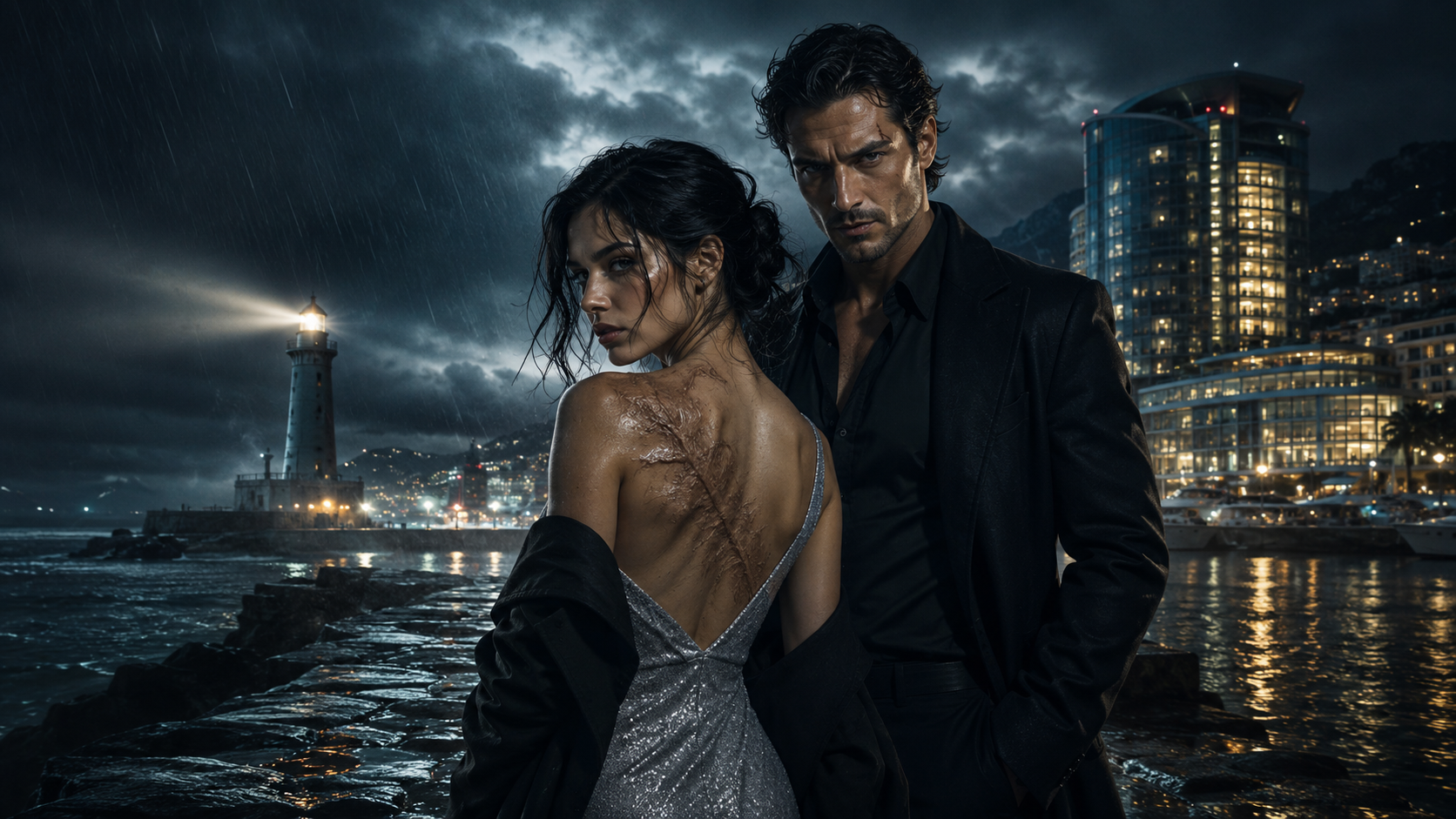
“You stopped breathing for twenty-three seconds,” she said. “The dress restricted your chest, so I cut it. I apologize for not asking permission. You were unconscious.”
A man stood at the edge of the stage.
He wore a black shirt with the sleeves folded to his forearms. He was tall, broad-shouldered, and completely still. A faint scar divided one eyebrow. His eyes were the gray of the sea before a storm.
Mara recognized him.
Everyone in Vesper Bay would have recognized him.
Roman Sable.
The newspapers called him a businessman because newspapers could be sued.
The police called him a person of interest because charges required witnesses.
The harbor called him the Undertow because people who crossed him vanished beneath the surface of respectable society.
Mara pulled the blanket tighter.
“You kidnapped the wrong woman,” she said.
Roman descended the steps from the stage.
“So I have been informed.”
“Then return me.”
“No.”
The answer came without anger, pleasure, or hesitation.
Mara’s pulse quickened.
“My sister is the bride.”
“Yes.”
“I am not valuable to you.”
Roman stopped several feet away.
“Lucian Crowe seems to disagree.”
“What does that mean?”
He lifted a remote from a dusty table.
A television mounted beneath the balcony flickered to life.
The picture showed the Halcyon Hotel surrounded by police vehicles. Reporters stood in the rain while emergency crews moved behind them.
Lucian appeared at a podium beneath the hotel awning.
He was still dressed for the gala. His black jacket was wet, and a streak of blood marked one cuff. Vivienne stood behind him, wrapped in a coat, her face colorless.
Mara leaned forward.
Her sister was alive.
Relief arrived first.
Then Lucian began to speak.
“Tonight, armed criminals attacked what should have been a private celebration of two families. During the assault, Mara Ellison was forced into a vehicle that was later found submerged near the eastern breakwater.”
Mara stopped breathing.
Lucian lowered his head with the solemn control of a man accustomed to cameras.
“Based on the evidence recovered at the scene, authorities do not believe she survived.”
The broadcast changed to aerial footage of a burning vehicle in the harbor.
Mara stared at the screen.
“That isn’t the vehicle they used.”
Roman switched off the television.
“No.”
“The police haven’t searched for me.”
“They were instructed not to.”
“My father would never—”
She stopped.
Roman’s expression did not change, but something in his silence made the unfinished denial feel childish.
Mara looked toward Dr. Voss.
The doctor closed her medical bag.
“Your reaction is stable,” she said. “Avoid sudden movement. I’ll be nearby.”
When she left, two armed guards followed her through the wings.
Mara faced Roman.
“You planned to take Vivienne.”
“I planned to take Lucian’s access key. Your sister wears it inside her wedding necklace.”
“The diamonds?”
“The central stone contains a quantum token that opens Crowe’s private shipping network.”
“You expect me to believe a billionaire carries secrets in a necklace?”
“I expect billionaires to mistake extravagance for security.”
“Why do you need his network?”
“Because he is moving something through my harbor.”
“Drugs?”
Roman looked toward the ceiling angel.
“People.”
The word changed the temperature of the room.
Mara said nothing.
“Crowe’s relief vessels enter ports without standard inspection,” Roman continued. “Six months ago, one of them arrived with forty-seven undocumented passengers hidden inside a sealed maintenance compartment. Twelve were children.”
“What happened to them?”
“My people intercepted the transfer.”
“And the smugglers?”
“They will not do it again.”
Mara did not ask why.
Roman’s gaze moved to the blanket around her shoulders.
“When Dr. Voss treated you, she photographed the chemical pattern around your scars.”
Mara’s grip tightened.
“She did what?”
“To identify the substance that complicated your breathing.”
“She had no right.”
“She was trying to keep you alive.”
“That does not give either of you ownership of my body.”
Roman accepted the accusation without blinking.
“No,” he said. “It does not.”
His agreement unsettled her more than an argument would have.
“The scars contain traces consistent with white phosphorus and an industrial catalyst called V-17,” he continued. “That combination was used in an experimental fuel cell developed at Bellweather’s Greyhaven facility thirteen years ago.”
Mara felt the old room return around her.
Alarms.
Smoke.
Heat so violent it had seemed solid.
Her younger sister screaming behind a locked laboratory door.
“Greyhaven was an electrical fire,” she said.
“That was the official report.”
“It was investigated.”
“The investigator was my brother.”
Mara looked at him.