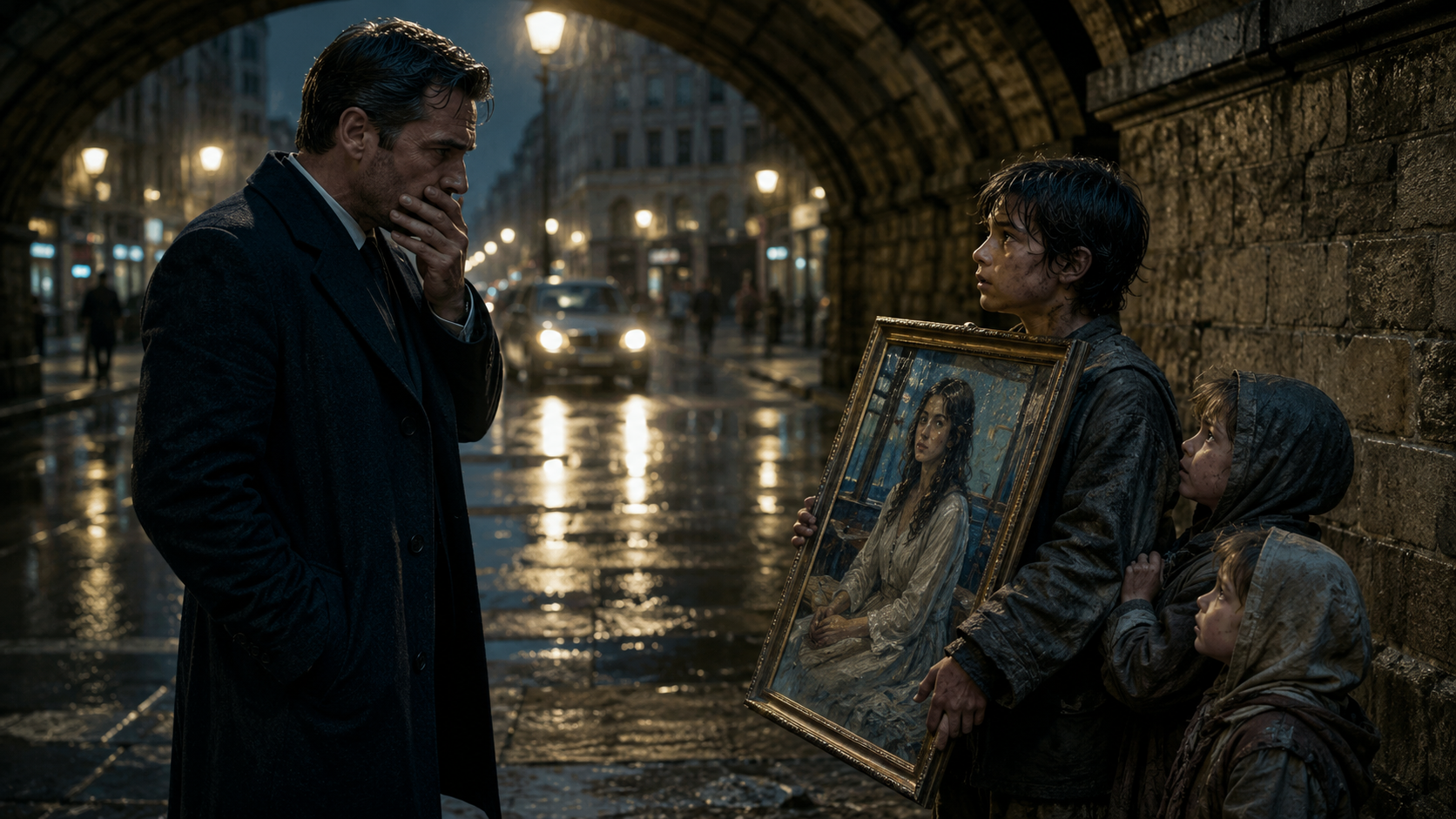
“He used mine.”
“Yes.”
For the first time, their eyes met without the full wall of seven years between them.
Not gone.
But cracked.
Elias Voss did not know he was being hunted until the trap was already closing.
He sat in his private office on the top floor of the Calder Foundation building, drinking tea from a porcelain cup and reviewing the guest list for the annual winter gala. He still enjoyed paper lists. Digital systems could be altered, traced, subpoenaed. Paper had a pleasing finality when burned.
His assistant entered.
“Mr. Calder requested the foundation archives from the Hollow Creek year.”
Elias did not look up.
“Did he?”
“Yes, sir.”
“Give him the public set.”
“He asked for the restricted set.”
Now Elias looked up.
His assistant lowered her voice. “He also requested the old medical examiner contract.”
The porcelain cup paused halfway to his mouth.
“Why?”
“He didn’t say.”
Elias smiled faintly.
Julian had always been dangerous in business but sentimental in blood. That had been his weakness. Men who loved deeply could be blinded deeply. Seven years ago, Elias had not needed to defeat Julian. He had only needed to break him and offer to hold the pieces.
Still, loose threads irritated him.
“Send a message to our friends near the river,” Elias said. “Ask if the Glasshouse has been cleared.”
His assistant hesitated. “Cleared?”
Elias looked at her.
She left without another question.
That evening, two men arrived at the abandoned conservatory and found it empty except for old blankets, a cold fire pit, and a child’s broken shoe.
Within an hour, Elias knew enough.
Mara was alive.
The children were gone.
Julian was asking questions.
For the first time in years, Elias Voss felt something close to fear.
Then he remembered that fear, like grief, could be weaponized.
Julian built his case in silence.
Not with rage, though rage was there.
Not with revenge, though revenge waited patiently at the edge of every breath.
He built it with bank records, forged signatures, witness statements, altered audio files, death certificates, insurance documents, and the testimony of a retired nurse in Albany who burst into tears when Elise showed her Mara’s photograph.
“I knew that woman wasn’t being protected,” the nurse said. “I knew it. But they told us her husband was violent. They said powerful people were searching for her.”
“Who told you?” Elise asked.
The nurse pointed at a photograph of Elias.
“That man.”
The old police report collapsed next.
The officer who signed it had accepted a “consulting fee” from a shell company tied to the foundation. The burned body identified as Mara Calder had belonged to an unidentified woman from a morgue two counties away. The dental confirmation had been fabricated by a medical examiner who died three years later with debts mysteriously paid in full.
Then came the money.
Mara had been right seven years ago.
The Calder Foundation had been bleeding funds through fake housing initiatives. Millions intended for shelters, clinics, and food programs had been redirected through nonprofit fronts and into accounts controlled by Elias.
Mara had found the first thread.
Elias had burned down her life to keep her from pulling it.
Julian read the final report alone in his study at 4:12 a.m.
At 4:18, he walked into the room where Mara sat awake beside Kit’s bed.
She looked up.
“What happened?”
Julian could not hide it from her.
Not this.
“You were right.”
Mara closed her eyes.
The words did not heal her.
They confirmed the size of the wound.
“How much?” she asked.
“Enough to ruin him. Enough to send him to prison for the rest of his life if the prosecutors do their jobs.”
“And if they don’t?”
Julian’s expression was quiet and terrible.
“They will.”
Mara looked at the sleeping children.
For years, she had imagined justice as a door opening, sunlight pouring in, fear evaporating.
But justice arrived with nausea.
With the knowledge that all her suffering had been useful to someone.
With the understanding that her children’s hunger had helped preserve a rich man’s reputation.
She covered her mouth.
Julian moved instinctively, then stopped himself.
“May I?” he asked.
The question broke something in her.
She nodded.
He sat beside her, not touching until she leaned forward first.
Then Mara Calder, who had survived a staged death, a false name, a winter in a basement apartment, childbirth without family, and seven years of looking over her shoulder, bent into her husband’s arms and made a sound too exhausted to be called crying.
Julian held her carefully.
As if she were not fragile.
As if she were sacred.
“I’m sorry,” he whispered.
Mara gripped his shirt.
“I believed him.”
“You were alone.”
“I taught them to hide from you.”
“You kept them alive.”
“Barely.”