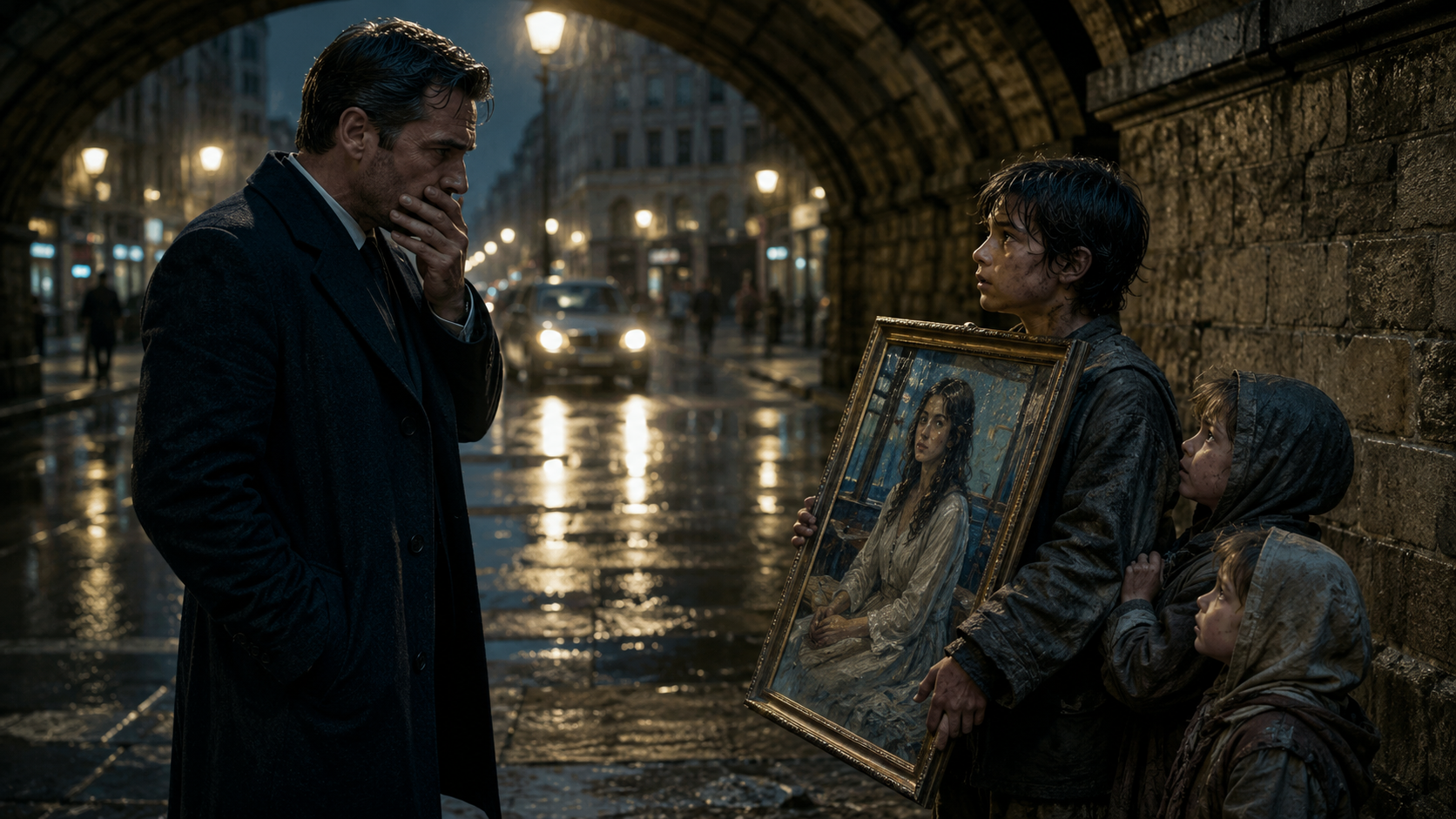
He closed his eyes. “Still alive.”
That was the first mercy.
Not forgiveness.
Not yet.
But mercy.
The children learned Julian in pieces.
Toby learned first that Julian did not shout.
This confused him because every man Toby had known who owned clean shoes shouted eventually. Julian did not. Even when a nurse spilled coffee on a stack of legal papers, even when Elise argued with him in the hallway, even when reporters began gathering outside Calder Tower after rumors leaked, Julian’s voice remained low.
“Maybe he yells in a special room,” Toby told Nell.
Nell considered this. “Maybe rich people have yelling rooms.”
Kit, wearing dinosaur socks Julian had purchased in six different sizes because he did not know how children’s feet worked, announced, “I want a soup room.”
Julian, standing outside the door with breakfast trays, said, “That can be arranged.”
The children went silent.
Then Kit whispered, “Can it?”
Julian looked at Mara.
For the first time, she almost smiled.
Nell learned that Julian knew how to braid hair badly but was willing to be instructed.
“No, not like rope,” she said, standing between his knees while he tried to separate her curls into three uneven sections. “Hair is not rope.”
“I see.”
“You don’t.”
“I don’t,” Julian admitted.
Toby watched from the window seat, pretending not to care.
Kit learned that Julian could draw terrible horses. This delighted him.
“That dog has long legs,” Kit said.
“It’s a horse.”
“No.”
Julian examined the paper. “You may be right.”
Mara watched these small failures with a pain sharper than distrust.
He should have learned all this years ago.
He should have held them as babies. He should have walked the floor with them at night, learned their cries, complained about lost sleep, known which songs calmed them. The theft was not only that he had lost Mara.
He had lost first steps.
First words.
First fevers.
First birthdays.
A thousand ordinary miracles stolen and spent by another man.
One evening, Toby found Julian in the clinic garden, sitting alone beneath a bare maple tree.
“Are you mad?” the boy asked.
Julian looked up. “Yes.”
Toby’s shoulders stiffened.
Julian added, “Not at you.”
“At Mom?”
“No.”
“At who?”
“At the man who hurt all of you.”
Toby came closer. “Are you going to kill him?”
Julian was silent long enough that Toby understood the truth was complicated.
“No,” Julian said at last. “That would be too quick.”
Toby sat on the bench, leaving a careful foot of space between them.
“What are you going to do?”
“Take away every lie he used as a house. Then let him live inside the truth.”
Toby frowned. “That sounds like grown-up talk.”
“It is.”
“Does it mean prison?”
“Yes.”
“Good.”
Julian looked at him.
Toby stared at the ground. “Bad people should be put somewhere they can’t come back.”
Julian’s chest hurt.
“Yes,” he said. “They should.”
After a moment, Toby leaned sideways. Not fully. Just enough for his shoulder to touch Julian’s sleeve.
Julian did not move.
He barely breathed.
But when Toby did not pull away, Julian looked up at the darkening sky and whispered a thank-you to no one in particular.
The winter gala of the Calder Foundation had always been a performance of generosity.
Cameras loved it. Donors loved it. Politicians loved it most of all. There were white flowers, champagne towers, string quartets, and enormous photographs of smiling children whose names the board members never learned.
This year, Elias Voss arrived wearing a black tuxedo and the calm expression of a man who had already arranged three escape routes.
He expected Julian to attack privately.
Julian did not.
He let Elias stand onstage beneath the foundation’s gold emblem. He let him speak about trust, stewardship, legacy, and “the sacred duty of protecting the vulnerable.”
Then Julian walked onto the stage.
The applause changed when people saw his face.
Elias turned smoothly.
“Julian,” he said warmly. “We weren’t expecting remarks tonight.”
“No,” Julian said. “I imagine not.”
A ripple moved through the room.
At the back entrance, federal agents waited with Elise.
In a private room upstairs, Mara watched through a secure feed with Dr. Reeve beside her and the children asleep under guard. She had chosen not to stand in that ballroom. Not yet. Her survival did not need to be displayed to be real.
Julian faced the audience.
“Seven years ago, my wife, Mara Calder, was declared dead.”
The room went silent.
Elias’s smile remained, but the muscles near his eyes tightened.
“I mourned her publicly. I buried an empty casket privately. I trusted the people who told me there was nothing to question.”
A photographer lowered his camera.
Julian continued.