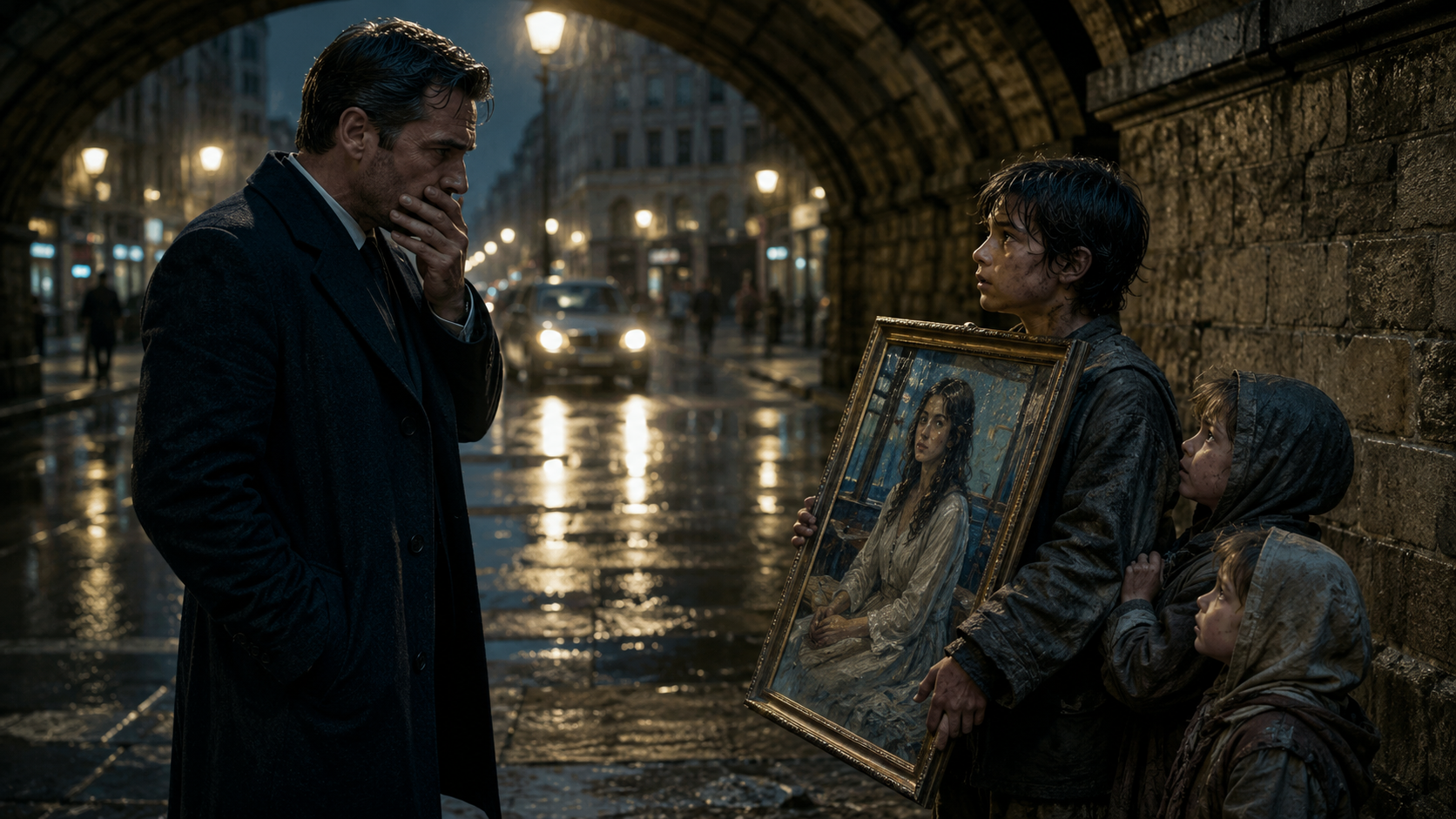
Despite everything, Mara almost laughed.
Toby leaned closer.
“Is he really the man from the picture box?”
The picture box was what the children called the small tin where Mara kept the few things she had not been able to burn: a wedding photograph folded into quarters, a museum ticket from their first date, and a note Julian had once written on hotel stationery that said, Come home whenever the world gets too loud.
Mara swallowed.
“Yes.”
“Is he our father?”
The question had been waiting six years to become words.
Mara reached for his hand.
“I don’t know who he is anymore.”
Toby frowned. “That’s not an answer.”
“No,” she whispered. “It isn’t.”
From the doorway, Julian’s voice came softly.
“He is allowed to ask.”
Mara turned.
Julian stood outside the threshold, one hand visible, as if approaching a frightened animal.
“I can leave,” he said.
Toby looked between them.
Mara shook her head. “Stay there.”
Julian obeyed.
That obedience unsettled her.
The Julian she had been taught to fear would have entered anyway.
Toby sat straighter. “Are you our father?”
Julian looked at Mara first.
She gave the smallest nod, though it cost her.
Julian crouched in the hallway so Toby would not have to look up.
“I believe I am,” he said.
“Believe?”
“I need tests to know the way courts and doctors know. But here—” He touched his chest. “I knew before anyone told me.”
Toby studied him with suspicion far older than six.
“If you’re our father, why didn’t you find us?”
The question struck exactly where it should.
Julian did not defend himself.
“Because I believed a lie.”
Toby’s mouth tightened. “That’s stupid.”
“Yes.”
“Grown-ups should know better.”
“Yes.”
Mara looked away.
Julian’s voice roughened. “You’re right to be angry.”
“I’m not angry.”
“You’re holding the blanket like you want to throw it at me.”
Toby glanced down at his fists twisted in the blanket.
After a moment, he said, “Maybe a little.”
Julian nodded gravely. “That seems fair.”
Nell woke next, crying because she did not know where she was.
Kit woke last and asked if soup lived in hospitals.
By midmorning, all three children had eaten warm oatmeal with bananas. Toby pretended not to like it and then scraped the bowl clean. Nell fell asleep again with a stuffed rabbit Elise had bought from a pharmacy gift shelf. Kit let Dr. Reeve place an oxygen tube under his nose after Julian told him it made him look like a small astronaut.
Mara watched all of it with a heart divided against itself.
Every tender thing Julian did made the old story weaker.
And if the old story was false, then what had she done?
She had hidden his children from him.
She had let them go hungry.
She had taught them to fear the sound of his name.
She had survived because she believed she had no other choice, but survival did not erase the damage done in its name.
That afternoon, Julian entered only after she said he could.
He placed a folder on the table between them.
“I started looking at the accident.”
Mara stiffened.
“I won’t push you,” he said. “But I need to know what you remember.”
She looked at the folder as if it might bite.
“I remember headlights.”
Julian sat very still.
“I was driving to meet you at the museum benefit,” she continued. “I had the envelope with the foundation records. I wanted to show you before I accused anyone. Then a black truck came too fast from the side road. I swerved. The guardrail broke. I remember rolling. I remember smoke.”
Her hand went to the scar on her neck.
“When I woke up, Elias was there.”
Julian’s jaw tightened.
“He said you had already been told I was dead. He said the funeral would happen quickly. He said he could save me only if I disappeared. I didn’t believe him at first. Then he played the recording.”
“What recording?”
Mara’s eyes filled.
“Your voice.”
Julian went cold.
“You said you knew about the pregnancy. You said you would never let a bastard inherit Calder blood. You said if I came near you, I would vanish for good.”
Julian stood abruptly and walked to the window.
For a moment, Mara saw the man the world knew: controlled, merciless, carved from wealth and will.
Then he pressed one hand against the glass, and she saw the tremor in his fingers.
“That was not me.”
“I know that now.”
He turned.
The words had escaped her before she understood their meaning.
His face changed.
Not relief.
Hope, which was far more dangerous.
Mara looked down. “I’m beginning to know.”
Julian returned to his chair slowly, as if sudden movement might frighten the truth away.
“Elias had access to archived calls,” he said. “Private recordings. Boardroom audio. Security files. He could have built anything.”
“He gave me papers too. Legal forms. Your signature.”
“I signed many things after the funeral without reading them.” His voice dropped. “I trusted him with my grief.”