THE WOMAN AT TABLE TWELVE

The first person to recognize Mara Ellison was a five-year-old boy who was supposed to have no memory of her.

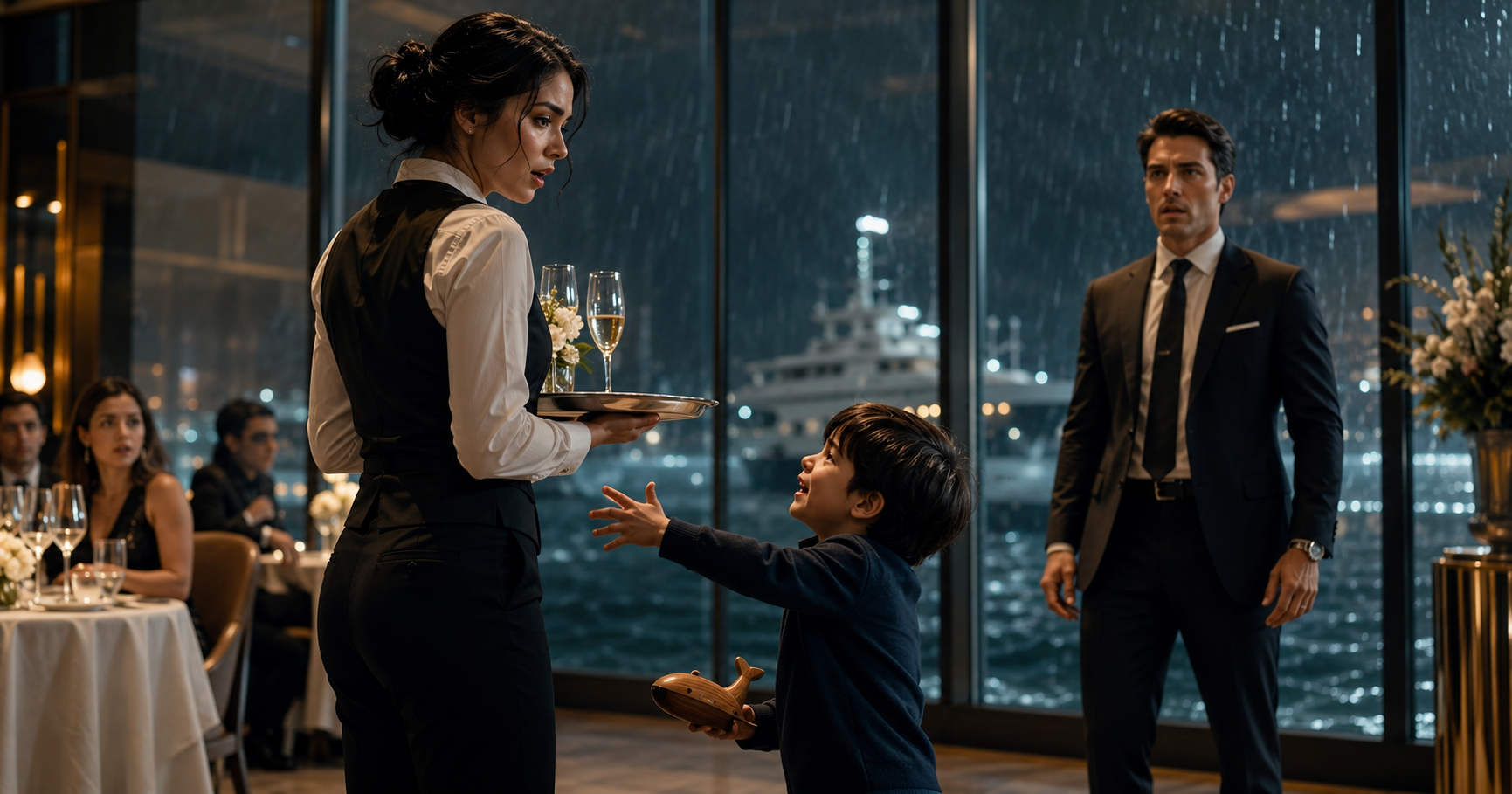
It happened on a stormy November evening inside the glass-walled reception hall of Mercer Harbor, where three hundred guests had gathered beneath chandeliers shaped like waves.

Outside, rain swept across the black water.

Inside, champagne flowed beneath golden lights.

Investors shook hands. Reporters waited behind velvet ropes. A string quartet played near the windows while waiters moved silently between people worth more money than Mara could imagine.

Mara was one of those waiters.

At least, that was what the temporary employment agency had told everyone.

Her uniform was simple: black trousers, a white shirt, a narrow charcoal vest. Her hair was pinned behind her neck. She carried a tray of sparkling water from table to table and tried not to look toward the enormous photograph hanging above the stage.

But she had already looked at it four times.

A man and a little boy stood in the photograph.

The man was Julian Mercer, chairman of Mercer Maritime.

The boy was his son, Leo.

Mara did not know either of them.

That was what she kept telling herself.

Yet every time she saw the child’s face, something inside her chest tightened.

Not recognition exactly.

Recognition would have been easier.

This was something deeper.

A physical ache without a memory attached to it.

She had experienced the same feeling when she first arrived at the harbor that afternoon.

The smell of salt.

The scream of gulls.

The distant horn of a cargo ship.

All of it felt like a place from a dream she had forgotten.

“Mara.”

Her supervisor touched her elbow.

“Table twelve needs water.”

“Sorry.”

“You all right?”

“Yes.”

She lied automatically.

She moved through the crowd.

Across the room, Julian Mercer stood beside the stage talking to two board members.

He was forty, perhaps forty-one, dressed in a perfectly tailored dark suit. Cameras followed him whenever he moved.

But there was something strangely detached about him.

People laughed around Julian.

He rarely did.

Mara had noticed that too.

She wished she hadn’t.

She reached table twelve.

A woman lifted her empty glass without looking at Mara’s face.

“Still water.”

“Of course.”

Mara poured it.

Nearby, someone began tapping a spoon against a glass.

Guests turned toward the stage.

The music stopped.

Julian stepped toward the microphone.

“Ladies and gentlemen, thank you for being here tonight.”

Mara lowered her tray and continued toward the service corridor.

Then she saw the little boy.

Leo Mercer stood near one of the windows with his nanny.

He was smaller than he appeared in photographs.

Dark hair.

Serious gray-blue eyes.

A small wooden whale clutched in one hand.

Mara stopped walking.

The room disappeared.

For one impossible second, she saw another room.

Sunlight.

A blue blanket.

Tiny fingers curled around hers.

Then the image vanished.

Mara gasped.

The tray tilted.

She caught it before the glasses fell.

Across the room, Leo was staring directly at her.

His wooden whale slipped from his fingers.

The child whispered something.

His nanny bent toward him.

“What did you say?”

Leo did not answer.

He started walking toward Mara.

Then walking became running.

“Leo!”

The nanny reached for him and missed.

People turned as the little boy raced between tables.

Julian stopped speaking.

Mara could not move.

Every instinct told her to step backward.

Instead, she lowered the tray.

Leo stopped two feet away from her.

His eyes filled with tears.

“Mama?”

Mara’s breath disappeared.

The word struck somewhere inside her that had been locked for years.

Leo came closer.

“You found us.”

Silence spread outward through the room.

Mara slowly crouched.

“I think you’ve mistaken me for someone, sweetheart.”

Leo shook his head violently.

“No.”

His lower lip trembled.

“You sing the whale song.”

Mara froze.

“What song?”

Leo began humming four notes.

Only four.

Mara’s hands started shaking.

Without understanding why, she hummed the next four.

Leo burst into tears.

He threw his arms around her neck.

And this time Mara saw more than a flash.

She saw herself holding a baby beside a bedroom window.

She saw a wooden whale hanging above a crib.

She heard herself singing.

She smelled lavender soap.

She heard a man’s laughter behind her.

Then pain split through her skull.

Mara nearly fell.

Someone caught her shoulder.

Julian Mercer.

He had crossed the room without her noticing.

His face had lost all color.

“Look at me,” he said.

Mara raised her eyes.

Julian stared at her as though the world had stopped obeying its own rules.

“No.”

The word barely left his mouth.

Mara tried to stand.

“I should go.”

Julian stepped in front of her.

“What’s your name?”

“Mara Ellison.”

“Your real name.”

“It is my real name.”

“How old are you?”

“I don’t know why—”

“Please.”

There was no anger in his voice now.

Only fear.

Mara swallowed.

“Thirty-five.”

Julian closed his eyes.

Leo was still holding her hand.

When Julian opened his eyes again, he looked toward Mara’s left wrist.

“May I see your arm?”

“What?”

“Your wrist.”

Mara instinctively covered it.

Beneath her sleeve was a pale crescent-shaped scar.

A surgeon had once told her it was old.

Older than the accident she remembered.

Julian whispered, “Celeste.”

The name made Mara’s stomach twist.

Across the room, someone dropped a glass.

A man standing beside the board members suddenly turned away.

Mara noticed him because of how quickly he moved.

Silver hair.

Broad shoulders.

Expensive navy suit.

Dominic Rainer.

Chief financial officer of Mercer Maritime.

Julian’s oldest business partner.

Mara had seen his photograph in the event program.

She had felt nothing then.

Now, watching him walk toward the exit, she heard a voice inside her head.

Not a thought.

A memory.

“Move her before she wakes up.”

Mara staggered backward.

Dominic stopped.

Their eyes met.

And fear appeared on his face.

Real fear.

Mara pointed at him.

“You.”

Julian turned.

Dominic gave a confused smile.

“Excuse me?”

“I know your voice.”

“Mara,” Julian said carefully, “what are you talking about?”

Rain struck the windows harder.

Mara pressed both hands against her temples.

There was darkness.

Smoke.

A boat rocking beneath her feet.

An alarm.

Someone shouting.

Then Dominic’s voice.

“Get her off the launch. Take her north. No hospitals.”

Mara looked at him.

“You were there.”

Dominic laughed once.

“This is absurd.”

But he was already moving toward the doors.

Julian’s security chief stepped into his path.

“Mr. Rainer?”

Dominic stopped.

Every camera in the room was now pointed toward them.

Julian lowered his voice.

“Nobody leaves.”


Two and a half years earlier, Celeste Mercer had supposedly died in a fire aboard a private company launch.

Investigators concluded that an electrical failure had ignited fuel fumes beneath the rear deck.

The boat burned less than a mile from shore.

Two crew members survived.

Celeste did not.

Divers never recovered an identifiable body.

But her wedding ring was found in the wreckage.

Her coat was recovered near the shoreline.

A forensic report declared that no one remaining in the forward cabin could have survived.

Julian had buried an empty coffin.

Leo had been two years old.

Eventually, the world moved on.

Julian did not.

Now the dead woman might be standing in front of him wearing a catering uniform.

Yet Julian refused to believe something simply because he wanted it to be true.

The gala ended early.

Guests were escorted out.

Reporters were kept behind the gates.

Mara was taken to a private office overlooking the harbor.

Leo refused to leave her.

Julian sat across from her.

Between them lay the wooden whale.

“Tell me everything you remember,” he said.

Mara looked toward the rain.

“My first clear memory is waking up in a rehabilitation center called North Briar House.”

“When?”

“About two years ago.”

Julian leaned forward.

“Where?”

“Three hours north of here.”

“You were injured?”

“Burns. A broken shoulder. Head trauma.”

“And they didn’t know your identity?”

“They said I had been brought in without identification after being found beside a coastal road.”

“Who brought you?”

“I was told a truck driver.”

“Name?”

“They never gave me one.”

Julian’s expression changed.

“Who paid for your treatment?”

“I don’t know.”

“Nobody asked?”

“I did.”

Mara looked down.

“The administrator told me a charitable trust covered patients who couldn’t pay.”

Julian stood.

He walked to the window.

For several seconds he said nothing.

Then he asked, “How did you become Mara Ellison?”

“The clinic helped me obtain temporary identity documents. Later they became permanent.”

“Based on what?”

“They said the police couldn’t identify me.”

Julian turned.

“And you believed them?”

Mara’s jaw tightened.

“When you wake up unable to remember your own birthday, you believe the people feeding you.”

He immediately regretted the question.

“You’re right. I’m sorry.”

Mara looked at Leo.

The boy had fallen asleep on the sofa with the wooden whale pressed against his chest.

She whispered, “I used to dream about him.”

Julian’s face changed.

“I didn’t know who he was. I thought I had invented him.”

“What did you dream?”

“A little boy running down a hallway.”

She hesitated.

“He called me something.”

Julian waited.

“Bluebird.”

Julian gripped the back of a chair.

Mara noticed.

“What?”

His eyes filled.

“Celeste called Leo her little bluebird.”

Mara looked away.

“I don’t remember being Celeste.”

“You don’t have to.”

“But you want me to.”

“I want the truth.”

“So do I.”

Julian looked at her for a long moment.

Then he said, “We’ll get it.”


The DNA results arrived the following afternoon.

Julian read the report twice.

Then a third time.

Probability of maternity exceeded 99.99 percent.

Mara Ellison was Leo Mercer’s biological mother.

She was Celeste Mercer.

Biologically, there was no question.

Emotionally, everything was a question.

Mara sat alone in the harbor house kitchen when Julian brought her the results.

She read them in silence.

No dramatic memories returned.

No miraculous transformation occurred.

She simply stared at the page until a tear landed on it.

“I thought this would feel different,” she said.

Julian sat across from her.

“How?”

“Like a door opening.”

“Maybe doors don’t open all at once.”

She looked at him.

“You sound like you know me.”

“I knew Celeste.”

“That’s not the same thing.”

“No.”

The answer surprised her.

Julian continued.

“If you are expecting me to tell you that you have to become my wife again, I won’t.”

Mara’s eyes narrowed slightly.

“You won’t?”

“I lost someone. You survived something. Those aren’t the same experience.”

For the first time since the gala, Mara relaxed.

Julian pushed the DNA report away.

“But someone took you from us.”

“Dominic.”

“Maybe.”

“You don’t believe me.”

“I believe you remember his voice. I need to prove what the voice means.”

Mara reached into her bag.

“There may be a way.”

She placed a small brass key on the table.

Julian stared at it.

“Where did you get that?”

“It was sewn into the lining of the coat I was wearing when I woke up.”

The key had three numbers stamped into it.

Julian’s expression sharpened.

“Pier storage.”

“What?”

“The old harbor terminal has private lockers.”

He picked up the key.

“Number 417.”


The locker had not been opened in thirty-one months.

Inside was a waterproof case.

Celeste had hidden it there two days before the boat fire.

The case contained financial records, photographs of unregistered cargo being unloaded at night, copies of insurance documents, and a small encrypted drive.

Julian’s legal team spent six hours breaking through the first layer of protection.

What they found changed the investigation completely.

Dominic Rainer had been using a Mercer Maritime subsidiary to conceal millions in illegal transactions.

Celeste had discovered irregular payments while preparing documents for the family’s charitable foundation.

She had begun collecting evidence.

Then she had scheduled a meeting with federal investigators.

She never made it.

The final file on the drive was an audio recording.

Celeste’s voice came first.

“If something happens to me, Dominic knows I found the North Channel accounts.”

Mara heard her own forgotten voice and covered her mouth.

Then another voice came through the recording.

Dominic.

“You have no idea what you’re doing.”

Celeste answered, “I know exactly what I’m doing.”

The recording ended.

Julian remained completely still.

Mara looked at him.

“You believe me now.”

He shook his head.

“I believed you before.”

His voice hardened.

“Now I can destroy him.”


Dominic did not run.

That was his mistake.

He returned to Mercer Harbor the following evening with two attorneys and the confidence of a man who had escaped consequences his entire life.

He denied everything.

The accounts were fabricated.

The recording was manipulated.

The locker had been planted.

Mara’s memories were unreliable.

Then Julian placed a second document on the table.

A payment record from North Briar House.

Dominic’s face changed.

The rehabilitation center’s so-called charitable trust had received regular payments from a shell company controlled by him.

“You kept her there,” Julian said.

Dominic said nothing.

“You knew she survived.”

Silence.

“You gave her another identity.”

Still silence.

Mara stood near the window.

Fragments of memory moved through her faster now.

The burning launch.

Cold water.

Hands dragging her onto a rocky shore.

A vehicle.

Dominic arguing with another man.

She turned.

“You didn’t mean for me to die on the boat.”

Dominic’s eyes shifted toward her.

That tiny movement was enough.

“You wanted the evidence destroyed,” Mara continued. “But when you found out I was alive, killing me became more dangerous.”

Julian stared at Dominic.

“So you erased her instead.”

Dominic finally spoke.

“I protected thousands of employees.”

Julian laughed without humor.

“You protected yourself.”

“You think companies survive on morality?”

Mara stepped closer.

“No. But people have to.”

Dominic’s calm disappeared.

“You were going to destroy everything your husband built.”

“I was trying to stop you from using his company as your private criminal network.”

“You don’t remember that.”

“No.”

Mara looked him directly in the eyes.

“But apparently I was smarter before the fire.”

Julian almost smiled.

Dominic didn’t.

Police entered through the conference-room doors moments later.

This time, Dominic finally looked afraid.

As officers approached, he turned toward Julian.

“You owe everything to me.”

Julian answered quietly.

“I nearly lost everything because of you.”

Dominic was led away.


The following weeks were louder than the previous two years combined.

Investigations opened.

Executives resigned.

Reporters camped outside the harbor gates.

North Briar House was searched.

Its former administrator was arrested for falsifying records and accepting payments to conceal Mara’s identity.

The two surviving crew members from the launch were questioned again.

One admitted that Dominic had ordered the route changed shortly before the fire.

For Julian, every new fact created another wound.

For Mara, every new fact returned another piece of herself.

But memory did not come back like a movie.

It came in fragments.

Leo hated peas.

Julian drank coffee without sugar when nervous.

Celeste had played the piano badly but enthusiastically.

She had once painted the guest bathroom yellow and refused to admit it was a terrible idea.

Mara remembered the small things before the important ones.

Perhaps because the small things had mattered more.

One evening she stood in the doorway of Leo’s bedroom.

He was arranging wooden animals along his pillow.

He looked up.

“Are you staying here tonight?”

“For tonight.”

“And tomorrow?”

“I think so.”

“And the next day?”

Mara smiled.

“You’re a very serious negotiator.”

Leo considered this.

“Papa says I get that from you.”

Mara laughed.

The sound startled her.

From the hallway, Julian stopped walking.

For one second, his eyes closed.

Mara knew why.

He remembered that laugh.

She did not.

Not completely.

But she was beginning to understand that memory was not the only way a person belonged somewhere.

Leo lifted the wooden whale.

“You gave me this.”

“So I’ve been told.”

“No.”

He climbed out of bed and placed it in her hand.

“I remember.”

Mara swallowed.

“You were very little.”

“I still remember.”

She sat beside him.

“What do you remember?”

Leo thought carefully.

“You singing.”

“What else?”

“You smelled like flowers.”

“Lavender?”

His eyes widened.

“Yes.”

Something warm moved through her chest.

Not pain this time.

Recognition.

Leo leaned against her.

“Do I have to call you Mara?”

She looked down at him.

“You can call me anything that feels true.”

He became very quiet.

Then he whispered, “Mama.”

Mara kissed his hair.

“That feels true to me too.”


Julian was waiting downstairs.

Not in a suit.

Not surrounded by attorneys.

Not sitting behind a desk.

He stood on the terrace with two cups of tea while rain drifted softly over the harbor.

Mara joined him.

He handed her a cup.

“Leo asleep?”

“Finally.”

“He used to negotiate bedtime with Celeste too.”

Mara smiled.

“Apparently some things survive everything.”

Julian looked toward the water.

For a while neither spoke.

Then Mara said, “I remember the yellow bathroom.”

Julian turned slowly.

“No.”

“Yes.”

“You defended that color for six months.”

“It was terrible.”

“It was radioactive.”

She laughed.

Julian laughed too.

Then both of them became quiet.

Mara looked at him.

“I still don’t remember our wedding.”

“That’s okay.”

“I don’t remember falling in love with you.”

His smile faded, but he nodded.

“That’s okay too.”

“You keep saying that.”

“Because I don’t want you to spend the rest of your life trying to become someone for me.”

Mara studied him.

“What do you want?”

Julian took a long time to answer.

“A chance to know the person standing here.”

Not the answer she expected.

Perhaps that was why she believed him.

She placed her cup on the railing.

“The woman you loved is part of me.”

“I know.”

“But I’m not exactly her.”

“I know that too.”

“And I can’t promise I’ll become her again.”

Julian looked at her.

“Then don’t.”

The harbor lights shimmered across the rain.

Mara extended her hand.

Julian stared at it before taking it.

Not like a husband reclaiming his wife.

Not like a man recovering something that belonged to him.

Like two people meeting again after surviving different versions of the same tragedy.

Behind them, a small voice came from the open terrace door.

“You said bedtime.”

Leo stood there in dinosaur pajamas.

Mara raised an eyebrow.

“You are in serious trouble, young man.”

Leo grinned.

Julian whispered, “That expression. That’s definitely you.”

Mara looked at him.

For the first time, she did not ask whether he meant Mara or Celeste.

Maybe eventually the distinction would matter less.

She walked toward Leo.

He lifted his arms.

Mara picked him up.

The boy rested his head against her shoulder.

Behind them, the harbor stretched into darkness.

It was the place where one version of her life had ended.

But it was no longer a grave.

It was simply water.

And beyond it, morning was already on its way.

THE WOMAN AT TABLE TWELVE
A bride secretly plans a touching ceremony for her deaf groom