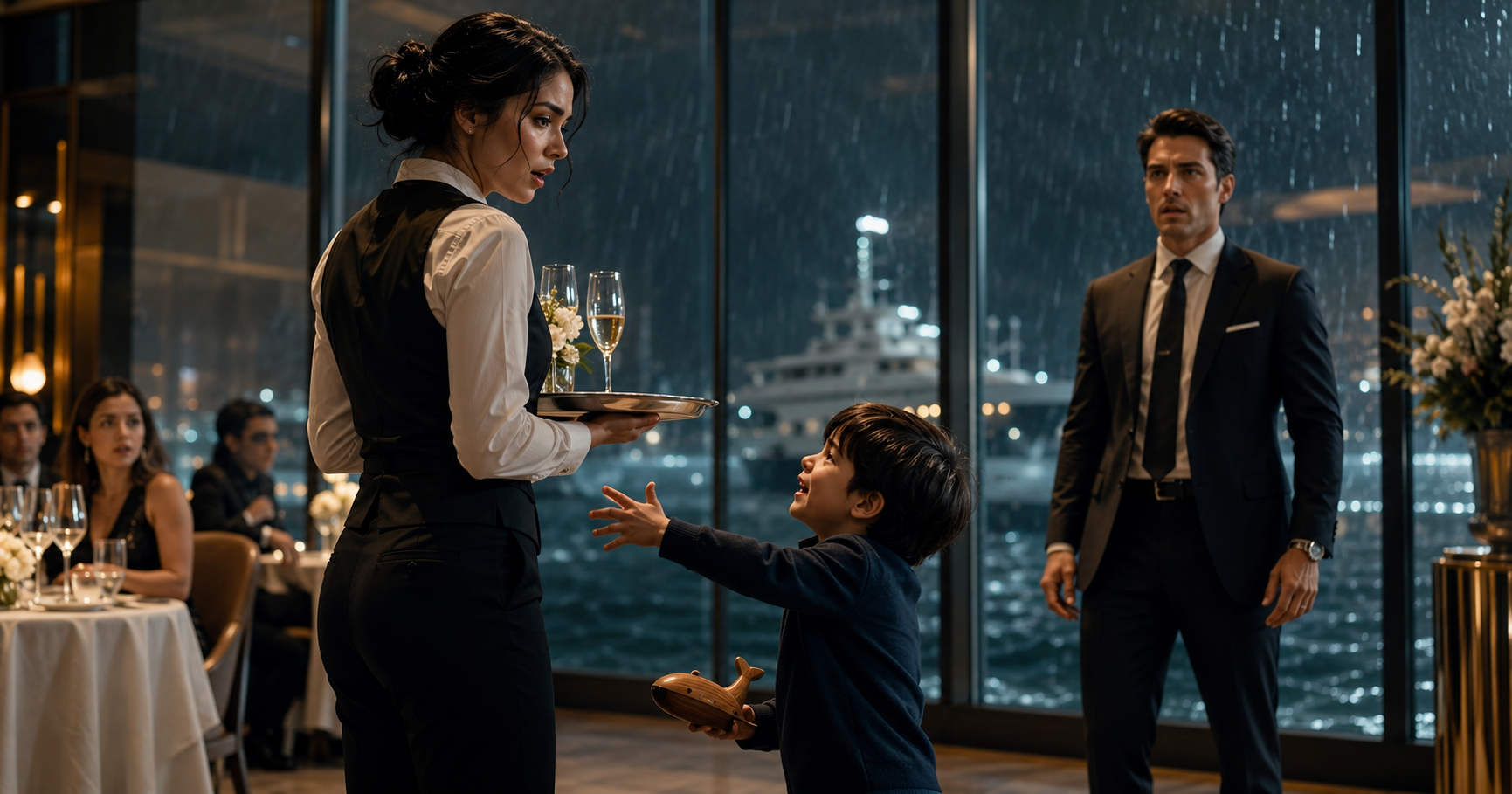
Mara tried to stand.
“I should go.”
Julian stepped in front of her.
“What’s your name?”
“Mara Ellison.”
“Your real name.”
“It is my real name.”
“How old are you?”
“I don’t know why—”
“Please.”
There was no anger in his voice now.
Only fear.
Mara swallowed.
“Thirty-five.”
Julian closed his eyes.
Leo was still holding her hand.
When Julian opened his eyes again, he looked toward Mara’s left wrist.
“May I see your arm?”
“What?”
“Your wrist.”
Mara instinctively covered it.
Beneath her sleeve was a pale crescent-shaped scar.
A surgeon had once told her it was old.
Older than the accident she remembered.
Julian whispered, “Celeste.”
The name made Mara’s stomach twist.
Across the room, someone dropped a glass.
A man standing beside the board members suddenly turned away.
Mara noticed him because of how quickly he moved.
Silver hair.
Broad shoulders.
Expensive navy suit.
Dominic Rainer.
Chief financial officer of Mercer Maritime.
Julian’s oldest business partner.
Mara had seen his photograph in the event program.
She had felt nothing then.
Now, watching him walk toward the exit, she heard a voice inside her head.
Not a thought.
A memory.
“Move her before she wakes up.”
Mara staggered backward.
Dominic stopped.
Their eyes met.
And fear appeared on his face.
Real fear.
Mara pointed at him.
“You.”
Julian turned.
Dominic gave a confused smile.
“Excuse me?”
“I know your voice.”
“Mara,” Julian said carefully, “what are you talking about?”
Rain struck the windows harder.
Mara pressed both hands against her temples.
There was darkness.
Smoke.
A boat rocking beneath her feet.
An alarm.
Someone shouting.
Then Dominic’s voice.
“Get her off the launch. Take her north. No hospitals.”
Mara looked at him.
“You were there.”
Dominic laughed once.
“This is absurd.”
But he was already moving toward the doors.
Julian’s security chief stepped into his path.
“Mr. Rainer?”
Dominic stopped.
Every camera in the room was now pointed toward them.
Julian lowered his voice.
“Nobody leaves.”
Two and a half years earlier, Celeste Mercer had supposedly died in a fire aboard a private company launch.
Investigators concluded that an electrical failure had ignited fuel fumes beneath the rear deck.
The boat burned less than a mile from shore.
Two crew members survived.
Celeste did not.
Divers never recovered an identifiable body.
But her wedding ring was found in the wreckage.
Her coat was recovered near the shoreline.
A forensic report declared that no one remaining in the forward cabin could have survived.
Julian had buried an empty coffin.
Leo had been two years old.
Eventually, the world moved on.
Julian did not.
Now the dead woman might be standing in front of him wearing a catering uniform.
Yet Julian refused to believe something simply because he wanted it to be true.
The gala ended early.
Guests were escorted out.
Reporters were kept behind the gates.
Mara was taken to a private office overlooking the harbor.
Leo refused to leave her.
Julian sat across from her.
Between them lay the wooden whale.
“Tell me everything you remember,” he said.
Mara looked toward the rain.
“My first clear memory is waking up in a rehabilitation center called North Briar House.”
“When?”
“About two years ago.”
Julian leaned forward.
“Where?”
“Three hours north of here.”
“You were injured?”
“Burns. A broken shoulder. Head trauma.”
“And they didn’t know your identity?”
“They said I had been brought in without identification after being found beside a coastal road.”
“Who brought you?”
“I was told a truck driver.”
“Name?”
“They never gave me one.”
Julian’s expression changed.
“Who paid for your treatment?”
“I don’t know.”
“Nobody asked?”
“I did.”
Mara looked down.
“The administrator told me a charitable trust covered patients who couldn’t pay.”
Julian stood.
He walked to the window.
For several seconds he said nothing.
Then he asked, “How did you become Mara Ellison?”
“The clinic helped me obtain temporary identity documents. Later they became permanent.”
“Based on what?”
“They said the police couldn’t identify me.”
Julian turned.
“And you believed them?”
Mara’s jaw tightened.
“When you wake up unable to remember your own birthday, you believe the people feeding you.”
He immediately regretted the question.
“You’re right. I’m sorry.”
Mara looked at Leo.
The boy had fallen asleep on the sofa with the wooden whale pressed against his chest.
She whispered, “I used to dream about him.”
Julian’s face changed.
“I didn’t know who he was. I thought I had invented him.”
“What did you dream?”
“A little boy running down a hallway.”
She hesitated.
“He called me something.”