Something better.
A chance.
The horses learned the sound of the barn hatch within three days. When Clara came up from below, they turned their heads instead of startling. The mare, heavy with her foal, seemed especially pleased that Clara no longer dragged the storm in with her every time she entered.
Water no longer froze solid in the kitchen bucket. The floor near the stove stayed cold but not cruel. The barn kept its warmth longer because Clara did not have to open the main doors against the wind.
Hester inspected the finished work and gave one sharp nod.
“That will do.”
From Hester Rowe, it was a standing ovation.
Then January arrived with teeth.
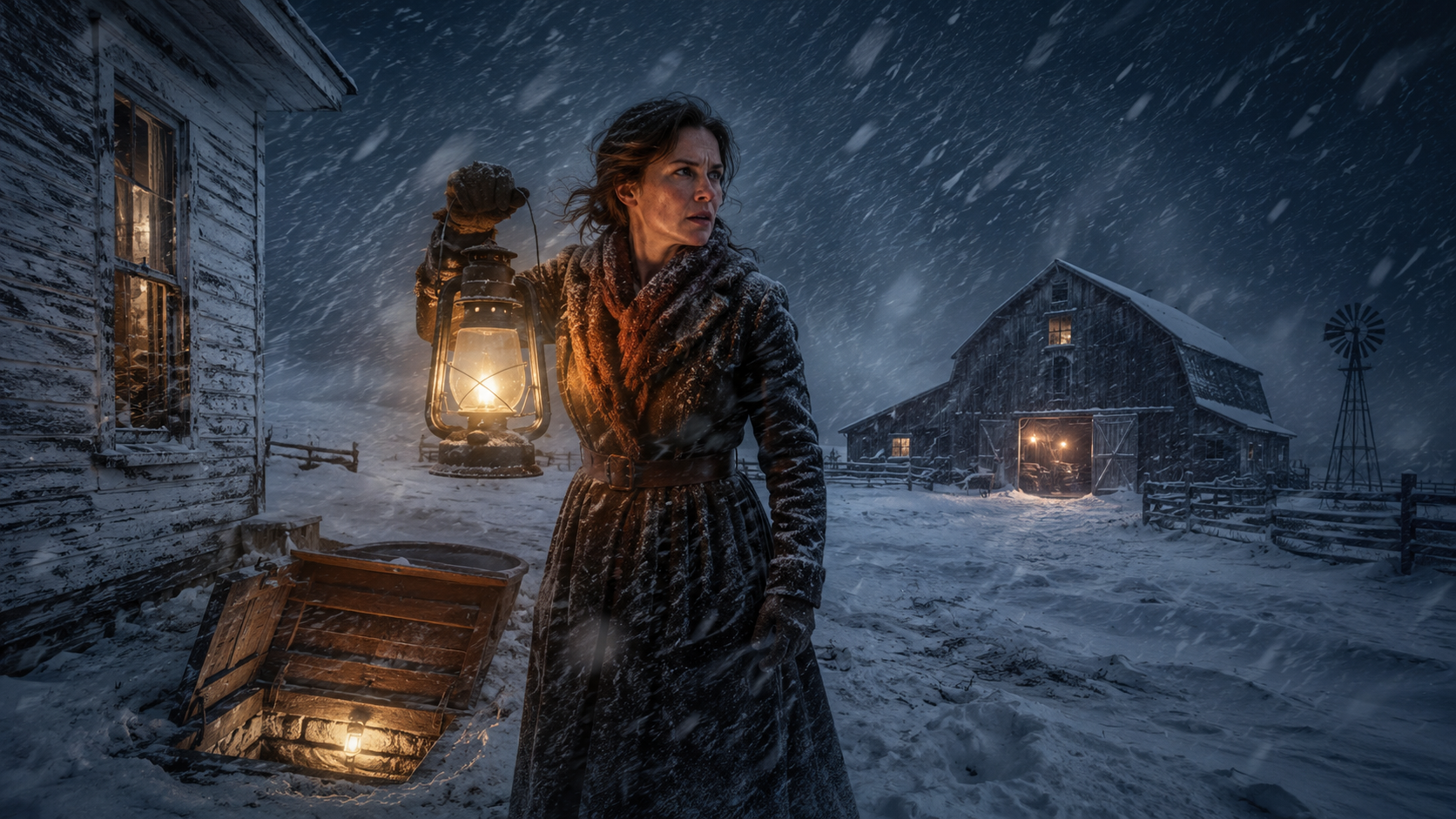
The storm began at sunset beneath a sky so clear Clara could see the first stars.
By eight, the wind had shifted.
By nine, the stovepipe groaned.
By ten, the world outside the windows was gone.
Snow did not fall. It attacked sideways. It rose from the ground in spinning sheets. It struck the house hard enough to make the walls creak. Clara opened the kitchen door one inch and saw nothing beyond her own hand.
Hester, who had stayed because her cough had worsened, sat upright on the cot.
“Close that door.”
“I have to check the barn.”
“You built a way.”
Clara shut the door and lifted the rug.
Warm air breathed up from the trapdoor.
Not warm like comfort.
Warm like life refusing to leave.
She took the lantern, a feed pail, and a short-handled axe, then descended.
The tunnel held.
Above her, the storm hammered the earth. Snow packed over the buried beams. Once, the roof gave a low wooden groan, and Clara froze in the passage, listening.
No crack.
No slide.
Only the sound of weight being carried.
“Hold,” she whispered.
The barn was chaos.
The horses stamped and blew steam into the dim light. Snow had forced itself through cracks in the boards. The mare stood in her stall with sweat darkening her neck, tail lifted, sides trembling.
“No,” Clara breathed. “Not tonight.”
But the foal had chosen its hour.
Clara worked by lantern while the blizzard tried to tear the barn apart.
She fed the other horses first because panic spread faster than fire. She checked the water, cleared ice from the buckets, and wedged the vent so air could move without letting the storm pour in. Then she rolled up her sleeves, knelt in straw, and helped the mare bring a new life into a night that seemed determined to take everything.
The foal came wrong at first.
One leg folded back.
Clara swallowed fear, reached carefully, found the small hoof, and eased it forward while the mare groaned and leaned against the stall wall.
“Come on,” Clara whispered. “You picked a hard night, little one. Now earn it.”
When the foal finally slid free, it lay silent.
Clara cleared its nose, rubbed its ribs with a feed sack, and bent close.
“Breathe.”
Nothing.
“Breathe, you stubborn scrap.”
The foal coughed.
The sound broke something open inside her.
By midnight, the foal was alive, the mare was standing, Hester’s cough had eased, and Clara had made three trips through the passage without once opening the house to the storm.
Then came the pounding.
Not from the barn.
From above.
Clara was halfway through the tunnel when she heard it: faint, frantic, irregular.
Someone was beating on the outside cellar hatch near the woodpile.
She ran back to the house, threw open the inner latch, and lifted the small emergency door.
A man fell through in a burst of snow.
Then another.
Then Owen Strake.
His face was gray. His eyebrows were iced white. Blood ran from a cut at his temple. Behind him, two of Sloane’s survey men crawled in shaking so hard they could not speak.
Clara stared.
Strake tried to stand and failed.
“Our truck went into the ditch,” he gasped. “We saw your vent pipe. We followed the fence by touch. Please.”
The word seemed to hurt him more than the cold.
Please.
Hester wrapped a blanket around one of the men and looked at Clara.
Clara could have said a dozen things.
She could have reminded Strake of the broken shovel in her yard. She could have asked whether horses ate tunnels. She could have told him to keep digging his own grave.
Instead, she stepped aside.
“Get in.”
They dragged the men down through the passage because the kitchen could not warm them fast enough. The barn held more heat. Animal bodies, hay, and earth had made a pocket of survival under the storm.
At the barn hatch, Eli Mercer appeared from the white darkness with a boy half-carried over his shoulder.
“Found him near the lower fence!” Eli shouted.
Clara helped pull them inside. The boy was no more than nineteen, one of Strake’s clerks. His hands were waxy with cold.
More pounding came.
Then voices.
All night, the tunnel became a throat between death and shelter.