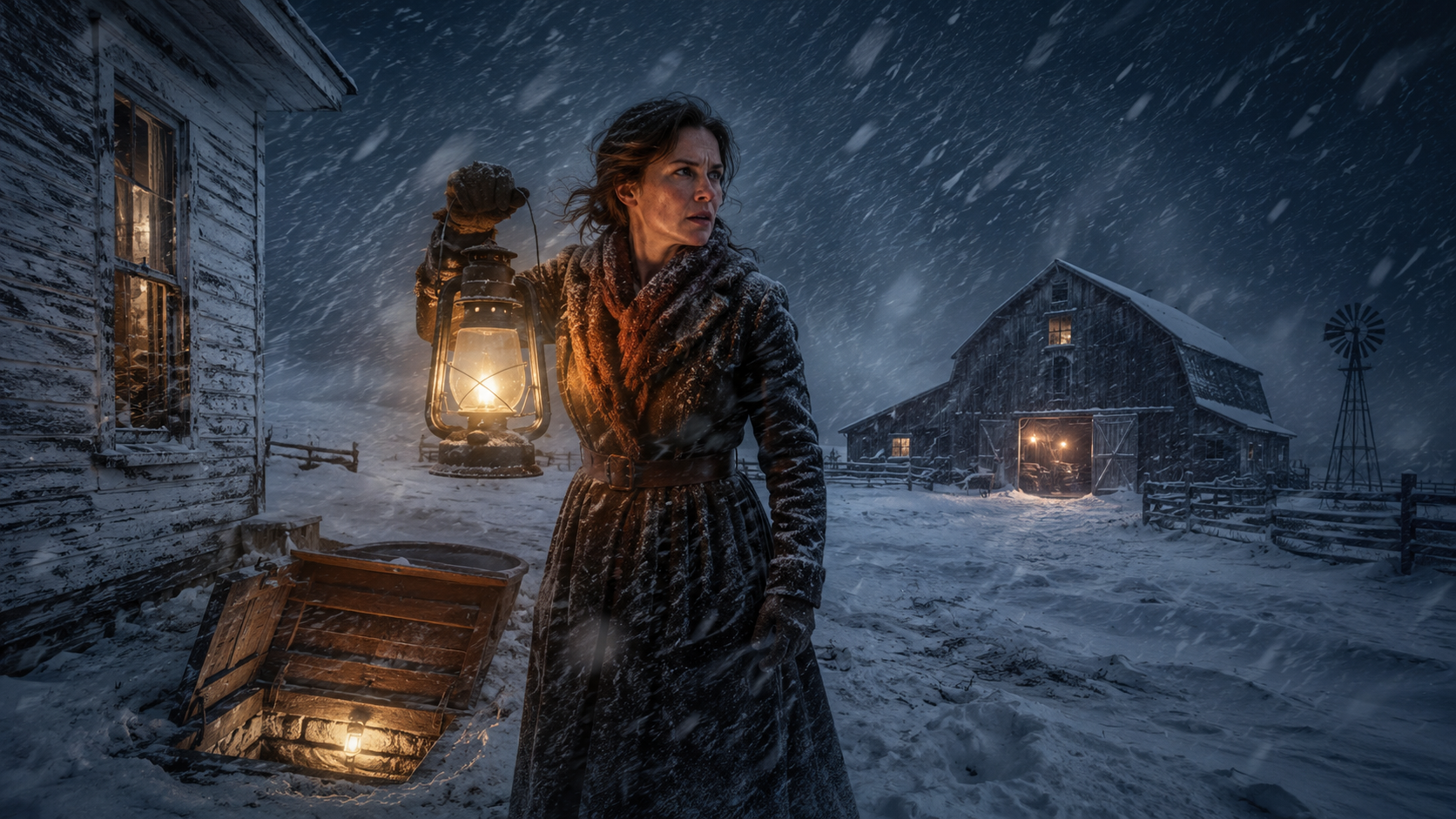
Clara moved people from the emergency hatch to the kitchen, from kitchen to barn, from barn to the warmest stalls. Eli brought in two ranch hands who had been trapped on the road. Hester heated water and cursed everyone back to consciousness. Strake sat wrapped in a horse blanket, watching Clara vanish into the passage again and again.
Near dawn, when the worst of the wind began to weaken, a final figure stumbled through the emergency hatch.
Victor Sloane himself.
The billionaire had come to the ridge to inspect the property line before the storm trapped his convoy. His expensive coat was torn. His polished boots were packed with snow. One of his men had tied a scarf around his arm to stop bleeding from a broken window.
He looked smaller without the distance money usually built around him.
Clara stood over the open hatch, lantern in hand.
For a moment, neither spoke.
Then Sloane looked past her into the passage, at the clay walls, the timber braces, the gravel floor, the warm breath rising from below.
“You built this?”
Clara’s face was streaked with mud, blood, soot, and birth straw.
“Yes.”
Sloane swallowed. “Mrs. Vale, we need shelter.”
Behind him, the storm still screamed.
Clara thought of Daniel. Of the debt papers. Of Strake laughing in town. Of survey flags planted like insults along her fence line. Of every man who had measured her land before measuring her will.
Then she thought of the foal breathing in the straw.
“Come down,” she said. “Carefully. The roof holds because it was built right.”
By morning, fourteen people, eight horses, one mare, one newborn foal, Hester Rowe, Eli Mercer, Owen Strake, and Victor Sloane were alive because Clara Vale had refused to be embarrassed out of saving herself.
The storm passed after thirty-six hours.
When the door finally opened, the yard had disappeared beneath sculpted drifts taller than a man. The road was gone. The fence line was gone. The broken shovel grave marker, buried somewhere under ten feet of snow, was gone too.
But the tunnel mouth opened clean.
The barn stood.
The house stood.
Clara stood between them with a lantern in one hand and mud on her boots.
Strake approached her near the woodpile. He had found his hat, though it had lost its shape.
“I owe you an apology,” he said.
“You owe me corrected ledgers.”
His mouth opened, then closed.
Hester snorted from the porch. “Start with the apology. It is smaller and you may be able to lift it.”
Strake lowered his eyes. “I was wrong.”
Clara waited.
“And cruel.”
She waited.
“And I shorted your account twice.”
“There it is,” Clara said.
Victor Sloane left two days later, after the road was cleared.
Before he went, he stood in Clara’s yard looking at the faint raised line where the underground passage ran beneath the snow.
“I could buy engineering like that,” he said.
“No,” Clara replied. “You could buy engineers. That isn’t the same thing.”
He studied her for a long moment.
Then he removed a folded paper from his coat.
It was not a contract.
It was a withdrawal notice.
His company would no longer pursue the ridge.
“You made this land inconvenient,” he said.
Clara took the paper. “Good.”
Sloane gave a tired smile. “You understand, Mrs. Vale, I have lost larger deals than this.”
“I understand that men like you call it losing only when money fails.”
“And what do you call it?”
She looked toward the barn. The foal was outside for the first time, wobbling beside its mother in the pale sun.
“I call it staying.”
By spring, people stopped calling it madness.
They called it the Winter Passage.
Neighbors came to see the drainage, the roof, the emergency hatch, the way warm air moved between house and barn. Some asked Clara to help design storm shelters. Some asked Hester. Hester told them she charged double for men who began sentences with, “I don’t mean to question you, but…”
Eli came often with stone, hinges, coffee, and no explanations.
One evening, after the thaw began, Clara found him at the barn hatch, looking down the passage.
“You still think winter doesn’t forgive clever?” she asked.
Eli glanced at her. “I think winter doesn’t forgive carelessness.”
“And clever?”
His mouth softened. “Clever, done properly, gets invited to supper.”
Clara smiled for the first time in what felt like years.
Below them, the tunnel waited in the earth, narrow and dark and strong.
It was not a miracle.
It was not luck.
It was a woman’s answer to every voice that had told her survival should look more respectable.
Aboveground, storms would come again. Men with money would come again. Doubt would come again, wearing different coats and speaking in different voices.
But beneath Clara Vale’s yard, there was now a way through.
And winter, which respected nothing easily, had respected that.