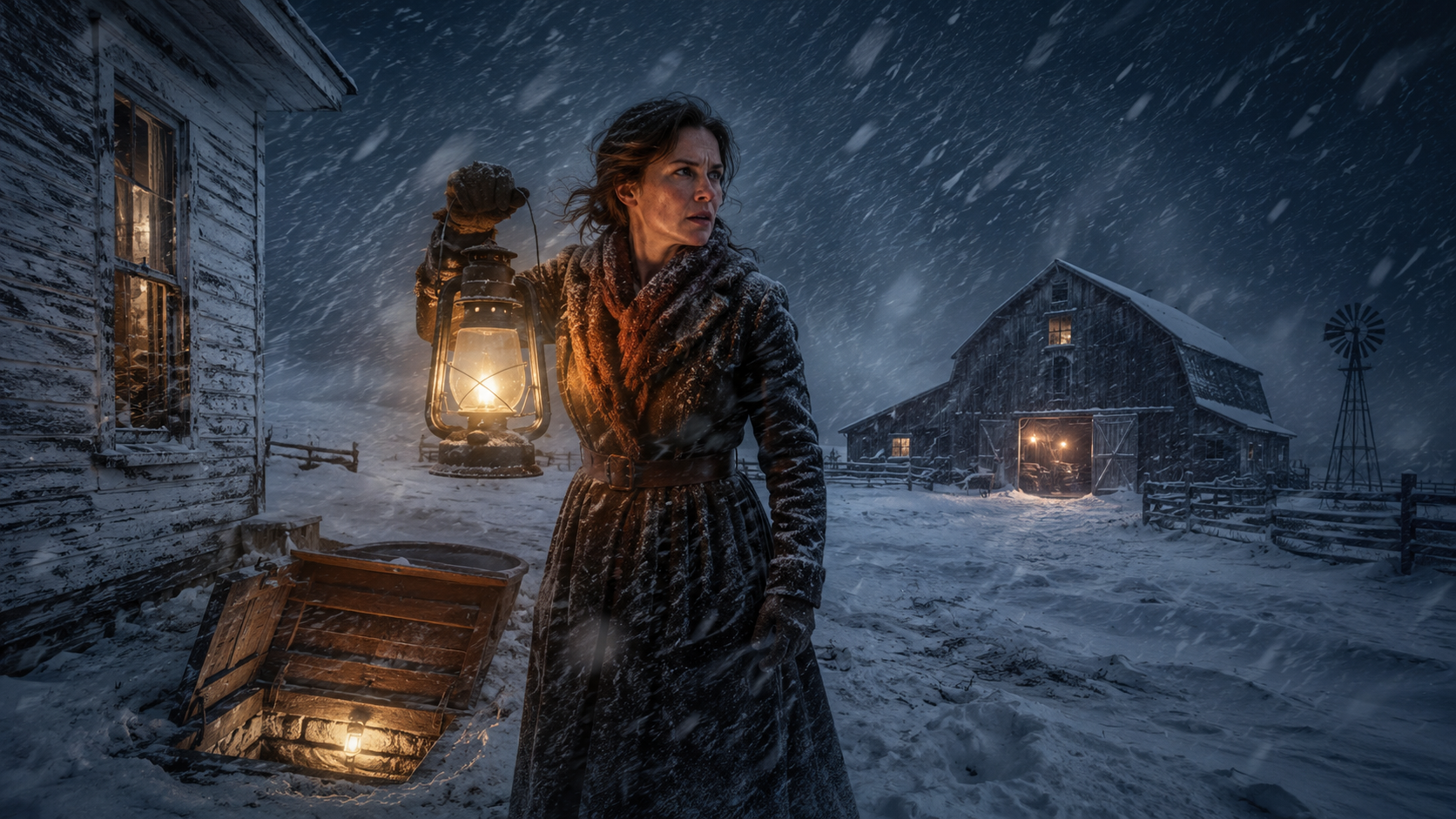
Clara placed coins on the counter. “Winter has never lied to me.”
“No,” Strake said. “It just buries people who think they’re smarter than it is.”
She picked up the bundle.
At the door, he called after her, loud enough for the stove men to hear.
“Keep digging, Clara. Maybe you’ll finish your own rich man’s grave before Christmas.”
The words followed her all the way home.
That evening, she drove the first shovel into frozen ground.
For the first week, the trench looked like a mistake.
For the second, it looked like a punishment.
The soil fought her in layers. The topsoil yielded easily, as if pretending to cooperate. Beneath it, the clay gripped the blade and sucked at her boots. Gravel tore her palms through her gloves. Roots snagged the shovel edge like old fingers refusing to let go.
Every night she dragged herself inside, washed mud from her wrists, wrapped new cloth over fresh blisters, and heated water for tea she was too tired to drink.
On the ninth day, a woman named Hester Rowe arrived at the edge of the trench.
Hester was seventy-two, narrow as a fence post, and tougher than the iron hinges on Clara’s barn. She had built storm cellars with her brothers in Nebraska before she was old enough to vote. Later, she delivered babies, set broken bones, and outlived two husbands who had both thought she was stubborn until they discovered she was simply correct.
She looked down at Clara’s work and said nothing for so long that Clara wanted to throw the shovel at her.
Finally, Hester said, “You’re making it too wide.”
“I need room to carry feed.”
“You need room to live. Those are not always the same thing.”
Clara wiped sweat from her forehead with the back of her wrist. “Are you here to stop me?”
“No.”
“To help me?”
“No.”
“Then why are you here?”
Hester climbed carefully into the trench, pressed her palm to the clay wall, and sniffed the damp earth like a cook judging bread dough.
“I’m here to keep you from building a coffin with a door at each end.”
After that, she came every afternoon.
She taught Clara to crown the roof so weight would slide instead of crush. She showed her how to cut small side drains, how to pack gravel under the walking path, how to leave the walls narrow enough to hold their own shape. She made Clara rebuild six feet of bracing because the posts were set too far apart.
Clara argued once.
Hester pointed to the wall and said, “The ground does not care about your schedule.”
So Clara rebuilt it.
People came to stare.
Some brought advice. Most brought ridicule.
Owen Strake’s boys rode by twice, laughing from the road. Someone left a broken shovel stuck upright in the yard like a grave marker. One morning Clara found a note nailed to the barn door.
SELL BEFORE THE SNOW SELLS YOU.
She burned it in the stove and used the ash to mark the next ten feet of tunnel.
By late November, the trench stretched from kitchen to barn like a scar across the yard. Clara worked by lantern before sunrise and after dark. Hester inspected the walls. A quiet neighbor named Eli Mercer brought a wagonload of flat stone and claimed it had been “in his way.”
Clara looked at the neat stack of stones. “Your creek bed was in your way?”
“Terrible inconvenience,” Eli said.
“You loaded all this by hand.”
“I was deeply annoyed.”
She almost smiled.
They worked side by side until the moon rose.
Eli was a widower with a careful voice and a habit of helping without asking permission. He had known Clara’s late husband, Daniel, though not well. After Daniel’s funeral, Eli had left a sack of potatoes, a jar of honey, and a coil of rope on Clara’s porch, then disappeared before she could thank him.
Now he tamped gravel into the tunnel floor while Clara set stone along the drainage channel.
“You still think this is foolish?” she asked.
Eli rested both hands on the shovel handle. “I think winter kills foolish people and proud people at about the same rate.”
“That isn’t an answer.”
“No,” he said. “It’s a warning.”
She looked at him sharply.
He met her eyes. “Finish it strong, Clara. Don’t finish it fast.”
The passage was completed four days before the first true blizzard.
It was not pretty.
It was narrow, low, damp, and smelled of clay, horse breath, cold stone, and smoke. The kitchen trapdoor sat beside the stove, hidden under a braided rug. A set of rough wooden steps led down to the passage floor. Overhead, cottonwood beams arched beneath packed earth. The barn hatch opened behind the tack room, where warm animal air gathered in the rafters.
Clara walked through it alone the first time.
Lantern in hand, shoulders brushing the walls, she moved beneath the frozen yard while the wind scraped over the roof of the world.
Halfway through, she stopped.
Above her was the place where she had once lost her way in the whiteout.
Below it, there was silence.
Not safety, exactly.