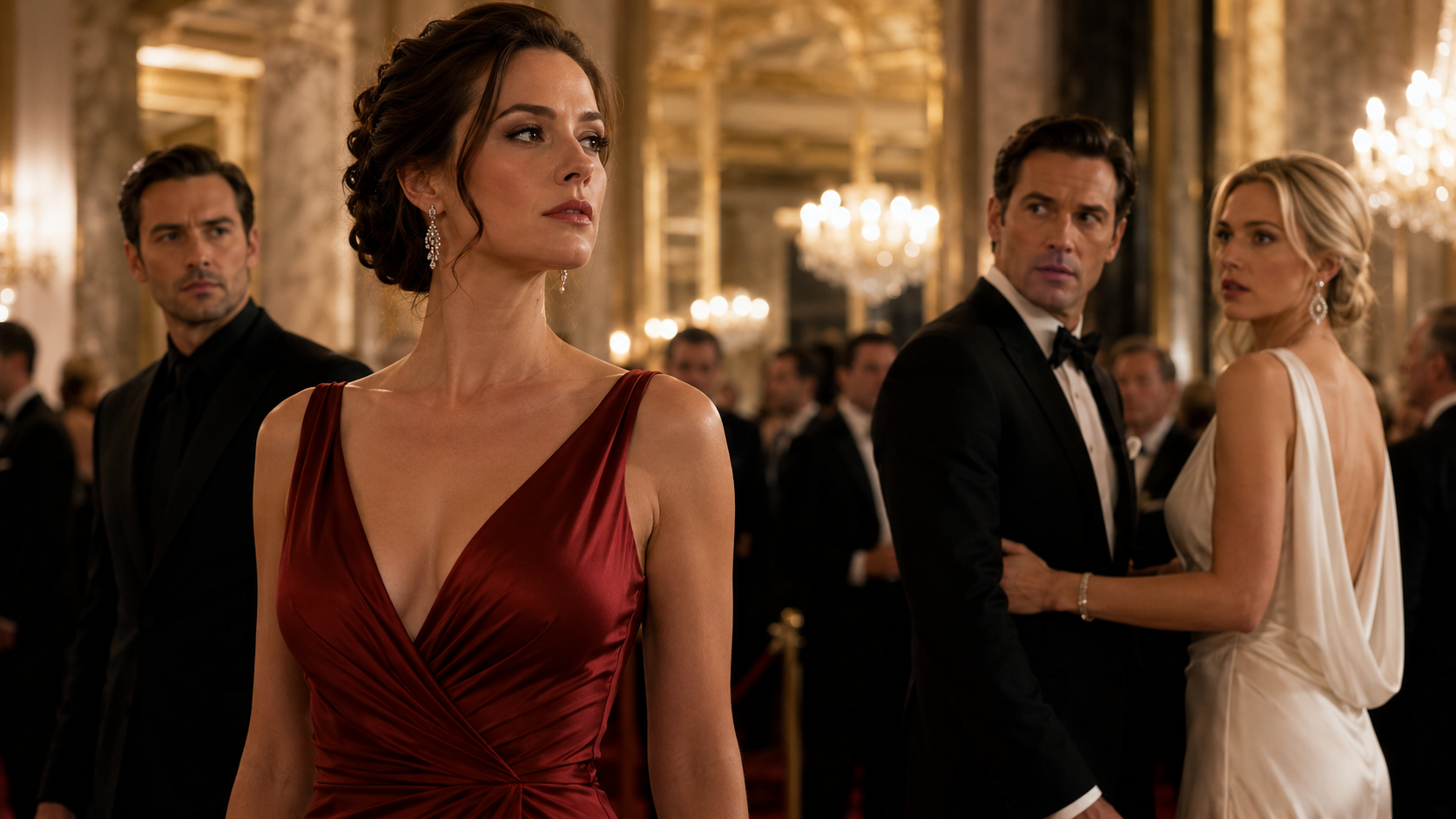
The Wife in the Red Dress

The first time Everett Langford told his wife not to wear red, he didn’t even bother to look ashamed.

He stood in front of the mirror in their bedroom, adjusting the cufflinks she had chosen for him, the silver ones shaped like tiny knots. Outside the windows, twilight had settled over the estate, turning the garden paths blue and the fountain into a sheet of glass. Downstairs, a car waited to take them to the annual Meridian House Ball, the most important charity event of the season.

Lena Langford held the red dress against her body and watched her husband’s reflection.

“Not that one,” Everett said.

His voice was calm, almost bored.

Lena looked down at the dress. It was deep red, not bright, not vulgar, not desperate. The fabric fell like poured wine, elegant and quiet until the light touched it. She had bought it two years ago and never worn it, because every time she reached for it, Everett found a reason to stop her.

“It’s a formal ball,” she said. “It seems appropriate.”

“It seems loud.”

She lifted her eyes. “A dress can be loud?”

“On the wrong woman, yes.”

The words landed softly because he had perfected that art. Everett never shouted when he wanted to wound her. He lowered his voice, as if cruelty became wisdom when delivered gently.

Lena folded the dress over her arm.

Everett turned then, finally looking at her. He was handsome in the way men become handsome when everyone around them has spent years agreeing not to notice their flaws. Tall, silver at the temples, expensive without appearing decorated. He had inherited enough old money to be forgiven for being arrogant, then made enough new money to be praised for it.

“Wear the pearl one,” he said. “The cream satin. People expect dignity from my wife.”

“My name is on the foundation invitation too.”

He smiled faintly. “Of course it is.”

Not yes.

Not you built it with me.

Of course it is.

As if her name were embroidery on a napkin. Decorative. Useful. Removable.

Lena said nothing. Thirteen years of marriage had taught her the cost of arguing before public events. Everett would sigh. He would call her emotional. He would say she was making the night difficult. Then, in the car, he would take her hand where the driver could see and perform tenderness like a habit.

She turned toward the wardrobe.

Behind her, Everett’s phone buzzed on the bed.

He didn’t notice. He was busy choosing a watch.

Lena did.

She had trained herself not to look at his phone. A good wife did not pry. A sensible wife did not create suspicion where there might be none. A graceful wife understood that powerful men had private matters.

Everett had told her all of those things over the years, never as rules, always as compliments.

You are not like other women, Lena. You trust me.

The phone lit again.

The message preview filled the screen.

I’m wearing white tonight, like you asked. She’ll look invisible beside me.

Lena stopped breathing.

The sender’s name was Bianca.

Bianca Vale.

Everett’s head of donor relations.

Bianca, who kissed Lena on both cheeks at lunches. Bianca, who called her darling. Bianca, who once stood in Lena’s kitchen and said, “You and Everett are proof that true partnership still exists.”

Another message arrived.

Suite 1407 after the ball. I miss the way you lie to her.

Lena placed one hand on the wardrobe door.

The room did not spin. That surprised her. She had imagined betrayal as noise, as broken glass, as screaming. Instead, it arrived like cold water poured slowly down the spine.

Everett crossed behind her.

“Are you still deciding?” he asked.

Lena closed the wardrobe.

“No,” she said. “I’ve decided.”

He glanced at the dress in her hands and frowned.

“Lena.”

She met his eyes in the mirror.

“I said I decided.”

Something in her tone made him pause. Not long enough to understand. Only long enough to be irritated.

“Fine,” he said. “But don’t blame me if people stare.”

For the first time that evening, Lena smiled.

“Maybe I won’t.”

He did not like that either.

The drive to Meridian House took thirty-four minutes. Lena counted them without meaning to.

Everett spoke on the phone twice. Once to his chief financial officer. Once to someone he called “a donor” but answered with his body turned slightly toward the window, his voice low and warm in a way Lena recognized now with brutal clarity.

She watched the city pass beyond the glass. The restaurants glowing gold. The women in coats laughing on sidewalks. The towers lifting their lit windows into the night. For years, she had mistaken the view from Everett’s world for safety. She had thought money meant shelter. She had thought being chosen by a man like him meant she had arrived somewhere permanent.

Now she understood she had been placed somewhere convenient.

The ball was already glittering when they arrived.

Meridian House had been built by a railroad family and restored by billionaires who liked their charity served under chandeliers. Marble stairs rose to an entry hall filled with white flowers. Violins played from a balcony. Waiters moved between guests with champagne, silent as ghosts.

Cameras flashed when Everett stepped from the car.

Lena stepped out after him.

The red dress caught the light.

For one second, every conversation near the entrance seemed to falter.

Everett leaned toward her, smiling for the cameras.

“Careful,” he whispered. “Red can make a woman look guilty.”

Lena turned her face slightly toward him.

“Then it suits the room.”

His smile froze.

Before he could answer, a man’s voice said from behind them, “That depends on who committed the crime.”

Lena looked over her shoulder.

A man stood at the foot of the stairs, one hand in the pocket of his black coat, the other holding a folded invitation. He was not as polished as Everett. His suit was expensive but worn as if he had forgotten it mattered. His dark hair was threaded with gray, and his eyes looked tired in the way honest men look tired when they have stopped sleeping for a reason.

Rowan Hale.

Lena recognized him immediately, though they had met only twice. He was Bianca Vale’s husband, a forensic accountant whose quiet reputation made louder men nervous. At every event, Bianca drifted away from him by the second glass of champagne, leaving him to make polite conversation near the edges of rooms.

Everett’s hand tightened at Lena’s lower back.

“Rowan,” he said. “Didn’t realize you were coming tonight.”

Rowan looked at Lena.

“You look very brave, Mrs. Langford.”

Everett laughed once. “It’s just a dress.”

“No,” Rowan said. “I don’t think it is.”

That was the first crack.

Small. Almost invisible.

But Lena heard it.

And across the entrance hall, Bianca Vale heard it too.

She stood beneath an arch of white roses, dressed exactly as her message had promised: white silk, diamonds, soft curls, the expression of a woman used to being admired from every angle. When she saw Lena in red, her mouth parted. When she saw Rowan standing beside her, her eyes changed.

Not jealousy.

Fear.

Everett felt it too. Lena knew because his hand dropped away from her back.

“Shall we go inside?” she asked.

Her voice was steady.

Everett stared at her.

Rowan offered his arm.

Lena took it.

That was when the room truly began to whisper.

Not because a married woman was entering a ball on another man’s arm. Rich people tolerated almost anything if it was done beautifully.

They whispered because Lena Langford had never done anything unexpected in public.

For thirteen years, she had stood beside Everett like a candle protected by glass. She remembered names. She remembered wives’ allergies. She sent flowers after surgeries and handwritten notes after funerals. She wore cream, navy, gray, champagne. She laughed at the correct volume. She sat at Everett’s left hand and made donors feel seen while never demanding to be seen herself.

Tonight, she walked into the ballroom in red.

And she did not look at him for permission.

The ballroom was enormous, flooded with gold light. Beneath the chandeliers, men who controlled banks embraced men who controlled newspapers. Women in gowns leaned close and exchanged information disguised as compliments. At the far end of the room, a stage waited with a podium bearing the Langford Foundation crest.

Lena looked at it and felt the old nausea rise.

The foundation had been her father’s dream before his stroke took his speech and then his life. He had believed money should move toward people who had been denied choices: women leaving dangerous homes, students aging out of foster care, families drowning in medical bills. When he died, Everett helped Lena “professionalize” the foundation.

That was the word he used.

Professionalize.

He moved the accounts to his firm’s preferred advisors. He hired consultants. He gave her documents to sign while praising her generosity. He told her the legal details were too tedious for her to carry alone.

“You should focus on the mission,” he would say. “Let me handle the machinery.”

She had believed him.

Until three nights ago.

Three nights ago, after seeing Bianca’s messages, Lena had done something she had never done in her marriage.

She called the other betrayed spouse.

Not immediately. First, she spent two hours on the bathroom floor, scrolling through Bianca Vale’s public life. Photos at galas. Photos at fundraisers. Photos beside Everett, always laughing, always near enough to look accidental. Photos with Rowan, too, though in those she seemed arranged rather than alive.

Lena found Rowan’s accounting firm. Then his office number. Then his email.

She wrote one sentence, deleted it, wrote another, deleted that too.

At dawn, she sent:

My name is Lena Langford. I think your wife and my husband have been lying to us. I have proof. I am sorry.

Rowan replied seven minutes later.

I know. But I don’t think you know all of it.

They met that afternoon in a bakery twenty miles outside the city, the kind of place where no one recognized rich people because no one expected them to eat soup under fluorescent lights.

Rowan arrived carrying two folders.

That was the first sign that the affair was not the deepest betrayal.

He did not ask to see Lena’s proof first. He did not deny anything. He sat across from her, opened the first folder, and turned a photograph toward her.

Everett and Bianca leaving a private hotel entrance.

Lena’s hand had gone still on her coffee cup.

“That was my anniversary,” she said.

Rowan closed his eyes for a moment.

“She told me she was visiting her sister.”

Then he opened the second folder.

“This,” he said, “is why I was afraid to contact you.”

Inside were invoices. Transfers. Vendor approvals. Consulting contracts. Copies of emails. A map of money moving from the Langford Foundation through a company called Vellum Advisory Group and then into private entities connected to Bianca’s brother.

Lena had stared at the pages.

“That’s not possible,” she whispered. “The foundation is audited.”

“It is,” Rowan said. “By people your husband recommended.”

“My signature is on these.”

“Yes.”

“I don’t remember signing them.”

His expression was gentle and terrible.

“Do you remember signing anything when he was in a hurry?”

She had wanted to say no.

But memory opened like a drawer spilling knives.

Everett placing papers beside her plate before dinner.

Just one signature, darling.

Everett handing her a folder while she planned seating charts.

It’s routine.

Everett kissing her temple while she held a pen.

You’re saving us both from a meeting.

The truth did not arrive as one blow. It came as a thousand small scenes rearranging themselves into evidence.

Rowan had not touched her hand. She was grateful. Sympathy would have broken her.

Instead, he said, “I think they used your trust as a system.”

Your trust as a system.

That sentence stayed with her.

Over the next three days, Lena and Rowan built a map. He brought bank records he had legal access to through his marriage. She brought foundation documents. Together they found repeated payments disguised as strategic outreach, donor hospitality, brand development, confidential consulting. They found luxury travel coded as site visits. Jewelry hidden under event expenses. Hotel suites billed through shell vendors. They found emails Bianca had sent from an account Everett thought no one would trace.

And they found something worse.

If the scheme collapsed, Lena was positioned to take the blame.

Her name. Her signatures. Her foundation. Her inheritance. Her public reputation for gentle distraction.

Everett had not only cheated.

He had prepared to sacrifice her.

On the fourth night, after Everett fell asleep, Lena stood in her dressing room and looked at the gowns he had approved for years.

Cream. Silver. Pale blue. Soft gold. Champagne.

Beautiful colors for disappearing.

Then she took the red dress from the back of the closet and texted Rowan.

I’m wearing it tomorrow.

His reply came after one minute.

Then we end it tomorrow.

Now, under the chandeliers of Meridian House, tomorrow had become tonight.

Everett moved through the ballroom with the stiff grace of a man trying to regain control without appearing to reach for it. Bianca stood near the donor wall, pretending to laugh at something an elderly senator had said. Rowan kept his hand lightly under Lena’s fingers, not possessive, not romantic, only steady.

That steadiness mattered.

Lena did not feel brave.

She felt hollow.

People stopped them every few steps.

“Lena, that dress.”

“How daring.”

“How unexpected.”

“Where is Everett?”

She smiled.

“Nearby.”

It was not a lie.

Predators were always nearby when the trap began to move.

At nine o’clock, the music softened. Guests turned toward the stage. Everett walked to the podium, smiling again, his public face restored. Behind him, the foundation crest glowed against a wall of white roses.

Lena stood near the front with Rowan.

Bianca stood three rows behind them.

Everett looked at his wife only once before beginning.

“Ladies and gentlemen,” he said, “welcome to the Meridian House Ball. Tonight we gather not simply to celebrate philanthropy, but to honor the values that guide every meaningful legacy: trust, stewardship, and integrity.”

Rowan exhaled softly.

Lena almost laughed.

Everett continued, smooth as polished stone.

“My wife, Lena, has always believed that generosity is not a gesture, but a duty. The Langford Foundation exists because of her heart.”

Applause rose.

Lena felt it move through the room like weather.

For years, that applause had warmed her. Tonight, it burned.

Everett turned slightly toward her and extended one hand.

“Lena, darling, come join me.”

There it was.

The old command wrapped as affection.

Every eye turned.

Lena walked to the stage.

Her heels made a clean, sharp sound against the steps.

Everett leaned toward her as she reached the podium.

“Smile,” he whispered.

She looked at him.

“No.”

For one second, his face emptied.

Then she took the microphone from his hand.

The room shifted.

Lena had hosted events, chaired committees, thanked donors. But she had never interrupted Everett. Never taken his microphone. Never stood between him and an audience that belonged to him.

“Thank you for coming tonight,” she said.

Her voice trembled on the first word.

Only the first.

“This foundation was created in my father’s memory. He taught me that money is not virtue. Money only reveals what a person chooses when no one can force them to be decent.”

A murmur moved through the guests.

Everett smiled tightly and reached for the microphone.

Lena turned her shoulder just enough to stop him.

“I spent years believing that trust meant not asking questions,” she continued. “I believed love meant letting someone else handle the parts of my life I found difficult. I believed loyalty meant silence.”

Her eyes found Bianca.

Bianca’s champagne glass had stopped halfway to her lips.

“I was wrong.”

Everett spoke softly through his smile. “Lena, this is not the time.”

She turned toward him.

“It is the first time.”

The room went very still.

At the side of the stage, the foundation’s outside counsel, Marion Ellis, stepped forward. She was a severe woman in a black suit, older than Everett, and famously allergic to embarrassment. Lena had sent her copies that afternoon.

Marion’s face told Lena enough.

She had read them.

Everett noticed her movement and frowned.

“Marion?” he said.

Marion did not look at him. She looked at Lena.

“Mrs. Langford,” she said, “do you wish to enter the records now?”

Everett’s expression changed.

Only for a second.

But the room saw it.

Lena reached into the small red clutch Hannah, her oldest friend, had once given her as a joke.

For when you finally decide to be dangerous.

Inside was a sealed drive.

She held it up.

“These files have already been delivered to counsel, external auditors, and investigators. They include bank transfers, vendor invoices, hotel records, emails, internal approvals, and correspondence showing that funds from the Langford Foundation were redirected through shell vendors for personal use.”

The silence became physical.

Everett laughed.

It was the wrong laugh.

Too sharp. Too late.

“My wife has clearly misunderstood routine administrative—”

“No,” Rowan said from the front row.

He stood.

Every head turned toward him.

Everett’s jaw tightened. “Rowan, I strongly suggest you sit down.”

Rowan stepped into the aisle.

“I reviewed the flow of funds. Some of the entities involved connect to my wife’s family. Some connect to your private accounts. Some connect to advisors you placed around the foundation. I have given my analysis to the proper parties.”

Bianca whispered, “Rowan.”

He did not look at her.

Everett’s eyes went cold.

“You are making a very serious accusation.”

“No,” Rowan said. “I am confirming a very serious pattern.”

That was when Bianca began to cry.

Not beautifully.

Not softly.

Fear made her face unfamiliar.

“Everett,” she said, “you said this couldn’t reach me.”

The entire room inhaled.

Lena looked at her husband.

Everett stared at Bianca with naked fury.

“Be quiet,” he said.

Bianca shook her head, panic rising. “You said Lena never read anything. You said she signed whatever you gave her.”

A woman near the stage gasped.

Someone dropped a glass.

Lena’s hand tightened around the microphone.

There were humiliations one could imagine surviving. An affair. Gossip. A mistress in white silk. But hearing your own ignorance described as part of a plan was different. It did not break the heart.

It removed the floor.

Everett lunged one step toward Bianca.

Security moved faster.

Marion Ellis raised one hand.

“Mr. Langford,” she said, “do not approach anyone.”

He turned on her. “This is my event.”

“No,” Lena said.

Her voice cut through the room.

Everett looked back at her.

Lena stepped closer to the edge of the stage.

“This is the night your audience became witnesses.”

His face went pale.

“You don’t know what you’re doing.”

“I know exactly what I’m doing now. That is what frightens you.”

Bianca sobbed harder. “He told me if auditors asked questions, the approvals were under Lena’s name. He said everyone believed she was sentimental and careless and easy to confuse.”

Lena closed her eyes once.

When she opened them, she was no longer shaking.

For years, Everett had called her gentle, soft, sheltered, trusting. She understood now that each word had been a room he wanted to lock her inside.

She turned to the guests.

“I was not careless,” she said. “I was trained to think questions were a form of betrayal. There is a difference.”

The room remained silent.

Not the silence of boredom.

The silence of recalculation.

Investors were thinking about risk. Board members were thinking about liability. Lawyers were thinking about exposure. Wives were thinking about signatures they had never read.

Everett tried one last time.

“Lena,” he said, softening his voice into the private tone that had once undone her. “Please. You’re hurt. You’re angry. Let’s go home and talk.”

Home.

The word almost worked.

For thirteen years, home had been the place where she translated loneliness into duty. She hosted dinners. She folded napkins. She remembered Everett’s medications after late nights. She kept flowers fresh in rooms no one used. She turned his moods into weather reports and dressed accordingly.

But home was not where a woman was kept useful.

Home was where she was safe to know the truth.

She removed her wedding ring.

The room watched her do it.

Everett’s eyes dropped to her hand.

“Don’t,” he whispered.

Lena placed the ring on the podium.

“It belonged to your family,” she said. “So did the silence. You can have both back.”

Someone in the crowd covered a sob.

Rowan looked down, giving her the dignity of not being watched too closely.

Everett stared at the ring like it had betrayed him.

“You’ll regret this,” he said.

“No,” Lena answered. “I regret the years I called endurance love.”

Marion Ellis stepped toward the security team.

“Escort Mr. Langford from the stage. His access to all foundation systems is suspended pending investigation.”

Everett’s head snapped toward her.

“You can’t do that.”

“I already did.”

Two security guards approached.

For one awful moment, Everett looked at the guests as if searching for the old world, the one where men like him were always believed first. But that world had stepped backward from him.

No one moved to help.

No one spoke.

Bianca sank into a chair, crying into both hands, diamonds trembling at her throat.

Everett was escorted down the stage steps.

As he passed Lena, he stopped.

His voice dropped so low only she could hear.

“You were nothing before me.”

Lena looked at him.

“No,” she said. “I was quiet before you. That was never the same thing.”

Then he was gone.

The scandal broke before dawn.

By breakfast, the story had become a thousand versions of itself. The wife in red. The billionaire exposed at his own ball. The mistress who confessed under chandeliers. The foundation fraud. The marriage that collapsed on stage.

Lena did not watch the clips.

She turned off her phone before the sun rose.

Public applause could not make private grief tidy. Strangers calling her fearless did not stop her hands from shaking when investigators asked about documents she had signed. Headlines praising her strength did not erase the sick feeling of realizing her name had been used like a weapon.

Three days later, she sat across from her attorney, Maren Wexler, a compact woman with silver hair and a voice that could make panic stand in line.

Maren reviewed the documents for nearly an hour before speaking.

“Your husband did not simply misuse charitable funds,” she said.

Lena swallowed. “What did he do?”

“He built a structure in which you appeared responsible for decisions you were deliberately prevented from understanding.”

Lena looked down at her hands.

“I signed them.”

“Yes.”

“I should have read them.”

“Yes.”

The bluntness hurt.

Then Maren leaned forward.

“But he made sure reading felt like distrust. That is not an accident. That is a method.”

Lena closed her eyes.

A method.

Not a misunderstanding. Not a failure of communication. Not a marriage that had drifted.

A method.

Maren continued, “From this point forward, you sign nothing without me. You communicate with Everett only through counsel. You preserve every email, every calendar entry, every text, every photograph of every document in that house. You do not let guilt make you useful to him again.”

Useful.

There was the word again.

Over the next months, Lena’s life became a schedule of consequences.

Investigators. Auditors. Attorneys. Forensic accountants. Divorce filings. Statements. Corrections to statements. Meetings where strangers dissected her marriage with spreadsheets and asked whether she remembered signing something on a Tuesday three years earlier.

Sometimes she remembered.

Sometimes she didn’t.

The not remembering hurt worst.

Rowan faced his own collapse. Bianca accused him publicly of revenge, then privately asked him not to “destroy everything.” He answered through lawyers. Unlike Lena, Rowan had always kept copies. Receipts. Calendar exports. Bank statements. Insurance records. He had the habits of a man who trusted paper more than charm.

They met every few weeks at first.

Never at night.

Never in expensive restaurants.

They chose ordinary places: a coffee shop with bad chairs, a park bench near the river, a bookstore café where no one cared who they had been married to.

People expected them to become lovers quickly. Scandal loved a neat replacement. Betrayal loved a romantic ending.

Lena and Rowan refused to cooperate.

One afternoon, three months after the ball, they sat on opposite sides of a scratched wooden table while rain striped the windows.

“I’m afraid people think you saved me,” Lena said.

Rowan stirred his coffee. “Did I?”

“No.”

“Good.”

She looked up, surprised.

He smiled faintly. “I was hoping you’d say that.”

For the first time in weeks, Lena laughed.

It sounded rusty.

Rowan’s expression softened.

“I don’t want to be the man who carried you out of Everett’s fire,” he said. “That sounds noble until you realize it still makes your life about a man.”

Lena looked out at the rain.

“What are we, then?”

“Two people learning not to confuse rescue with love.”

She remembered that sentence later.

Many times.

The Langford estate became unbearable.

Every room was arranged around the woman she had been trained to perform. The dining room seated thirty. The kitchen had three ovens and a flower refrigerator. The guest suites were stocked with monogrammed towels. The dressing room held gowns Everett liked because they made her expensive but indistinct.

One Saturday, Lena opened her wardrobe and began pulling them down.

Cream satin.

Ivory lace.

Pale gold chiffon.

Silver silk.

She folded them into donation boxes.

Her friend Mira arrived carrying soup, wine, and rage.

Mira had been Lena’s college roommate before marriage slowly turned their friendship into holiday cards and annual lunches Everett always interrupted with phone calls. When Lena finally called her after the ball, apologizing for disappearing into her marriage, Mira said only, “Send the address. I’m coming.”

Now Mira stood in the dressing room, watching Lena pack the approved gowns.

“Good,” she said.

“You don’t know what I’m donating.”

“I know exactly what you’re donating. Costumes.”

Lena laughed, then cried so suddenly that Mira crossed the room and wrapped both arms around her.

“I was so stupid,” Lena whispered.

“No.”

“I let him use me.”

“No.”

“I signed—”

“You trusted your husband,” Mira said. “He used the sacred part. That is his shame.”

Lena pressed her face into Mira’s shoulder and let herself fall apart.

Later, Mira found the red dress hanging alone on the wardrobe door.

“You’re keeping this.”

“I don’t know where I’d wear it.”

“Wear it to buy milk. Wear it to a bank meeting. Wear it to make mediocre men nervous. That dress has done public service.”

Lena smiled.

Not happiness yet.

But something small and bright enough to survive the room.

Spring came slowly.

Everett was removed from all foundation authority. His company issued a statement about internal review, ethical breaches, and cooperation with investigators. Bianca was terminated from the donor relations office. Her brother’s consulting company dissolved so quickly that investigators became even more interested in it.

Everett tried to reach Lena through apologies first.

Then outrage.

Then memories.

He sent a photo from their first apartment: the two of them sitting on the floor, eating takeout from paper cartons, young and laughing.

We were real once, he wrote.

Lena stared at the photo for a long time.

She did not deny it.

That was the hardest part.

If everything had been false, she could have hated him cleanly. But there had been mornings when he made terrible coffee and kissed her shoulder. There had been jokes only they understood. There had been road trips, small apartments, winter walks, plans they made before money hardened into power.

Some true things had existed.

And he had hidden lies behind them.

Finally, she replied:

I was real. You were rehearsing.

He did not send another memory.

During the divorce, Everett’s lawyers tried to suggest that Lena had knowingly approved the questionable transactions. Maren responded with recordings, emails, witness statements, Bianca’s panicked confession, Rowan’s analysis, and one message Everett had sent to Bianca months earlier:

Lena signs when I ask. That’s why this works.

The accusation disappeared.

But the sentence did not.

Lena printed it and kept it in a folder. Not because she wanted to suffer. Because some days grief tried to rewrite history, and she needed proof.

She began studying finance at night.

At first, she hated every page. Balance sheets looked like punishment. Tax filings looked like another language. Trust documents made her furious. But slowly, the fog lifted. She learned how accounts moved. How shell companies hid ownership. How donor-restricted funds should be tracked. How signatures could be weaponized when a person was taught not to understand what she signed.

The first time she found an error before her accountant did, she cried.

Not because of the money.

Because knowledge felt like a door opening in a room where she had once been told to wait.

Rowan helped only when asked.

That mattered.

He would sit across from her with a laptop and explain a term, then stop when she said, “I want to try.” He never took the pen from her hand. He never called confusion cute. He never made competence feel unfeminine.

One evening, after she traced a transfer through four entities and found where Everett had hidden a payment, Rowan looked at her with quiet pride.

Lena felt warmth rise in her face.

Then she avoided him for seventeen days.

When they finally met again, she sat down across from him and said, “I disappeared.”

“I noticed.”

“You didn’t ask why.”

“I thought you would tell me when you were ready.”

She stirred her tea.

“I was afraid.”

“Of me?”

“Of needing you.”

Rowan nodded.

“I’m afraid of that too.”

She looked at him.

He continued, “I don’t want us to build something out of wreckage before either of us knows what we look like outside the smoke.”

Lena breathed out.

That was when she began to trust him differently.

Not because he reached for her.

Because he didn’t.

By autumn, the investigations had changed shape. Everett avoided prison through cooperation, repayment, and settlements, but he lost his leadership roles, most of his social standing, and the effortless protection of people who once found him useful. Bianca left the city, gave one disastrous interview about “being manipulated by power,” and discovered that public sympathy had limits when screenshots existed.

Lena did not celebrate.

People expected her to.

Mira suggested a party. Maren suggested not doing anything that could appear vindictive in court. Rowan brought flowers and said, “You don’t have to call this justice if it doesn’t feel like justice.”

It did not.

It felt like standing after an earthquake, alive but unable to admire the wreckage because some of it had once been home.

In winter, Lena sold the estate.

On the last morning, she walked through every empty room.

The dining room echoed.

The bedroom looked smaller without furniture.

In the kitchen, she stood where Everett had once placed papers beside cutting boards and wine glasses and half-made salads. She remembered his voice.

Just sign here.

It’s routine.

You trust me, don’t you?

She expected anger.

Instead, she whispered, “I forgive the woman who believed him.”

The words surprised her.

Then they steadied her.

Because that was the forgiveness she had needed most.

Not for Everett.

For herself.

She bought a smaller house on a tree-lined street with uneven floors, old windows, a garden that needed work, and a kitchen where people naturally gathered. There was no ballroom, no wine cellar, no formal dining room designed to impress men who mistook wealth for character.

Mira walked in carrying boxes and announced, “This house looks like it knows how to keep secrets but chooses not to.”

Lena smiled.

“Perfect.”

Rowan came later with his dog, a gray-muzzled retriever named August, who immediately claimed Lena’s rug and acted as if he had survived the divorce too.

“He’s manipulative,” Lena said.

Rowan nodded. “Deeply. But unlike most executives, he is transparent about his motives.”

Their friendship grew slowly, which made it stronger.

It became less about evidence and more about ordinary life.

They talked about books, bad movies, childhood fears, food they hated, music they pretended not to love. Rowan admitted he had always wanted to learn the piano but hated being bad at things. Lena admitted she used to paint before marriage made every hobby feel selfish unless it served a party.

For her first birthday after the divorce, Mira hosted dinner in Lena’s kitchen. Maren came with a cake shaped like a legal file because apparently even terrifying attorneys had jokes. Rowan brought August, who stole bread and became the evening’s most forgiven criminal.

Lena wore the red dress.

Not because of Everett.

Not because of the video.

Not because strangers had turned it into a symbol.

She wore it because she liked herself in it.

When she came downstairs, Rowan looked at her for a long moment.

She braced herself for beautiful.

Men had called her beautiful before when they meant decorative.

Rowan smiled and said, “You look present.”

Lena blinked.

Then she smiled back.

“That might be the best compliment I’ve ever received.”

The next year, Lena began working with Maren on workshops for women who needed to understand money before life punished them for not knowing. At first, it was informal: ten women in a library room, then twenty, then fifty. The emails came after that.

My husband says I don’t need access to the accounts.

My name is on documents I’ve never read.

He says asking questions means I don’t trust him.

Am I being dramatic?

Lena answered as many as she could.

You are not dramatic for wanting to understand your own life.

The workshops became an organization.

Mira wanted to call it Red Dress Reckoning.

Maren threatened legal action against the name.

Rowan suggested The Red Door Initiative.

“Why red door?” Lena asked.

“Because you’re not teaching women to burn everything down,” he said. “You’re teaching them to find the exit, the lock, and the key.”

Lena loved it.

The Red Door Initiative offered financial education, legal referrals, divorce preparation resources, workshops on hidden assets, credit reports, charitable structures, business entities, estate documents, coercive control, and the quiet ways money could be used to keep someone obedient without ever raising a hand.

Lena did not tell every woman to leave.

She taught them how to see.

That mattered more.

One evening after a workshop, a woman stayed behind. She twisted her wedding ring until the skin beneath it turned red.

“My husband says privacy is normal,” the woman whispered. “He says only jealous women ask for passwords.”

Lena remembered Everett’s phone lighting up on the bed.

She remembered how trust had been turned into blindness.

She handed the woman a tissue.

“Privacy and secrecy are not the same thing,” Lena said. “And love that requires your ignorance is not love. It is control wearing good manners.”

The woman cried.

Lena stayed with her until the building staff began turning off the lights.

When she got home, Rowan was in the kitchen making tea. August slept under the table, twitching in some heroic dream.

“How was it?” Rowan asked.

“Hard,” Lena said. “Useful. No — important.”

“That sounds like you.”

She looked at him across the kitchen.

He had become familiar without becoming demanding. Present without taking ownership. Kind without keeping score.

“I like coming home to a life where my strength is not treated as a threat,” she said.

Rowan’s face softened.

For a moment, neither of them moved.

Then August snored so loudly the silence broke, and they both laughed.

Love arrived like that.

Not as rescue.

Not as revenge.

Not as a replacement for what had been stolen.

As laughter in a kitchen after a hard day.

Two years after the ball, Rowan told Lena he loved her while fixing the crooked latch on her garden gate.

It was not cinematic. His sleeves were rolled up. There was dirt on his knee. August was barking at a squirrel with no strategy whatsoever.

Rowan tightened a screw, looked at Lena, and said, “I love the life we are making.”

Lena stood there holding a packet of basil seeds.

No music swelled.

No chandelier glittered.

No champagne glass shattered.

Her eyes filled anyway.

“I love it too,” she said.

They did not marry right away.

People asked, of course.

Mira asked shamelessly.

Maren asked whether drafting a prenup would calm everyone down.

Rowan’s mother asked sweetly and brought pie, which was emotional manipulation of the highest order.

Lena always smiled and said, “We are happy.”

Rowan always said, “Lena gets to decide what promises feel safe.”

That answer made her love him more.

Five years after the Meridian House Ball, Lena returned to the same ballroom.

This time, she had rented it.

The Red Door Initiative was hosting its first national conference for women rebuilding after betrayal, financial abuse, divorce, coercion, and the slow erosion of being told they were lucky while they were being used.

The chandeliers were the same.

The marble stairs were the same.

Even the stage was the same.

But the banners had changed.

No Langford Foundation crest.

No portrait of Everett smiling like integrity was one of his assets.

No men giving speeches about stewardship while hiding theft under polished shoes.

Instead, there were tables for attorneys, forensic accountants, therapists, career coaches, housing advocates, and women who arrived nervous, angry, ashamed, hopeful, polished, messy, newly divorced, secretly planning, or simply tired of not knowing what they were allowed to ask.

Backstage, Lena stood in the red dress.

It had been altered over the years. Her body had changed. Her life had changed. The dress had changed with her.

Rowan stood nearby holding two bottles of water.

“You all right?” he asked.

Lena looked toward the stage.

“The last time I stood out there, I thought I was exposing my husband.”

“You did expose him.”

She shook her head slowly.

“No. I exposed the life I had mistaken for love.”

Rowan handed her the water.

“That’s a better opening than anything I was going to suggest.”

“You were not scheduled to speak.”

“Exactly. My best speeches are imaginary.”

She laughed.

Then her name was announced.

The applause began before she stepped onto the stage.

Lena walked into the light.

For a second, she saw the old room layered over the new one: Everett’s pale rage, Bianca’s shattered composure, Rowan standing in the aisle, her own hand trembling around the microphone. She did not hate the woman she had been that night.

She loved her.

She wanted to reach back through time and tell her that shaking was not weakness. Sometimes the body trembled because courage was arriving and needed space.

Lena took the microphone.

“When I first stood in this ballroom,” she began, “I thought the worst thing that had happened to me was betrayal.”

The room quieted.

“I was wrong. The worst thing was how long I had been trained to distrust my own discomfort. The affair hurt. The money hurt. The humiliation hurt. But what nearly destroyed me was realizing I had spent years confusing usefulness with love.”

Women throughout the room nodded.

“A useful woman remembers everyone’s needs. A loved woman is allowed to have needs. A useful woman keeps peace. A free woman knows that false peace is just silence with better manners. A useful woman signs what she is handed. A free woman reads.”

Applause rose.

Lena lifted one hand gently.

“I am not here to sell revenge. Revenge is too small for what was taken. I am not here to tell you to hate the person who lied to you. Hate may light the match, but it cannot build a home. I am here to tell you that your life is not over because someone hid a lie inside it.”

In the back of the room, Rowan stood beside Mira and Maren. August, wearing a red bow tie against several building policies, slept beneath a table.

Lena smiled when she saw them.

Then she looked back at the crowd.

“The red dress did not save me. The viral video did not save me. The man who walked beside me did not save me. What saved me was deciding that being called dramatic was less frightening than being erased.”

This time, the applause came like thunder.

Women stood.

Some cried.

Some laughed through tears.

Some held hands.

Lena waited until the room settled.

“Tonight,” she said, “we talk about bank accounts. Passwords. Credit reports. Retirement funds. Business entities. Emergency plans. Therapy. Friendship. Rest. And the sacred act of no longer apologizing for wanting to understand your own life.”

By the end of the night, the ballroom no longer felt like the place where Lena had been humiliated.

It felt reclaimed.

After the conference ended, she stood alone near the stage while staff cleared tables. The chandeliers reflected in the polished floor. The old ghosts were still there, but they were quieter now.

Rowan approached with two glasses of water.

“Still avoiding hotel champagne?” he asked.

“Forever.”

“I remembered.”

“You remember suspiciously well.”

“I’m a forensic accountant. Suspicion is part of my charm.”

Across the room, Mira shouted, “Romantic moment later! August is eating someone’s centerpiece!”

Rowan sighed. “Our son lacks refinement.”

“He’s a dog.”

“He contains multitudes.”

Lena laughed loudly, freely, without checking who heard.

Years later, people still told the story of Lena Langford and the red dress.

Some told it as revenge.

Some told it as scandal.

Some told it as the night a powerful husband and his mistress lost everything beneath a chandelier.

But Lena no longer thought of it that way.

To her, the real story was not that Everett was exposed.

It was that she finally saw herself.

Her dress had never been too red.

Her voice had never been too loud.

Her questions had never been too dangerous.

Her love had never been too much.

She had simply given all of it to a man who wanted her dimmed, useful, and easy to blame.

And when Lena stepped into the light at last, the truth did not destroy her.

It only destroyed the lies that had been standing in her place.