Abel turned sharply.
“Wet?”
Gideon said nothing.
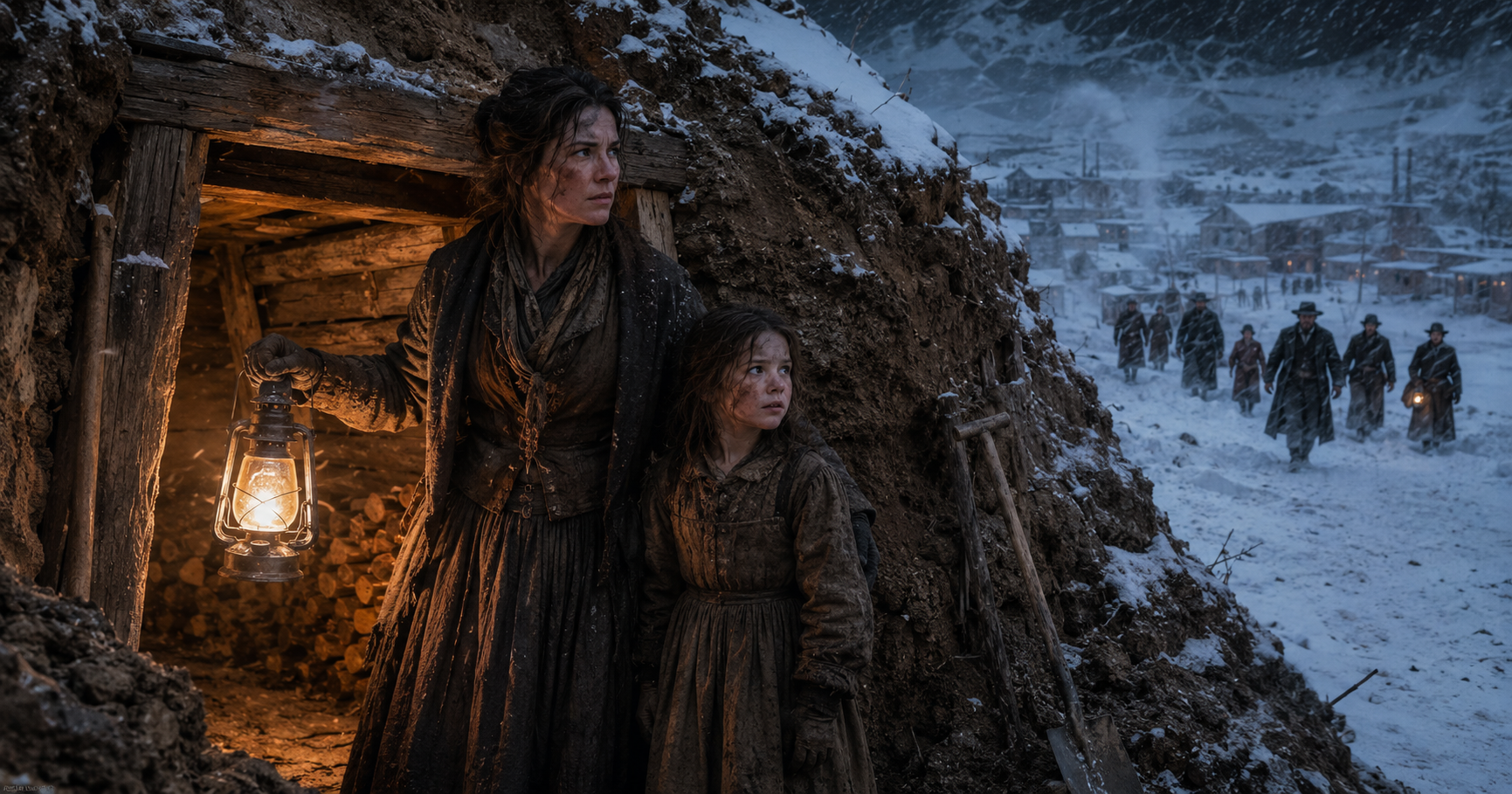
Mara stepped closer, lantern light cutting hard across her cheekbones.
“My dry wood goes first to homes with children, the elderly, and the sick. Your teams will haul it. Your men will bring your wet wood here and split it smaller. Abel will help stack it properly. When the roads open, you will replace every cord you sold falsely.”
Gideon stared at her.
“You’re giving orders on my property now?”
“No,” Mara said. “I am giving the price of shelter in mine.”
The tunnel went still.
Gideon’s pride twitched like a wounded animal.
“That wood is mine to sell.”
“Then carry your son back into the storm and sell it to the snow.”
No one breathed.
Eli coughed weakly.
That tiny sound did what argument could not.
Gideon lowered his head.
“All right.”
Mara did not soften.
“And when daylight comes, you will tell them the truth.”
“What truth?”
“That the wood was wet. That you knew it. That you sold fear because fear fills a purse.”
His jaw clenched.
“Careful, Mara.”
“No,” she said. “I was careful in September. I was careful in October. I was careful while you laughed. Tonight I am finished being careful.”
Abel Rowan stepped beside her.
“She’s right.”
Gideon looked at him.
Abel’s voice was rough with shame.
“And I was wrong. I told her wood could not season in darkness. I told her sun mattered more than air. I said it kindly, which only made my ignorance sound respectable.”
He lifted the split pine.
“This is better wood than half of what my mill has sold.”
The admission moved through the tunnel like another current.
Reverend Hale bowed his head.
“Then we learn.”
For three days, the Whitlock place became the heart of Cold Hollow.
Gideon’s teams hauled dry wood to families whose stoves had died. Abel showed men how to split wet cordwood smaller and stack it with space enough for air. Mara directed the tunnel, the cabin, the stove, the sick, the frightened, and the ashamed.
Lottie became fiercer than any foreman.
“Not tight!” she snapped at a ranch hand twice her size. “Air needs a road!”
The man looked to Mara for rescue.
Mara only said, “You heard my daughter.”
By the fourth day, the storm broke.
Sun came weak over a white world that looked remade by punishment.
Eli Pike lived.
Two of his toes did not recover, but his hands did. Mrs. Branson’s cough eased. Old Mr. Fenn survived the night everyone expected him not to. Children slept in the tunnel wrapped in quilts, breathing pine-scented air while the wind screamed itself empty above them.
On the fifth morning, Gideon came to Mara’s kitchen.
His son lay asleep near the stove. Lottie sat at the table, mending one of Eli’s torn gloves with stern concentration.
Gideon removed his hat.
“I owe you.”
Mara poured coffee into one cup.
Hers.
“You owe several people.”
“I’ll make it right.”
“Yes,” she said. “You will.”
He reached into his coat and placed a folded paper on the table.
“Edward had an unpaid freight note.”
Mara did not touch it.
“No, he didn’t.”
Gideon froze.
Lottie looked up.
Mara crossed to the shelf, opened Edward’s Bible, and removed the oilskin packet. She laid the signed receipt beside Gideon’s paper.
“Paid in full. Witnessed by Abel Rowan and Reverend Hale.”
Gideon’s face drained.
For a moment, the only sound in the cabin was the steady draw of the stove.
Lottie stared at the receipt.
Then at Gideon.
“You lied about my father.”
Gideon swallowed.
“Accounts get tangled.”
Mara’s voice was calm, and that made it colder than shouting.
“Snow gets tangled. Rope gets tangled. Accounts do not sign themselves twice.”
His gaze flicked toward Eli.
Mara saw it.
She hated him for using the boy even silently. She also understood that a child should not wake to his father ruined in front of him.
“You will write a statement today,” she said. “In front of Abel, Reverend Hale, and Cale Branson. You will state that Edward Whitlock’s account was paid in full and that you hold no claim against this land.”
Gideon breathed hard.
“And after that, your teams haul community wood without charge until thaw.”
His eyes flashed.
“Without charge?”
“You prefer I take both papers to the marshal when the road opens?”
He looked at the receipt.
Then at the stove.
Then at his sleeping son.
“I’ll sign.”
Mara pushed paper and ink toward him.
“No,” she said. “You’ll write it in your own hand. Men remember truth better when their fingers have to shape it.”
And he did.
That afternoon, Gideon Pike wrote the truth at Mara Whitlock’s kitchen table while Abel Rowan witnessed it, Reverend Hale stood with his Bible under one arm, and Mrs. Branson watched from the corner with the hard-eyed satisfaction of a woman who had chosen the winning side too late but intended to stand there firmly now.
When Gideon finished, Mara read every line.