Then she handed it to Lottie.
“You read it too.”
Lottie read slowly.
By the end, her chin had lifted.
The land was theirs.
Not because the town approved.
Not because Gideon allowed it.
Because Edward had paid.
Because Mara had kept proof.
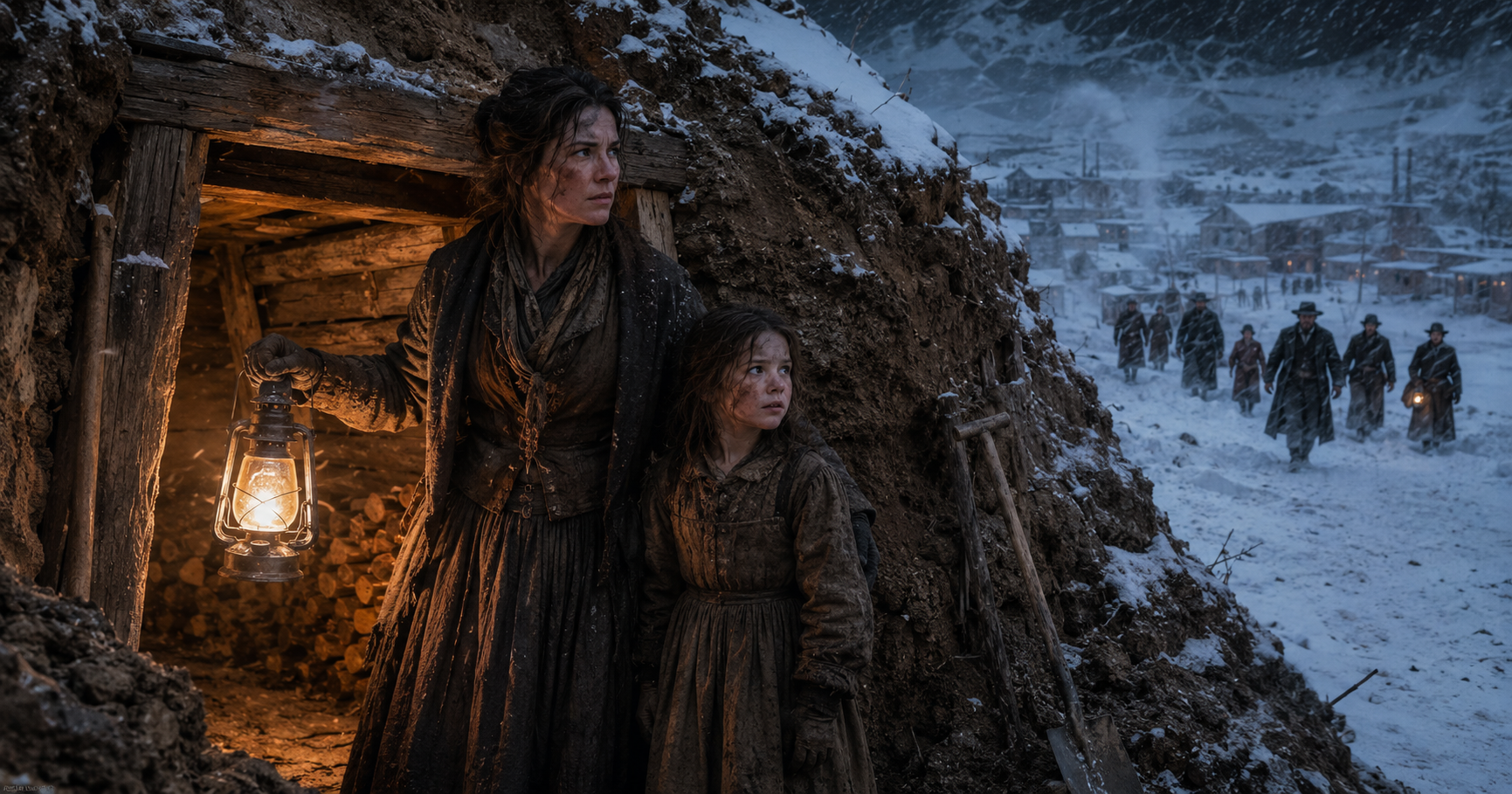
Because a tunnel mocked as a grave had become the one place in Cold Hollow where breath, truth, and fire still moved.
The killing winter did not end quickly.
Hard winters never do. They retreat by inches, loosening their grip in daylight and tightening it again after dusk. They leave behind dead cattle, cracked hands, empty barns, and people who no longer speak lightly about preparation.
But Cold Hollow survived better than it should have.
Mara’s tunnel did not save everyone by itself. No one woman’s work could undo a season of arrogance. But it bought time. It gave dry fire to cold rooms. It taught desperate hands how to stack wet wood so air could do what pride had not. Abel rebuilt part of his mill shed into a drying house with vents along both walls. Reverend Hale organized cutting crews. Mrs. Branson, having learned that a sharp tongue did not warm a bed, spent the rest of winter delivering soup and apologies in equal measure.
Gideon’s teams hauled until March.
Some said he did it because Mara kept his signed confession in her Bible.
Some said he did it because Eli, who walked with a slight limp after that winter, refused to let his father speak one cruel word about the woman who had saved him.
Both were probably true.
When spring finally came, it came quietly.
Snow shrank from fence posts. Water ran beneath the crust. The hill above the Whitlock cabin darkened first at the tunnel mouth, where warm breath had passed all winter.
One afternoon, Abel Rowan arrived carrying a notebook.
Mara found him standing outside the tunnel, hat in hand.
“I came to ask,” he said.
“That is new.”
He nodded. “Earned.”
Lottie, who had grown taller over the winter or perhaps only straighter, leaned on a shovel nearby and smiled without mercy.
Abel opened the notebook.
“I want to build one behind the mill. Properly. I need the measurements. The slope. The vent angle. How wide the center path should be. How long the first stacks took. Everything.”
Mara studied him.
“For profit?”
“For use first,” he said. “Then profit, maybe. But if I sell tunnel-dried wood, it will be tunnel-dried wood. Not hope wrapped in a tarp.”
Mara looked past him toward Cold Hollow. Chimneys smoked across the valley, thin and steady. People who had mocked her now stacked wood with gaps between the rows. Men who once laughed at her tunnel now argued about vent placement. Women who had pitied her now brought questions, not sympathy.
“My father used to say knowledge kept too tightly grows mold,” Mara said.
Abel waited.
She took the notebook from him.
“Write this down.”
By the next September, three more drying tunnels had been dug in Cold Hollow.
Abel’s was the largest, framed with mill scraps and fitted with two vents. The Bransons built one behind the store and allowed families to season wood there before winter. Reverend Hale organized a shared tunnel near the church for those who had no land suitable for digging.
Gideon Pike built none.
But his teams hauled for those who did.
As for Lottie, she changed most of all.
Before the tunnel, she had been a grieving girl standing beside a grieving mother, trying not to collapse under the weight of other people’s pity. After the winter, she became someone who knew what her hands could make. She knew the sound of dry pine. She knew the patience of moving air. She knew adults could be loud and wrong, and that being right did not require shouting.
One evening in October, Mara found her at the tunnel mouth, tapping two split pieces together.
“Checking the rows?” Mara asked.
Lottie nodded. “This side needs four more days.”
Mara lifted one of the pieces, weighed it, pressed the end grain, and struck it once.
A dull note answered.
She smiled.
“Four days.”
Lottie’s face brightened, not with surprise, but with the calm satisfaction of knowledge confirmed.
Together, they looked into the tunnel.
It was full again. Ordered. Breathing.
Not a grave.
Not madness.
Not a widow’s refusal to accept the world.
A method.
A promise.
A future cut by hand into the side of a hill.