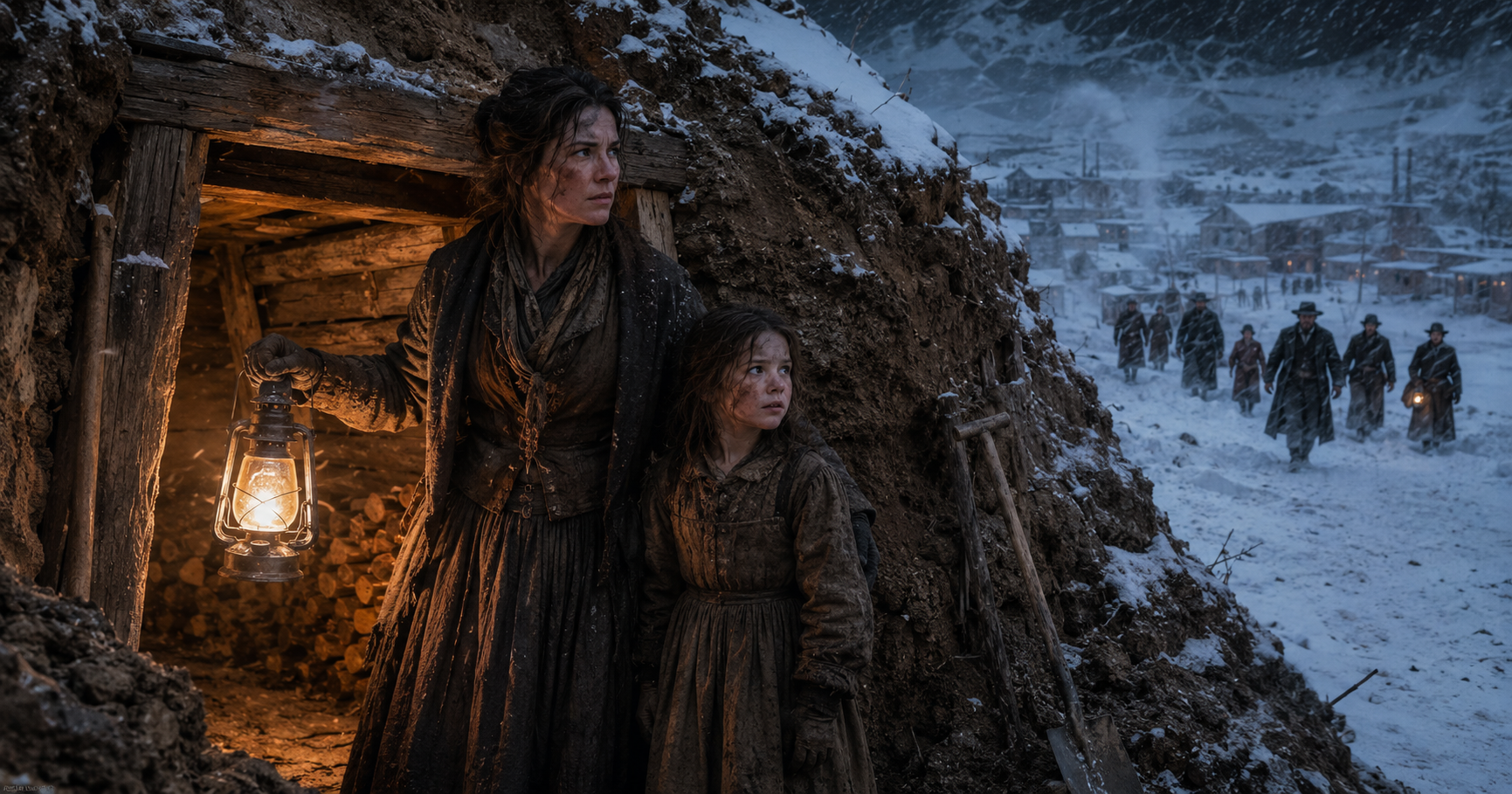
Mara lifted a piece of wet pine. It was heavy, sappy, useless for a clean fire.
“Some people ask because they want to learn,” she said. “Some ask because they want a better way to laugh. Know the difference before you spend your breath.”
Lottie stood silent.
Mara handed her the green split.
“Feel this.”
Lottie took it.
“Now take that one.”
She pointed to a piece of dead pine that had been standing dry on the upper slope for two seasons. Lottie lifted it easily.
“This one’s lighter.”
“Why?”
“Less water.”
“And when it burns?”
“It burns hotter.”
“Why?”
“Because the fire isn’t wasting itself boiling water out first.”
Mara nodded toward the dark mouth of the tunnel.
“That is all we’re doing. Taking the water out before the cold comes.”
Lottie looked at the hillside again. For the first time, her expression changed from doubt to calculation.
“And if it works?”
Mara picked up the axe.
“Then we live.”
The tunnel was finished on the twenty-sixth day.
It ran deep enough that the light at the mouth thinned to blue and then to gray. Mara and Lottie dug the rear vent shaft by hand, lying flat in dirt, scraping upward through clay and gravel until at last Lottie’s trowel broke through into daylight.
She screamed so loudly Mara thought the shaft had collapsed.
“I see sky!”
Mara stumbled up the slope, breathless, and found Lottie’s muddy fingers poking through a little hole in the earth like roots reaching for air.
They widened the opening and tested it with smoke from dried grass.
The smoke bent inward at the tunnel mouth. It slid through the dark passage, thin and obedient, then rose from the vent in a pale ribbon.
Lottie laughed.
“It’s breathing!”
Mara stood below, her face lifted to the hillside, feeling the draft move past her skirt.
“Yes,” she whispered. “Now let’s feed it.”
They filled the tunnel with wood in careful rows.
Not packed tight. Mara would not allow it. Every stack had space behind it. Every row had gaps. Every split piece faced the draft. The driest deadfall went deepest. The greener wood stayed nearer the mouth where it could begin its slow surrender.
Lottie tried to fill every empty place.
“Space looks like waste,” she muttered.
“Space is the part that does the work,” Mara said.
That became the rule of the tunnel.
Space for air.
Space for patience.
Space for being right before anyone believed it.
In October, Abel Rowan came.
He owned the sawmill three miles east of town and had spent thirty years turning trees into boards. He was not cruel, but he had the solemn certainty of a man used to being consulted. He stood at the tunnel mouth with his hat in his hands, peering into the dark.
“Mara,” he said carefully, “wood kept underground can rot.”
“It can.”
“It can mold.”
“It can.”
“It can sour until it smokes black and coats your chimney like tar.”
“It can.”
He turned to her. “Then why are you doing this?”
“Because none of those things happen when the air moves right.”
Abel looked tired. “You’re betting your winter on a draft.”
“I’m betting it on work I understand.”
He glanced at Lottie, who stood inside the tunnel with clay on her cheek and defiance in her eyes.
“I could sell you seasoned slab wood at a fair price,” he said. “Enough to get through the worst months.”
Mara heard kindness in his voice. That made the refusal harder.
“I thank you,” she said. “But I have my own.”
“You have an experiment.”
“I have my father’s method.”
“Your father wasn’t from here.”
“No. But fire is fire everywhere.”
Abel sighed. “I hope you’re right.”
“So do I.”
He left unconvinced.
Gideon Pike came at dusk.
Gideon did not own the town, but he had spent twenty years persuading people that he did. He owned freight wagons, cattle, three rental houses, and enough unpaid notes to make half of Cold Hollow careful in his presence. Since Edward’s death, he had made four offers for the Whitlock land. Mara had refused all four.
The fifth offer arrived without paper.
Gideon sat on his horse by the fence, looking toward the tunnel with open amusement.
“I hear you’ve dug yourself a miracle.”
Mara kept stacking wood.
“I didn’t dig it for you.”
“No. You dug it because grief makes women stubborn.”
Lottie stiffened.
Mara did not look up. “Leave my daughter out of your mouth.”
Gideon smiled. “I’m only saying what others are thinking. A woman alone on land this hard ought to accept help when it’s offered.”
“I have help.”
He looked at Lottie and laughed softly.
“You have a child.”
The axe in Mara’s hand stopped midair.
Lottie went pale.
Gideon leaned forward on the saddle horn. “There’s a difference between courage and foolishness, Mrs. Whitlock. Winter will teach it better than I can.”
“Then let winter teach.”
His smile thinned.
“You know, Edward carried debt.”
Mara turned then.
“What debt?”