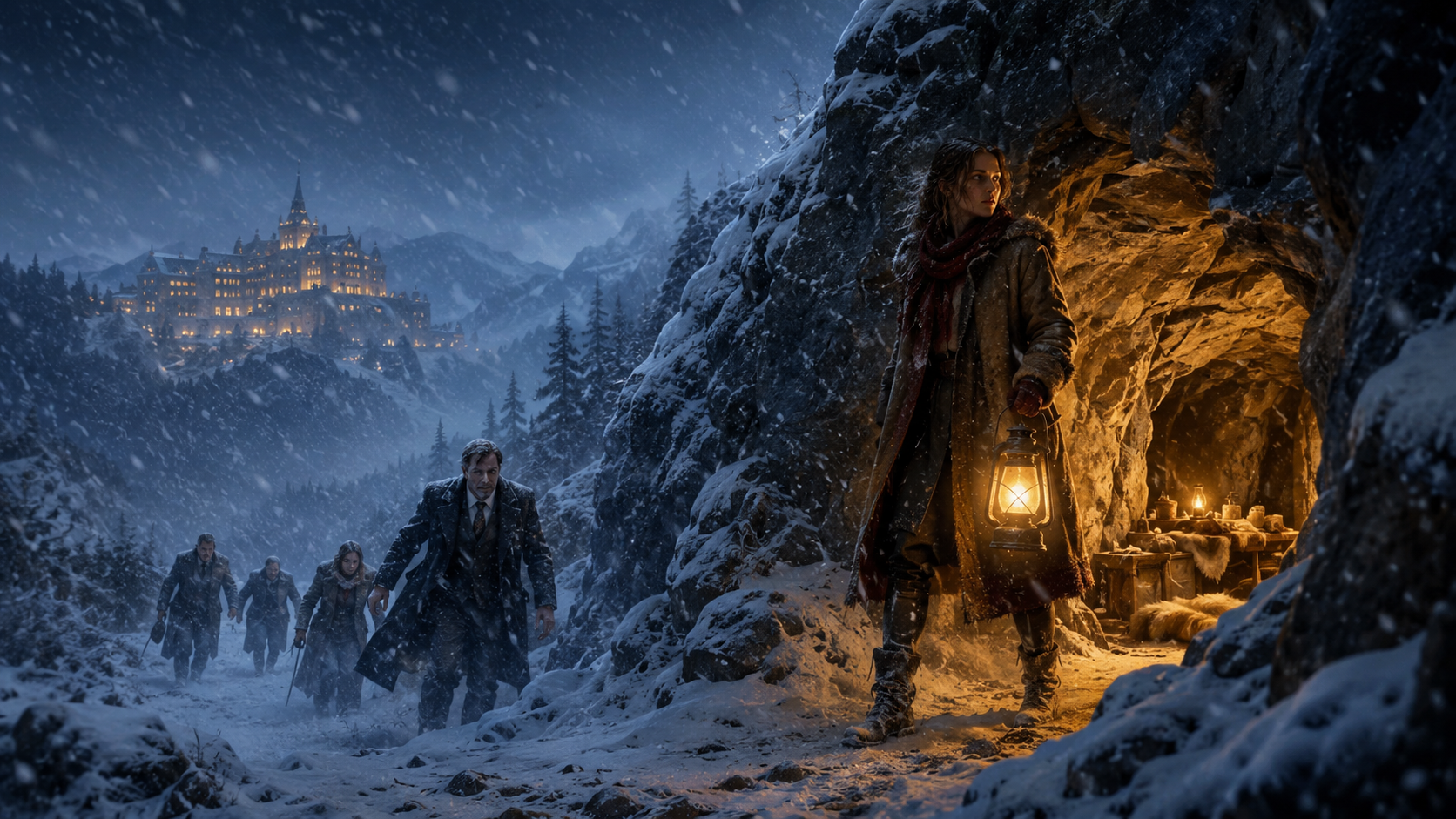
When Adrian Vale told Mara Ellis she would freeze before Thanksgiving, he said it with the calm certainty of a man who had never once been cold without knowing a thermostat was within reach.
He stood beneath the arched stone entrance of Grayhaven Lodge, wrapped in a black cashmere coat, one gloved hand resting on the brass head of his walking cane. Behind him, through the tall windows, chandeliers burned like captured suns. A fire roared in the great hall, servants moved silently between polished tables, and somewhere inside, a pianist was playing a soft piece meant to make rich people feel tragic.
Mara stood on the gravel drive with one suitcase, one torn wool coat, and the kind of silence that forms when a person has been humiliated too many times to waste breath defending herself.
Snow had not fallen yet, but the mountains were already warning everyone. The air smelled metallic. Frost clung to the iron gates. Clouds lowered over the pine forest like a ceiling about to collapse.
“You cannot stay here,” Adrian said.
His voice was smooth. Educated. Practiced. A voice that made cruelty sound like administration.
Mara looked past him toward the lodge, toward the place where she had cooked breakfasts before dawn, mended curtains after midnight, and memorized every creak of the old house because she had once believed loyalty might become safety.
“I worked here for nine years,” she said.
“And you were paid for nine years.”
“My mother died here.”
“She was employed here too.”
That struck harder than the cold.
Mara’s mother had spent half her life keeping the Vale estate alive. She had known which pipes froze first, which guest rooms collected damp, which roads became deathtraps after the first real storm. She had also known, better than anyone, what kind of man Adrian Vale had become after inheriting his father’s fortune: elegant, powerful, and empty in the places where warmth should have been.
Mara lifted her chin. “The storm season is coming early.”
Adrian smiled, barely. “Then you should have planned better.”
A few people watched from inside. Not openly, of course. Grayhaven had rules about dignity, and dignity meant never staring too long at another person’s ruin. But Mara saw their pale faces between the curtains: Mrs. Bell, the housekeeper; Dorian, Adrian’s cousin; two investors from the city who had arrived that morning to discuss turning part of the mountain land into private luxury cabins.
Adrian took one step closer.
“You’ve become inconvenient,” he said quietly. “You ask questions. You refuse instructions. You keep bringing up old promises my father supposedly made to your mother.”
“He did make them.”
“My father was sentimental when drunk. That is not a legal contract.”
“He said we would always have a place here.”
“And yet here you are,” Adrian said, looking around the drive as if the evidence pleased him. “Without one.”
For a moment, something hot rose behind Mara’s eyes. Not tears. She had already spent those. This was sharper. Cleaner.
“Winter humbles everyone in these mountains,” she said.
Adrian’s expression hardened.
“Do not threaten me.”
“I’m not.”
“Good. Because no one survives up here without my roads, my fuel, my generators, my storage barns, or my permission.” He leaned in, his breath faintly visible. “You’ll come crawling back by the first hard frost. By Thanksgiving, if you haven’t frozen, you’ll be begging.”
Mara picked up her suitcase.
“No,” she said. “By Thanksgiving, you’ll remember what my mother taught me.”
Then she turned and walked toward the service road, leaving Grayhaven’s golden windows behind her.
No one followed.
That was their first mistake.
The second was assuming Mara had nowhere to go.
The third was forgetting that servants hear everything.
For years, Mara had listened while wealthy men spoke freely around her because they saw her as furniture with hands. She had heard about supply shortages before the village did. She had heard about Adrian cutting costs on winter fuel, delaying generator maintenance, selling off emergency reserves to impress investors with cleaner balance sheets. She had heard Dorian joke that mountain people were “dramatic about weather” and that panic made them easy to manage.
Most importantly, she had heard about the geological survey.
Three summers earlier, before Adrian fully took over, surveyors had mapped the ridge behind the northern cedar line. They had found old mining tunnels, collapsed in places, but not all. The company abandoned the project, calling the mountain unstable. Adrian dismissed the report. Mara’s mother did not.
“There are older places than houses,” her mother had whispered one night, coughing by the kitchen stove. “Stone keeps secrets better than people.”
After her mother died, Mara found the marked map hidden inside a flour tin.