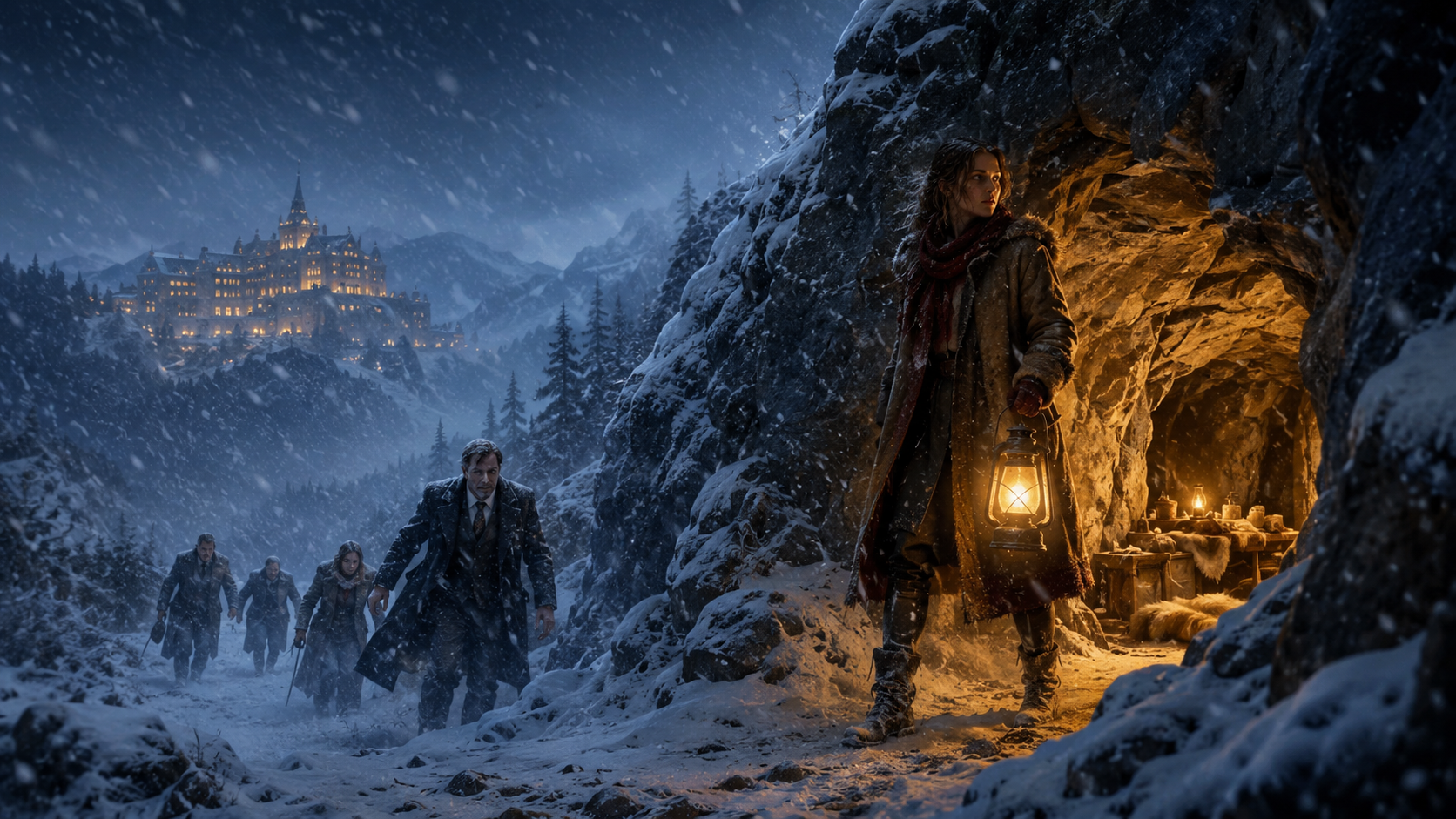
And while everyone at Grayhaven believed she spent her rare days off visiting the village, Mara had been preparing.
The cave was not beautiful at first. It was a wound in the mountain, half-hidden by thorn bushes and black spruce, its mouth narrow enough that a grown man would have to turn sideways to enter. Inside, the passage widened into a chamber with a low ceiling, dry stone walls, and a natural vent that carried smoke through a crack high above the ridge.
Mara had found it in late spring. By summer, she had cleared debris. By early autumn, she had reinforced the entrance with salvaged beams, lined the coldest wall with old wool blankets and tarred canvas, and built shelves from broken crates no one at Grayhaven thought worth saving.
Then she began stocking it.
Not all at once. Never enough to be noticed.
A sack of lentils from a merchant who owed her mother a kindness. Jars of beans. Flour sealed in metal tins. Salt. Dried apples. Candles. Matches wrapped in wax paper. Kerosene lamps. A small cast-iron stove dragged up the ridge in pieces over six exhausting nights. Coils of rope. Medicine. Bandages. Blankets. Tools. A hand-crank radio. Two water barrels fed by a spring that seeped clean from the rock.
She stored books too, because survival without beauty was just waiting to die.
When Adrian threw her out, Mara did not walk to the village.
She walked uphill.
By dusk, she reached the hidden entrance. Her hands were numb, her suitcase handle had cut a red groove into her palm, and the first pellets of ice were beginning to tick against the trees. She pushed through the brush, shifted the camouflaged screen of branches, and stepped into the mountain.
The cave smelled of cedar smoke, dried herbs, stone, and patience.
Mara shut the entrance behind her.
Then she lit the stove.
A small flame became a steady one. The metal warmed. The chamber slowly softened around the edges. Mara removed her torn coat, wrapped herself in a blanket, and sat on a wooden crate with her mother’s map across her knees.
For the first time that day, she laughed.
It was not a happy laugh. Not yet.
But it was alive.
The first snow came three days later.
It fell politely at first, a white dusting on pine needles and roof tiles. Grayhaven posted photographs of it on its social pages, though Mara never saw them. Guests smiled beside the windows. Adrian held meetings by the fire. The village children ran outside with open mouths and red mittens.
Then the wind changed.
By the sixth day, the road to the eastern pass closed.
By the ninth, the lodge’s lower generator failed.
By the tenth, the village lost power after a frozen branch tore down a line.
Adrian Vale discovered, with some irritation, that money could order helicopters but could not make them fly through whiteout conditions.
At first, Grayhaven was merely uncomfortable.
The west wing grew cold. Guests complained. Pipes knocked in the walls. The chef announced that fresh deliveries had not arrived. Adrian told everyone it was temporary. He wore confidence like another expensive coat.
But storms in the North Crown Mountains did not care about confidence.
Snow kept falling.
The lodge’s remaining generator began to cough.
Fuel ran low.
Phone signals flickered and died.
By the time Thanksgiving week arrived, Grayhaven’s chandeliers were dark, its grand hall smelled of damp ash, and the rich people inside had stopped pretending cold was picturesque.
Mara heard about it through the radio.
She sat in the cave beside the stove, mending the sleeve of a wool jacket, while the village emergency channel crackled with voices.
“Grayhaven requesting assistance again.”
“Road team unable to pass mile marker twelve.”
“Any available shelter with heat, report capacity.”
“Repeat, any available heated shelter, report capacity.”
Mara turned the radio dial lower.
The cave was not silent anymore.
By then, she had guests.
The first had been old Tomas Reed, a trapper from the lower valley who arrived at the entrance half-frozen after his cabin roof split under snow weight. He nearly fainted when Mara pulled him inside.
“Saints preserve me,” he whispered, staring at the shelves. “Girl, you built yourself a kingdom in a hole.”
“It’s not a kingdom,” Mara said, helping him sit by the stove. “It’s a shelter.”
The second was Elise Ward and her eight-year-old son, Noah, from the village store. Their furnace had failed, and Elise had tried to reach her sister’s house before the trail vanished. Mara found them beneath a leaning pine, the boy too tired to cry.
Then came two brothers from the road crew. Then Mrs. Bell’s nephew with frostbitten fingers. Then a nurse named Lina carrying a backpack of medicine and a face full of exhaustion.
Mara took them all in.