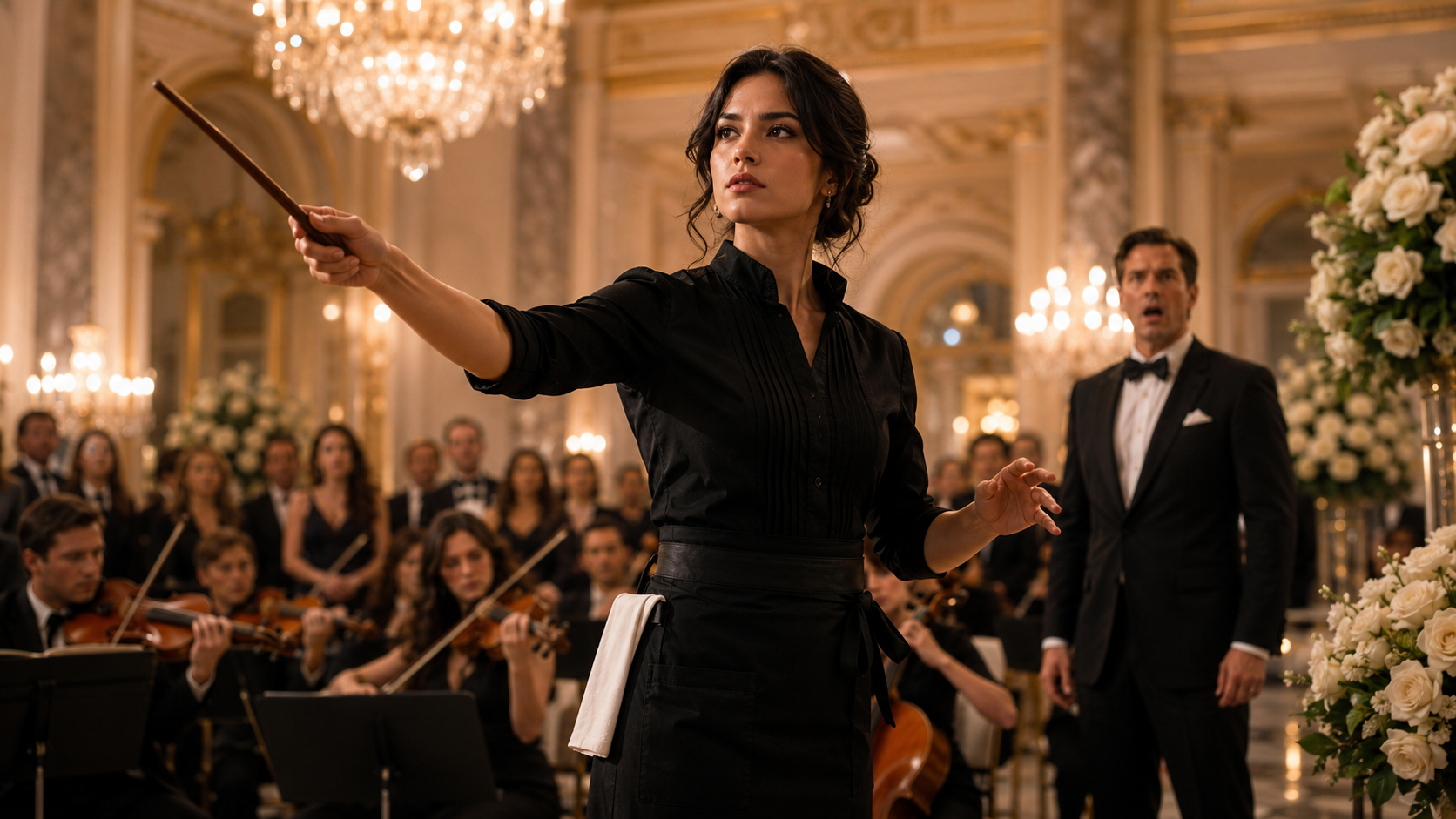
Guests stood at their tables. Hotel workers appeared in the service doorways. Cooks, cleaners, porters, and servers watched Nora beneath the chandelier.
Vincent remained seated.
Silas stood near the podium with his hands at his sides.
Nora stepped down.
The applause continued, but she did not smile.
She faced Silas.
“Say his name.”
He stared at her.
The applause weakened.
“Excuse me?”
“My father died believing the world considered him a thief. You used his music to build your reputation. Tonight you will say his name.”
Silas looked around the ballroom.
Every camera was pointed at him.
“You do not understand the situation.”
“I understand the contract. I understand that you found a desperate composer with a sick wife and a child. I understand that you offered him a small payment in exchange for everything he had written.”
“He signed willingly.”
“He signed because we needed heat in our apartment.”
“That does not make the agreement illegal.”
“No,” Nora said. “It makes it shameful.”
Silas’s jaw tightened.
Vincent slowly stood.
“Is she telling the truth?”
His father said nothing.
“Did you write this composition?”
Silas looked away.
That was the answer.
A murmur spread through the guests.
Vincent turned toward Nora. The confidence had vanished from his face.
“I did not know.”
“You did not ask.”
He looked at the server’s vest folded near the orchestra platform.
“No,” he said quietly. “I suppose I did not.”
Camille stepped away from him.
Silas attempted to recover his authority.
“This spectacle changes nothing. The foundation owns the composition.”
Camille removed the diamond necklace from around her throat and placed it on the table.
“It changes what everyone in this room thinks your foundation represents.”
A prominent donor stood.
“My company will suspend its partnership until the authorship is investigated.”
Another guest followed.
“So will ours.”
Voices rose across the ballroom.
Silas turned toward Vincent.
“Control this.”
Vincent looked at his father for several seconds.
Then he walked to Nora.
He no longer seemed like the untouchable heir who had pointed at her for the amusement of his friends.
He seemed younger.
Smaller.
Ashamed.
“I made a promise,” he said. “One hundred thousand dollars to the music program of your choice.”
Nora looked at him.
“The Blue Door Music Room.”
“You will have the money tomorrow.”
“No.”
Confusion crossed his face.
“You won.”
“I am not accepting a private favor that can disappear when the attention moves elsewhere.”
She pointed toward the cameras.
“You will announce the donation publicly. It will be placed in an independent trust. Your family will have no control over the school, its teachers, or its students.”
Vincent nodded.
“Agreed.”
“And every hotel employee who worked tonight will receive the bonus your manager told us had been canceled.”
Mr. Dallow looked horrified.
Vincent glanced at him.
“Canceled?”
The manager began to stammer.
“Operating costs required certain adjustments.”
Nora looked at Vincent.
“The flowers in this room cost more than the annual wages of half the kitchen staff.”
Vincent studied the workers standing in the doorways.
“Pay the bonuses,” he said.
Mr. Dallow opened his mouth.
“Tonight,” Vincent added.
The workers exchanged astonished looks.
Nora turned toward Silas.
“And my father’s name?”
Silas remained silent.
Theodore stepped forward.
“I performed sections of The Lantern Symphony under Mateo Bell’s direction. I will testify to that publicly.”
The orchestra librarian raised her hand.
“The archive contains correspondence about the original score.”
Camille looked directly at Silas.
“You can tell the truth now, or everyone else will tell it for you.”
For the first time, the powerful chairman appeared to have no room left in which to hide.
He looked at Nora.
“Your father composed the original work.”
Nora did not blink.
“His name.”
Silas swallowed.
“Mateo Bell composed The Lantern Symphony.”
The words were quiet, but the microphones near the orchestra captured them.
Nora closed her eyes.
For seven years she had imagined clearing her father’s name.
She had imagined anger, triumph, and revenge.
Instead, she felt an enormous sadness for the years he had lost.
When she opened her eyes, Vincent was holding out the white baton he had taken from the music stand.
She did not accept it.
“I believe this belongs to you,” he said.
“No. Mine is better.”
She lifted her father’s dark wooden baton.
A few members of the orchestra smiled.
Vincent lowered his hand.
“I am sorry.”
Nora studied him.
His apology could not erase the laughter. It could not undo his arrogance or restore her father’s life.
But for the first time that night, he was speaking without performing for an audience.