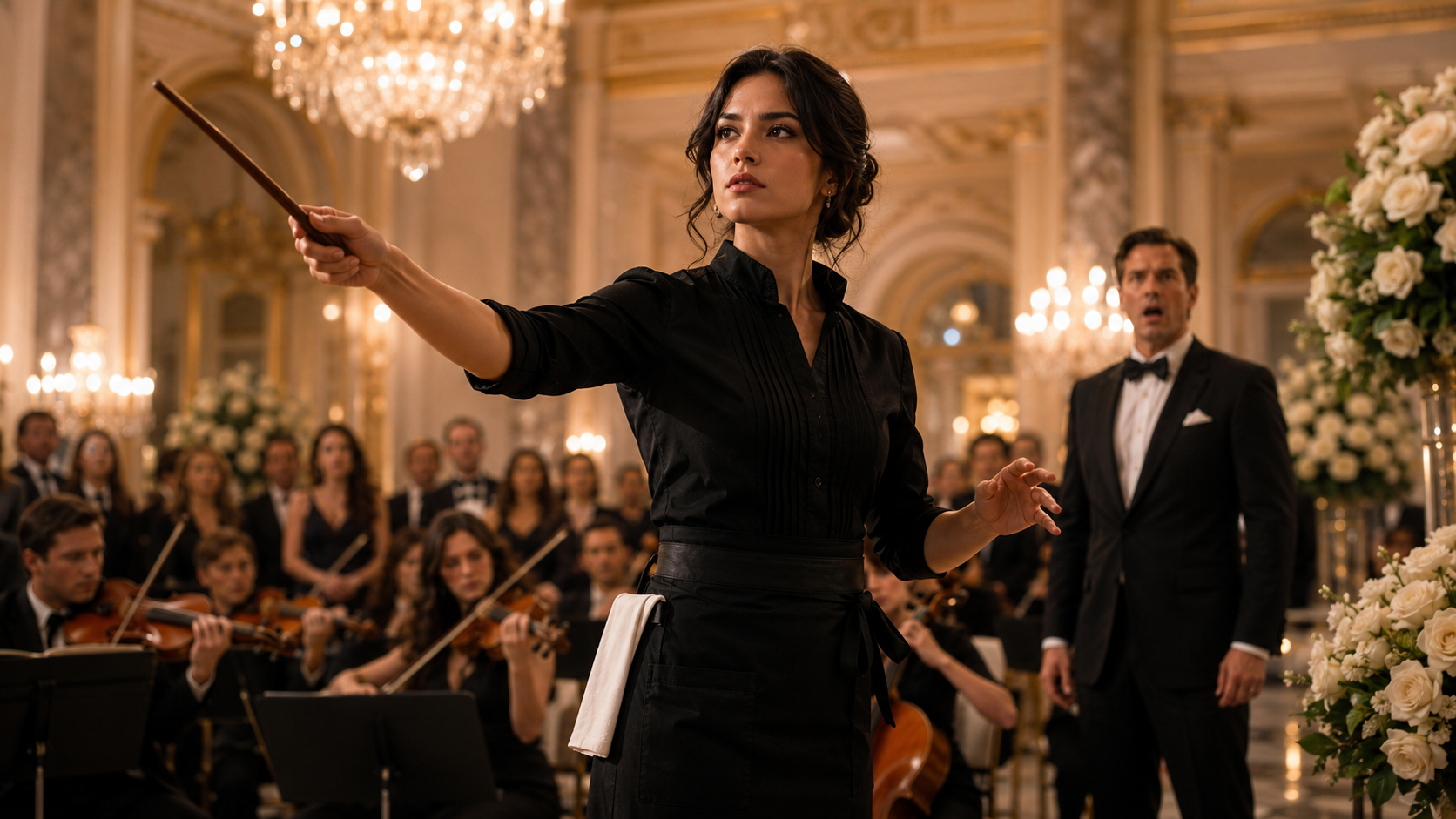
“You were certain I had nothing to offer because I was carrying a tray,” she said.
“I was wrong.”
“You were not wrong because I can conduct an orchestra. You were wrong before you knew that.”
Vincent looked toward the other hotel workers.
“I understand.”
“No,” Nora replied. “You are beginning to.”
She removed the conducting jacket and folded it over her arm.
Mr. Dallow approached nervously.
“Miss Bell, regarding your position at the hotel—”
“I resign.”
“Nora,” he whispered, “please consider the practical consequences.”
She looked at the cooks, cleaners, servers, and porters gathered behind him.
“For years, you told us we should be grateful for work that barely paid enough to survive. Perhaps you should consider the practical consequences.”
She picked up her server’s vest but did not put it on.
Theodore approached her.
“The orchestra needs an assistant conductor for its spring program.”
Nora shook her head.
“I have a school to save.”
“Then bring your students. We need a youth ensemble.”
For the first time that evening, Nora smiled.
“We have twelve musicians.”
“Bring all twelve.”
The young first violinist stepped closer.
“And perhaps you could teach me how not to lose my page.”
Nora laughed softly.
“That may require several lessons.”
The crowd began applauding again.
This time the sound was different.
They were not applauding a performance they could consume and forget.
They were applauding a woman who had forced them to see the people they usually looked through.
Nora walked toward the service doors.
Vincent called after her.
“Miss Bell.”
She turned.
He lifted his glass, then seemed to reconsider. He placed it on the table.
“The Blue Door Music Room will remain open.”
Nora looked at the cameras, the donors, and the foundation representatives.
“Yes,” she said. “Now it will.”
She passed through the golden doors.
The hotel workers moved aside to let her through, but she stopped among them.
A dishwasher took her hand.
One of the cooks embraced her.
Camille followed, leaving her diamonds and her engagement ring on Vincent’s table.
Behind them, the orchestra began playing the final theme again.
Not City of Glass.
The Lantern Symphony.
Mateo Bell’s name traveled through the ballroom in whispers, interviews, phone calls, and hurried conversations.
By morning, it would be known far beyond the walls of the Grand Aster Hotel.
But Nora did not remain to watch Silas Hale’s reputation collapse.
She took the night bus to the Blue Door Music Room.
Snow had begun to fall when she arrived.
The eviction notice still hung on the entrance.
Nora unlocked the door and turned on the hallway lights.
Children’s drawings covered the walls. Music stands waited inside the practice room. A broken cello rested on a table beside a box of donated strings.
She removed the notice from the door.
Then she entered the empty classroom and placed her father’s baton on the piano.
For a moment, she stood in silence.
“You were heard,” she whispered.
Outside, the city was dark.
Inside the Blue Door Music Room, one small lamp remained illuminated beside the window.
Then another light appeared in the apartment across the street.
And another.
Like a melody passing from one instrument to the next.
Like lanterns refusing to go out.