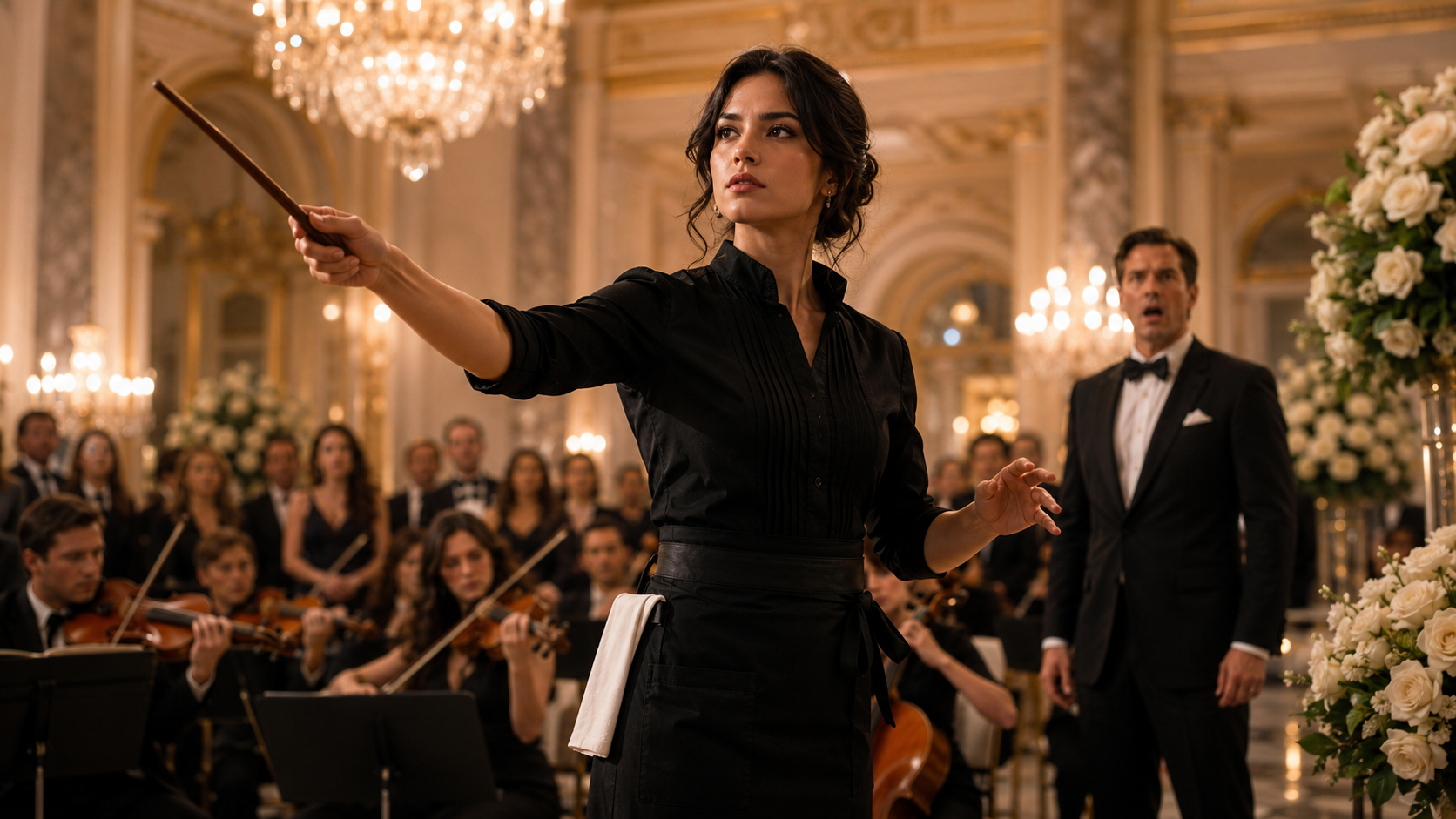
The orchestra reached the end of the second movement.
According to the score, the piece was supposed to conclude with a loud, triumphant chord.
Nora did not give it to them.
She held the baton in the air.
Silence spread across the ballroom.
Vincent stood.
“That is the end.”
Nora looked at him.
“No. That is where your father stopped printing it.”
A door opened at the far side of the ballroom.
Silas Hale entered.
He was in his early sixties, silver-haired and broad-shouldered. He had the measured expression of a man accustomed to controlling every room before speaking in it.
He had arrived late because of the same storm that had delayed the conductor.
“What is going on?” he asked.
Vincent pointed toward Nora.
“Our waitress decided to rewrite your composition.”
Silas looked at the podium.
Then he saw the baton in Nora’s hand.
All color left his face.
“Where did you get that?”
“It belonged to Mateo Bell.”
The name changed the atmosphere of the room.
Silas did not move.
Nora reached inside the conductor’s jacket and removed several folded pages.
The paper was old and yellowed. Notes covered the margins in her father’s handwriting.
She placed the pages on the music stand.
Silas walked toward her.
“You should not have those.”
“They were left to me.”
“That movement was never completed.”
“My father completed it six months before you bought the rest of the symphony.”
Vincent stared at his father.
“Bought?”
Silas’s eyes remained fixed on Nora.
“This is neither the time nor the place.”
Nora’s voice carried across the silent ballroom.
“This gala was created to celebrate young artists. I cannot imagine a better place to discuss what happens when a powerful man takes an artist’s work and erases his name.”
A camera clicked.
Then another.
Silas glanced toward the guests.
“Put those pages away.”
Nora raised the baton.
“No.”
The orchestra waited.
Silas turned to Theodore.
“Do not play.”
The cellist slowly positioned his bow above the strings.
“I should have played this movement twenty years ago.”
Silas looked toward the orchestra.
“Anyone who continues will never work at an event sponsored by my foundation again.”
The young first violinist lowered his instrument.
Several musicians looked frightened.
Nora understood their fear.
They had rent to pay. Families to support. Careers that could be destroyed by one powerful enemy.
She lowered her baton.
“You are free to leave,” she told them. “No one should be punished for refusing.”
Theodore remained in position.
“I will play.”
The first violinist looked at him.
Then he raised his instrument again.
“So will I.”
The woman beside him lifted her viola.
One by one, the others followed.
Even the assistant conductor stepped away from the podium and nodded to Nora.
Silas stood alone before them.
Nora turned to the orchestra.
“Final movement,” she said. “The Lanterns.”
She raised the baton.
The music began with a single violin.
The melody was simple, almost childlike. A second violin answered it from the opposite side of the orchestra. Then a flute joined, followed by the cello.
The sound traveled between the musicians like one small light being passed from hand to hand.
Nora guided each entrance.
More instruments joined.
The melody grew stronger, but it never lost its tenderness. It became the sound of people surviving long winters, sharing what little they had, and refusing to allow darkness to define them.
The chandeliers seemed less important now.
The diamonds seemed ordinary.
The true center of the ballroom was the woman in the black jacket standing before an orchestra that had chosen music over fear.
Nora’s gestures widened.
The final theme rose.
The brass entered, not with arrogance, but with warmth. The percussion moved like distant thunder. The strings climbed higher until the entire room seemed to vibrate.
Tears appeared in Theodore’s eyes.
Camille covered her mouth.
Even Vincent had stopped pretending not to care.
At the height of the movement, Nora suddenly pulled the orchestra into silence.
One quiet piano note remained.
Then the cellos returned with Mateo Bell’s original theme.
Nora’s hand trembled.
She could almost hear her father counting beside her.
One, two, three.
Breathe.
She gave the final cue.
The orchestra released one magnificent chord.
It filled the ballroom, struck the marble walls, and seemed to remain in the air long after every instrument had fallen silent.
No one moved.
Nora lowered the baton.
Theodore stood first.
He struck his bow gently against his music stand.
The first violinist joined him.
Then the entire orchestra rose.
The applause began among the musicians before spreading into the audience.
Within seconds, the ballroom thundered.