“So do I.”
Camille looked between them.
“What are you talking about?”
Nora removed her server’s vest. Beneath it, she wore a simple black blouse. She put on the old conducting jacket and fastened the buttons.
“My father wrote City of Glass.”
Camille’s face went still.
“That piece belongs to Silas Hale.”
“No. Silas Hale owns the paper it was printed on. That is not the same thing.”
Theodore nodded.
“Mateo called it The Lantern Symphony. He played parts of it for me more than twenty years ago.”
“Can you prove that?” Camille asked.
Nora closed the locker.
“The original final movement was never sold. My father removed it before signing the contract.”
“What contract?”
“The one Silas offered him when we were about to lose our home.”
Nora picked up the baton.
“My father received enough money to survive for six months. Silas received a lifetime of praise.”
From the ballroom, Vincent’s voice echoed through the doors.
“Ladies and gentlemen, our fearless volunteer appears to be preparing for her debut.”
The crowd laughed.
Nora looked at Theodore.
“Will the orchestra follow me?”
The cellist gave her a sad smile.
“A real orchestra follows the music.”
He opened the door for her.
“Give us the truth, and we will follow that.”
When Nora returned, the laughter stopped one table at a time.
She no longer wore her service vest.
The black conducting jacket fit closely around her shoulders. Her hair remained tied back, and she wore no jewelry except for the small musical note pin now visible at her collar.
She did not look like a transformed princess.
She looked like someone who had finally stopped hiding.
Vincent stood beside the podium.
“Well,” he said. “The waitress brought her own costume.”
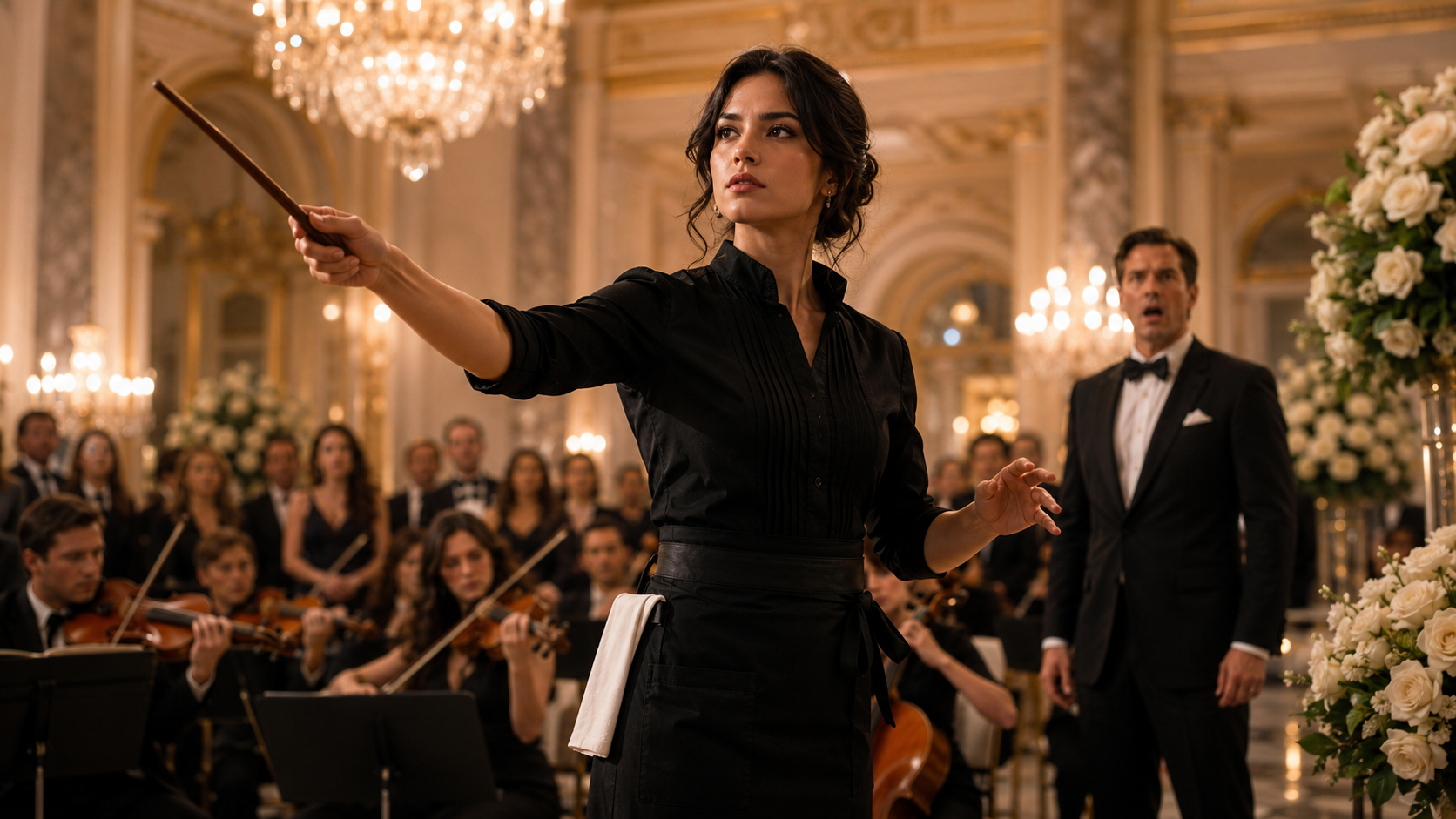
Nora held up the wooden baton.
“This belonged to my father.”
“How touching.”
Camille entered behind her.
“Vincent, you should stop.”
He frowned.
“Why?”
“Because you do not understand what is happening.”
Vincent offered Nora the podium.
“Please. Educate us.”
Nora climbed the two steps.
The musicians adjusted themselves in their chairs.
Theodore sat behind his cello, watching her.
The young first violinist who had turned the wrong page earlier leaned toward Nora.
“What tempo?”
She looked across the orchestra.
“Not the printed one.”
A confused whisper passed through the musicians.
Nora opened the score.
The title page read City of Glass, composed by Silas Hale.
She turned past it.
“Begin at measure sixteen,” she said. “Second violins, remove the mute. Horns, hold the final note of the opening phrase for one additional beat.”
The assistant conductor shook his head.
“That is not in the score.”
“It was in the original.”
Vincent laughed.
“You have not begun, and you are already changing the music.”
Nora faced him.
“You asked me to conduct. You did not ask me to obey a mistake.”
A few guests exchanged surprised looks.
Theodore lifted his bow.
“Ready,” he said.
One by one, the musicians raised their instruments.
Nora closed her eyes.
For a moment, she was eleven years old again, sitting on the floor of the Blue Door Music Room while her father played an unfinished melody on an old piano.
Then she opened her eyes and raised the baton.
The first note emerged from the cellos like a voice waking beneath the earth.
The violas joined.
Then the violins entered, soft and uncertain, carrying a fragile melody through the candlelit room.
Nora’s hand moved with careful precision.
The orchestra followed.
She gave the woodwinds space to breathe. She guided the horns beneath the strings instead of allowing them to overwhelm the melody. When the percussion entered, she pulled the sound backward, creating tension instead of noise.
The guests stopped drinking.
Vincent’s smile disappeared.
The orchestra had expected an inexperienced woman waving her arms.
Instead, they found themselves responding to a conductor who understood the piece more deeply than the printed pages did.
Nora did not simply count the rhythm.
She shaped it.
She drew the music upward with one hand and held the orchestra at the edge of silence with the other. Her movements were controlled, but emotion lived inside every gesture.
At measure sixty-four, she changed the tempo.
The assistant conductor stared at her.
Theodore smiled.
He remembered.
The new tempo transformed the composition. What had sounded ceremonial became intimate. Beneath the grand brass and polished strings, another melody appeared—a modest tune filled with longing.
It was the theme Mateo Bell had written for his wife.
Nora’s mother had died when Nora was seven.
Her father had spent the rest of his life hiding her name inside his music.
Guests leaned forward.
Some closed their eyes.
Others looked suddenly uncomfortable, as if beauty had entered the room without permission and discovered them pretending to care about it.