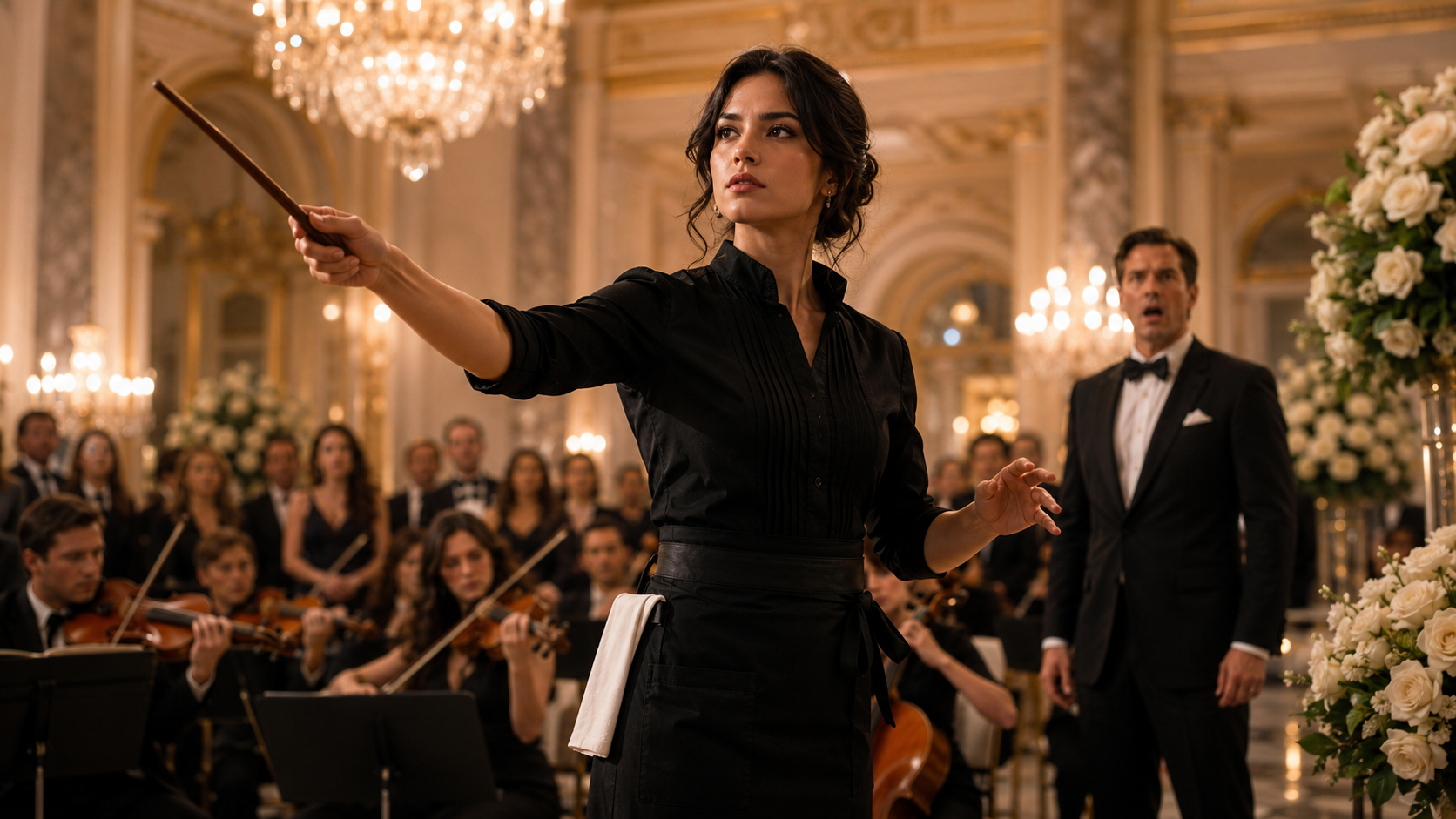
“And if I fail?”
Vincent shrugged.
“You admit that serving champagne does not make you a musician.”
Camille’s face hardened.
“This is cruel, Vincent.”
“It is entertainment.”
“No,” Nora said quietly. “It is a wager.”
Vincent looked pleased.
“Then do we have a wager?”
Nora thought of the Blue Door Music Room.
She saw the narrow hallway covered with children’s drawings. She saw twelve-year-old Mia practicing the cello with a bow repaired using black tape. She saw brothers Leon and Lucas sharing one trumpet because their mother could not afford another.
She remembered the eviction notice taped to the front door.
She also remembered her father standing in the center of that same room years earlier, tapping a pencil against a music stand.
Music does not ask where you came from, he used to tell his students. It only asks whether you are brave enough to be heard.
Nora looked at the baton in Vincent’s hand.
“What piece?”
He turned toward the orchestra.
“Play the foundation’s new composition.”
The assistant conductor looked alarmed.
“Mr. Hale, that work has never been performed publicly.”
“Then tonight will be its premiere.”
A murmur moved through the musicians.
The composition was called City of Glass. According to the gala program, it had been written by Silas Hale, Vincent’s father and chairman of the Hale Foundation.
Nora had seen the score earlier that evening.
She had found several pages abandoned on a service cart and returned them to the orchestra librarian.
The melody on those pages had followed her ever since.
She knew it.
Not merely as a familiar tune.
She knew where every phrase wanted to breathe. She knew where the violins should rise, where the horns should soften, and where the final movement should break open like sunlight through a storm.
She knew it because she had heard her father composing it when she was a child.
Only then, the piece had carried a different name.
The Lantern Symphony.
Nora lifted her eyes toward Vincent.
“I accept.”
The ballroom became still.
For the first time that evening, Vincent appeared uncertain.
Mr. Dallow grabbed Nora’s elbow.
“Service hallway. Now.”
Nora pulled her arm free.
“I am taking my break.”
“You will lose your job.”
“Then I will lose it after the performance.”
She turned and walked through the golden service doors.
Behind her, the ballroom erupted into excited conversation.
In the service corridor, the music of the orchestra became a distant murmur. Nora placed her tray on a linen cart and pressed both hands against its metal frame.
Her heart was beating too quickly.
She had not conducted in seven years.
Not since the conservatory.
Not since the accusations against her father had destroyed his reputation.
Not since he had died believing that the music world had forgotten him.
“Nora.”
She turned.
Camille had followed her into the corridor.
Up close, Vincent’s fiancée looked less like a glittering socialite and more like an exhausted woman trapped inside a perfect photograph.
“You do not have to return in there,” Camille said.
“Yes, I do.”
“Vincent expects you to fail.”
“I know.”
“He will turn it into a story about generosity. He will say he gave an ordinary waitress an opportunity.”
“I know that too.”
Camille lowered her voice.
“Then why are you doing it?”
Nora opened her locker.
Inside hung an old black jacket protected by a transparent garment bag. Beneath it rested a narrow wooden case.
“Because there are children who will lose the only safe place they have on Friday.”
She removed the case and opened it.
Inside lay a conductor’s baton made of dark wood.
Her father’s initials were carved into the handle.
Camille stared at it.
“You brought that to work?”
“I carry it everywhere.”
“Why?”
Nora ran her thumb across the carved initials.
“Because forgetting is sometimes easier than remembering. I needed something that would not let me forget.”
A door opened behind them.
The elderly cellist from the orchestra stood in the corridor.
His name was Theodore Lane. Nora remembered seeing him on concert posters when she was younger.
He looked from her face to the baton.
“Mateo Bell’s daughter,” he said.
Nora did not answer.
Theodore stepped closer.
“I heard you conduct at the Eastern Conservatory. You were nineteen.”
“That was a long time ago.”
“You disappeared.”
“My father was accused of stealing another composer’s work.”
Theodore’s expression darkened.
“I remember.”
“Then you remember what happened to anyone who defended him.”
“I remember being a coward.”
Nora met his eyes.
From the ballroom came the sound of Vincent tapping a spoon against a glass.
Theodore glanced toward the doors.
“Do you know what they are asking us to play?”
“Yes.”
“Do you recognize it?”
“Yes.”
He took a slow breath.