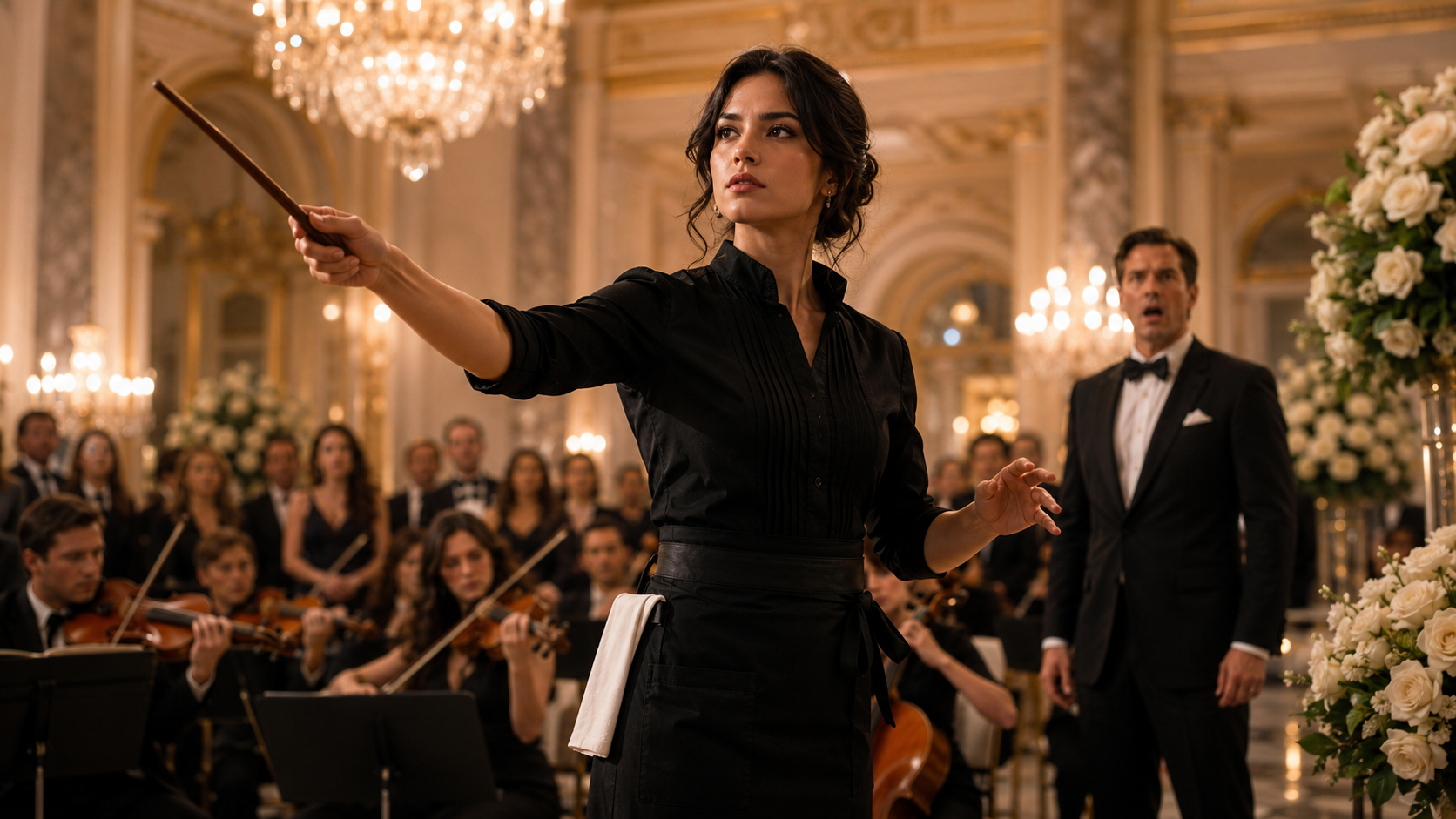
THE WAITRESS WHO TOOK THE MAESTRO’S BATON

The first laugh rolled across the ballroom before Nora Bell had even realized that everyone was looking at her.

It began near the central fountain, where champagne glasses glittered beneath a ceiling of suspended crystals. Then it traveled from table to table, growing louder as wealthy guests turned in their chairs to see what had interrupted the evening.

Nora stood beside the orchestra platform with a silver tray pressed against her waist.

One of the champagne flutes had tipped over.

Nothing had broken. Nothing had spilled on a guest. She had not made a mistake.

The people were laughing because Vincent Hale was pointing at her.

The Grand Aster Hotel had never looked more magnificent. Hundreds of candles burned inside tall glass cylinders. White roses climbed the marble columns. A thirty-piece orchestra waited beneath an enormous chandelier while politicians, investors, celebrities, and heirs drank to the future of the arts.

The gala was supposed to raise money for young musicians.

Nora had been working since noon without a proper break.

Her black uniform was spotless, although the soles of her shoes were beginning to separate. Her dark hair was tied behind her head, and a small silver pin shaped like a musical note was hidden beneath her collar.

She was twenty-eight years old.

To the guests, she was simply another server.

To the hotel manager, she was employee number forty-seven.

To the children at the Blue Door Music Room, she was the person who repaired broken violin strings, found secondhand instruments, cleaned the floors after midnight, and promised that their little neighborhood school would somehow remain open.

But the Blue Door Music Room had received its final eviction notice three days earlier.

The landlord wanted the building empty by Friday.

Nora had not yet told the children.

Vincent Hale lifted his champagne glass and smiled at the crowd.

He was tall, handsome, and perfectly dressed. His family owned the hotel, two financial companies, a private aviation business, and the charitable foundation sponsoring the gala.

Vincent had never built any of them.

He had inherited his position, his fortune, and the confidence of a man who had never faced a consequence he could not purchase his way out of.

Beside him stood his fiancée, Camille Arden, wearing an ivory gown and a diamond necklace bright enough to illuminate the entire table.

Vincent continued pointing at Nora.

“Our waitress appears to have an opinion about the orchestra.”

The guests laughed again.

Nora’s fingers tightened around the tray.

A few moments earlier, the young first violinist had turned two pages at once. The orchestra had nearly begun the wrong movement. Nora had quietly leaned toward him and whispered the correct page number.

She had not expected anyone to notice.

Vincent had noticed.

He stepped away from his table.

“Come closer,” he said.

Nora remained where she was.

The hotel manager, Mr. Dallow, hurried through the crowd. His face was pale with panic.

“Nora,” he whispered, “do what Mr. Hale asks.”

Vincent heard him.

“No need to be frightened,” he said. “This is a charity event. We are all friends here.”

No one in the ballroom believed that.

Nora approached slowly.

Vincent studied her as though she were an unusual object placed on display.

“You corrected the violinist.”

“I helped him find the right page.”

“So you can read music?”

“Yes.”

The simplicity of her answer seemed to irritate him.

Vincent glanced toward the orchestra.

The scheduled conductor had been delayed by a winter storm, and the musicians had spent the past twenty minutes waiting for instructions. A nervous assistant stood near the podium, speaking into a phone.

Vincent looked back at Nora.

“Perhaps we no longer need the maestro.”

Several guests laughed.

Camille touched Vincent’s arm.

“That is enough.”

He ignored her.

“Tell me, Miss…”

“Bell.”

“Miss Bell, have you ever conducted an orchestra?”

Mr. Dallow stepped between them.

“She is a member of the service staff, sir. She needs to return to work.”

Vincent raised one finger, silencing him.

Nora looked toward the musicians.

The oldest cellist was watching her carefully.

His expression had changed.

There was no amusement in his eyes.

Vincent walked to the conductor’s podium and picked up the thin white baton resting on the music stand.

He held it toward Nora.

“Let us make the evening interesting.”

A camera flashed.

More guests turned toward them.

Vincent’s smile widened as he sensed the attention of the room.

“If you can conduct one complete piece without the orchestra stopping, the Hale Foundation will donate one hundred thousand dollars to any music program you choose.”

The laughter faded.

Nora stared at him.

“One hundred thousand?”

“Provided you finish the piece.”

“And if I fail?”

Vincent shrugged.

“You admit that serving champagne does not make you a musician.”

Camille’s face hardened.

“This is cruel, Vincent.”

“It is entertainment.”

“No,” Nora said quietly. “It is a wager.”

Vincent looked pleased.

“Then do we have a wager?”

Nora thought of the Blue Door Music Room.

She saw the narrow hallway covered with children’s drawings. She saw twelve-year-old Mia practicing the cello with a bow repaired using black tape. She saw brothers Leon and Lucas sharing one trumpet because their mother could not afford another.

She remembered the eviction notice taped to the front door.

She also remembered her father standing in the center of that same room years earlier, tapping a pencil against a music stand.

Music does not ask where you came from, he used to tell his students. It only asks whether you are brave enough to be heard.

Nora looked at the baton in Vincent’s hand.

“What piece?”

He turned toward the orchestra.

“Play the foundation’s new composition.”

The assistant conductor looked alarmed.

“Mr. Hale, that work has never been performed publicly.”

“Then tonight will be its premiere.”

A murmur moved through the musicians.

The composition was called City of Glass. According to the gala program, it had been written by Silas Hale, Vincent’s father and chairman of the Hale Foundation.

Nora had seen the score earlier that evening.

She had found several pages abandoned on a service cart and returned them to the orchestra librarian.

The melody on those pages had followed her ever since.

She knew it.

Not merely as a familiar tune.

She knew where every phrase wanted to breathe. She knew where the violins should rise, where the horns should soften, and where the final movement should break open like sunlight through a storm.

She knew it because she had heard her father composing it when she was a child.

Only then, the piece had carried a different name.

The Lantern Symphony.

Nora lifted her eyes toward Vincent.

“I accept.”

The ballroom became still.

For the first time that evening, Vincent appeared uncertain.

Mr. Dallow grabbed Nora’s elbow.

“Service hallway. Now.”

Nora pulled her arm free.

“I am taking my break.”

“You will lose your job.”

“Then I will lose it after the performance.”

She turned and walked through the golden service doors.

Behind her, the ballroom erupted into excited conversation.

In the service corridor, the music of the orchestra became a distant murmur. Nora placed her tray on a linen cart and pressed both hands against its metal frame.

Her heart was beating too quickly.

She had not conducted in seven years.

Not since the conservatory.

Not since the accusations against her father had destroyed his reputation.

Not since he had died believing that the music world had forgotten him.

“Nora.”

She turned.

Camille had followed her into the corridor.

Up close, Vincent’s fiancée looked less like a glittering socialite and more like an exhausted woman trapped inside a perfect photograph.

“You do not have to return in there,” Camille said.

“Yes, I do.”

“Vincent expects you to fail.”

“I know.”

“He will turn it into a story about generosity. He will say he gave an ordinary waitress an opportunity.”

“I know that too.”

Camille lowered her voice.

“Then why are you doing it?”

Nora opened her locker.

Inside hung an old black jacket protected by a transparent garment bag. Beneath it rested a narrow wooden case.

“Because there are children who will lose the only safe place they have on Friday.”

She removed the case and opened it.

Inside lay a conductor’s baton made of dark wood.

Her father’s initials were carved into the handle.

Camille stared at it.

“You brought that to work?”

“I carry it everywhere.”

“Why?”

Nora ran her thumb across the carved initials.

“Because forgetting is sometimes easier than remembering. I needed something that would not let me forget.”

A door opened behind them.

The elderly cellist from the orchestra stood in the corridor.

His name was Theodore Lane. Nora remembered seeing him on concert posters when she was younger.

He looked from her face to the baton.

“Mateo Bell’s daughter,” he said.

Nora did not answer.

Theodore stepped closer.

“I heard you conduct at the Eastern Conservatory. You were nineteen.”

“That was a long time ago.”

“You disappeared.”

“My father was accused of stealing another composer’s work.”

Theodore’s expression darkened.

“I remember.”

“Then you remember what happened to anyone who defended him.”

“I remember being a coward.”

Nora met his eyes.

From the ballroom came the sound of Vincent tapping a spoon against a glass.

Theodore glanced toward the doors.

“Do you know what they are asking us to play?”

“Yes.”

“Do you recognize it?”

“Yes.”

He took a slow breath.

“So do I.”

Camille looked between them.

“What are you talking about?”

Nora removed her server’s vest. Beneath it, she wore a simple black blouse. She put on the old conducting jacket and fastened the buttons.

“My father wrote City of Glass.”

Camille’s face went still.

“That piece belongs to Silas Hale.”

“No. Silas Hale owns the paper it was printed on. That is not the same thing.”

Theodore nodded.

“Mateo called it The Lantern Symphony. He played parts of it for me more than twenty years ago.”

“Can you prove that?” Camille asked.

Nora closed the locker.

“The original final movement was never sold. My father removed it before signing the contract.”

“What contract?”

“The one Silas offered him when we were about to lose our home.”

Nora picked up the baton.

“My father received enough money to survive for six months. Silas received a lifetime of praise.”

From the ballroom, Vincent’s voice echoed through the doors.

“Ladies and gentlemen, our fearless volunteer appears to be preparing for her debut.”

The crowd laughed.

Nora looked at Theodore.

“Will the orchestra follow me?”

The cellist gave her a sad smile.

“A real orchestra follows the music.”

He opened the door for her.

“Give us the truth, and we will follow that.”

When Nora returned, the laughter stopped one table at a time.

She no longer wore her service vest.

The black conducting jacket fit closely around her shoulders. Her hair remained tied back, and she wore no jewelry except for the small musical note pin now visible at her collar.

She did not look like a transformed princess.

She looked like someone who had finally stopped hiding.

Vincent stood beside the podium.

“Well,” he said. “The waitress brought her own costume.”

Nora held up the wooden baton.

“This belonged to my father.”

“How touching.”

Camille entered behind her.

“Vincent, you should stop.”

He frowned.

“Why?”

“Because you do not understand what is happening.”

Vincent offered Nora the podium.

“Please. Educate us.”

Nora climbed the two steps.

The musicians adjusted themselves in their chairs.

Theodore sat behind his cello, watching her.

The young first violinist who had turned the wrong page earlier leaned toward Nora.

“What tempo?”

She looked across the orchestra.

“Not the printed one.”

A confused whisper passed through the musicians.

Nora opened the score.

The title page read City of Glass, composed by Silas Hale.

She turned past it.

“Begin at measure sixteen,” she said. “Second violins, remove the mute. Horns, hold the final note of the opening phrase for one additional beat.”

The assistant conductor shook his head.

“That is not in the score.”

“It was in the original.”

Vincent laughed.

“You have not begun, and you are already changing the music.”

Nora faced him.

“You asked me to conduct. You did not ask me to obey a mistake.”

A few guests exchanged surprised looks.

Theodore lifted his bow.

“Ready,” he said.

One by one, the musicians raised their instruments.

Nora closed her eyes.

For a moment, she was eleven years old again, sitting on the floor of the Blue Door Music Room while her father played an unfinished melody on an old piano.

Then she opened her eyes and raised the baton.

The first note emerged from the cellos like a voice waking beneath the earth.

The violas joined.

Then the violins entered, soft and uncertain, carrying a fragile melody through the candlelit room.

Nora’s hand moved with careful precision.

The orchestra followed.

She gave the woodwinds space to breathe. She guided the horns beneath the strings instead of allowing them to overwhelm the melody. When the percussion entered, she pulled the sound backward, creating tension instead of noise.

The guests stopped drinking.

Vincent’s smile disappeared.

The orchestra had expected an inexperienced woman waving her arms.

Instead, they found themselves responding to a conductor who understood the piece more deeply than the printed pages did.

Nora did not simply count the rhythm.

She shaped it.

She drew the music upward with one hand and held the orchestra at the edge of silence with the other. Her movements were controlled, but emotion lived inside every gesture.

At measure sixty-four, she changed the tempo.

The assistant conductor stared at her.

Theodore smiled.

He remembered.

The new tempo transformed the composition. What had sounded ceremonial became intimate. Beneath the grand brass and polished strings, another melody appeared—a modest tune filled with longing.

It was the theme Mateo Bell had written for his wife.

Nora’s mother had died when Nora was seven.

Her father had spent the rest of his life hiding her name inside his music.

Guests leaned forward.

Some closed their eyes.

Others looked suddenly uncomfortable, as if beauty had entered the room without permission and discovered them pretending to care about it.

The orchestra reached the end of the second movement.

According to the score, the piece was supposed to conclude with a loud, triumphant chord.

Nora did not give it to them.

She held the baton in the air.

Silence spread across the ballroom.

Vincent stood.

“That is the end.”

Nora looked at him.

“No. That is where your father stopped printing it.”

A door opened at the far side of the ballroom.

Silas Hale entered.

He was in his early sixties, silver-haired and broad-shouldered. He had the measured expression of a man accustomed to controlling every room before speaking in it.

He had arrived late because of the same storm that had delayed the conductor.

“What is going on?” he asked.

Vincent pointed toward Nora.

“Our waitress decided to rewrite your composition.”

Silas looked at the podium.

Then he saw the baton in Nora’s hand.

All color left his face.

“Where did you get that?”

“It belonged to Mateo Bell.”

The name changed the atmosphere of the room.

Silas did not move.

Nora reached inside the conductor’s jacket and removed several folded pages.

The paper was old and yellowed. Notes covered the margins in her father’s handwriting.

She placed the pages on the music stand.

Silas walked toward her.

“You should not have those.”

“They were left to me.”

“That movement was never completed.”

“My father completed it six months before you bought the rest of the symphony.”

Vincent stared at his father.

“Bought?”

Silas’s eyes remained fixed on Nora.

“This is neither the time nor the place.”

Nora’s voice carried across the silent ballroom.

“This gala was created to celebrate young artists. I cannot imagine a better place to discuss what happens when a powerful man takes an artist’s work and erases his name.”

A camera clicked.

Then another.

Silas glanced toward the guests.

“Put those pages away.”

Nora raised the baton.

“No.”

The orchestra waited.

Silas turned to Theodore.

“Do not play.”

The cellist slowly positioned his bow above the strings.

“I should have played this movement twenty years ago.”

Silas looked toward the orchestra.

“Anyone who continues will never work at an event sponsored by my foundation again.”

The young first violinist lowered his instrument.

Several musicians looked frightened.

Nora understood their fear.

They had rent to pay. Families to support. Careers that could be destroyed by one powerful enemy.

She lowered her baton.

“You are free to leave,” she told them. “No one should be punished for refusing.”

Theodore remained in position.

“I will play.”

The first violinist looked at him.

Then he raised his instrument again.

“So will I.”

The woman beside him lifted her viola.

One by one, the others followed.

Even the assistant conductor stepped away from the podium and nodded to Nora.

Silas stood alone before them.

Nora turned to the orchestra.

“Final movement,” she said. “The Lanterns.”

She raised the baton.

The music began with a single violin.

The melody was simple, almost childlike. A second violin answered it from the opposite side of the orchestra. Then a flute joined, followed by the cello.

The sound traveled between the musicians like one small light being passed from hand to hand.

Nora guided each entrance.

More instruments joined.

The melody grew stronger, but it never lost its tenderness. It became the sound of people surviving long winters, sharing what little they had, and refusing to allow darkness to define them.

The chandeliers seemed less important now.

The diamonds seemed ordinary.

The true center of the ballroom was the woman in the black jacket standing before an orchestra that had chosen music over fear.

Nora’s gestures widened.

The final theme rose.

The brass entered, not with arrogance, but with warmth. The percussion moved like distant thunder. The strings climbed higher until the entire room seemed to vibrate.

Tears appeared in Theodore’s eyes.

Camille covered her mouth.

Even Vincent had stopped pretending not to care.

At the height of the movement, Nora suddenly pulled the orchestra into silence.

One quiet piano note remained.

Then the cellos returned with Mateo Bell’s original theme.

Nora’s hand trembled.

She could almost hear her father counting beside her.

One, two, three.

Breathe.

She gave the final cue.

The orchestra released one magnificent chord.

It filled the ballroom, struck the marble walls, and seemed to remain in the air long after every instrument had fallen silent.

No one moved.

Nora lowered the baton.

Theodore stood first.

He struck his bow gently against his music stand.

The first violinist joined him.

Then the entire orchestra rose.

The applause began among the musicians before spreading into the audience.

Within seconds, the ballroom thundered.

Guests stood at their tables. Hotel workers appeared in the service doorways. Cooks, cleaners, porters, and servers watched Nora beneath the chandelier.

Vincent remained seated.

Silas stood near the podium with his hands at his sides.

Nora stepped down.

The applause continued, but she did not smile.

She faced Silas.

“Say his name.”

He stared at her.

The applause weakened.

“Excuse me?”

“My father died believing the world considered him a thief. You used his music to build your reputation. Tonight you will say his name.”

Silas looked around the ballroom.

Every camera was pointed at him.

“You do not understand the situation.”

“I understand the contract. I understand that you found a desperate composer with a sick wife and a child. I understand that you offered him a small payment in exchange for everything he had written.”

“He signed willingly.”

“He signed because we needed heat in our apartment.”

“That does not make the agreement illegal.”

“No,” Nora said. “It makes it shameful.”

Silas’s jaw tightened.

Vincent slowly stood.

“Is she telling the truth?”

His father said nothing.

“Did you write this composition?”

Silas looked away.

That was the answer.

A murmur spread through the guests.

Vincent turned toward Nora. The confidence had vanished from his face.

“I did not know.”

“You did not ask.”

He looked at the server’s vest folded near the orchestra platform.

“No,” he said quietly. “I suppose I did not.”

Camille stepped away from him.

Silas attempted to recover his authority.

“This spectacle changes nothing. The foundation owns the composition.”

Camille removed the diamond necklace from around her throat and placed it on the table.

“It changes what everyone in this room thinks your foundation represents.”

A prominent donor stood.

“My company will suspend its partnership until the authorship is investigated.”

Another guest followed.

“So will ours.”

Voices rose across the ballroom.

Silas turned toward Vincent.

“Control this.”

Vincent looked at his father for several seconds.

Then he walked to Nora.

He no longer seemed like the untouchable heir who had pointed at her for the amusement of his friends.

He seemed younger.

Smaller.

Ashamed.

“I made a promise,” he said. “One hundred thousand dollars to the music program of your choice.”

Nora looked at him.

“The Blue Door Music Room.”

“You will have the money tomorrow.”

“No.”

Confusion crossed his face.

“You won.”

“I am not accepting a private favor that can disappear when the attention moves elsewhere.”

She pointed toward the cameras.

“You will announce the donation publicly. It will be placed in an independent trust. Your family will have no control over the school, its teachers, or its students.”

Vincent nodded.

“Agreed.”

“And every hotel employee who worked tonight will receive the bonus your manager told us had been canceled.”

Mr. Dallow looked horrified.

Vincent glanced at him.

“Canceled?”

The manager began to stammer.

“Operating costs required certain adjustments.”

Nora looked at Vincent.

“The flowers in this room cost more than the annual wages of half the kitchen staff.”

Vincent studied the workers standing in the doorways.

“Pay the bonuses,” he said.

Mr. Dallow opened his mouth.

“Tonight,” Vincent added.

The workers exchanged astonished looks.

Nora turned toward Silas.

“And my father’s name?”

Silas remained silent.

Theodore stepped forward.

“I performed sections of The Lantern Symphony under Mateo Bell’s direction. I will testify to that publicly.”

The orchestra librarian raised her hand.

“The archive contains correspondence about the original score.”

Camille looked directly at Silas.

“You can tell the truth now, or everyone else will tell it for you.”

For the first time, the powerful chairman appeared to have no room left in which to hide.

He looked at Nora.

“Your father composed the original work.”

Nora did not blink.

“His name.”

Silas swallowed.

“Mateo Bell composed The Lantern Symphony.”

The words were quiet, but the microphones near the orchestra captured them.

Nora closed her eyes.

For seven years she had imagined clearing her father’s name.

She had imagined anger, triumph, and revenge.

Instead, she felt an enormous sadness for the years he had lost.

When she opened her eyes, Vincent was holding out the white baton he had taken from the music stand.

She did not accept it.

“I believe this belongs to you,” he said.

“No. Mine is better.”

She lifted her father’s dark wooden baton.

A few members of the orchestra smiled.

Vincent lowered his hand.

“I am sorry.”

Nora studied him.

His apology could not erase the laughter. It could not undo his arrogance or restore her father’s life.

But for the first time that night, he was speaking without performing for an audience.

“You were certain I had nothing to offer because I was carrying a tray,” she said.

“I was wrong.”

“You were not wrong because I can conduct an orchestra. You were wrong before you knew that.”

Vincent looked toward the other hotel workers.

“I understand.”

“No,” Nora replied. “You are beginning to.”

She removed the conducting jacket and folded it over her arm.

Mr. Dallow approached nervously.

“Miss Bell, regarding your position at the hotel—”

“I resign.”

“Nora,” he whispered, “please consider the practical consequences.”

She looked at the cooks, cleaners, servers, and porters gathered behind him.

“For years, you told us we should be grateful for work that barely paid enough to survive. Perhaps you should consider the practical consequences.”

She picked up her server’s vest but did not put it on.

Theodore approached her.

“The orchestra needs an assistant conductor for its spring program.”

Nora shook her head.

“I have a school to save.”

“Then bring your students. We need a youth ensemble.”

For the first time that evening, Nora smiled.

“We have twelve musicians.”

“Bring all twelve.”

The young first violinist stepped closer.

“And perhaps you could teach me how not to lose my page.”

Nora laughed softly.

“That may require several lessons.”

The crowd began applauding again.

This time the sound was different.

They were not applauding a performance they could consume and forget.

They were applauding a woman who had forced them to see the people they usually looked through.

Nora walked toward the service doors.

Vincent called after her.

“Miss Bell.”

She turned.

He lifted his glass, then seemed to reconsider. He placed it on the table.

“The Blue Door Music Room will remain open.”

Nora looked at the cameras, the donors, and the foundation representatives.

“Yes,” she said. “Now it will.”

She passed through the golden doors.

The hotel workers moved aside to let her through, but she stopped among them.

A dishwasher took her hand.

One of the cooks embraced her.

Camille followed, leaving her diamonds and her engagement ring on Vincent’s table.

Behind them, the orchestra began playing the final theme again.

Not City of Glass.

The Lantern Symphony.

Mateo Bell’s name traveled through the ballroom in whispers, interviews, phone calls, and hurried conversations.

By morning, it would be known far beyond the walls of the Grand Aster Hotel.

But Nora did not remain to watch Silas Hale’s reputation collapse.

She took the night bus to the Blue Door Music Room.

Snow had begun to fall when she arrived.

The eviction notice still hung on the entrance.

Nora unlocked the door and turned on the hallway lights.

Children’s drawings covered the walls. Music stands waited inside the practice room. A broken cello rested on a table beside a box of donated strings.

She removed the notice from the door.

Then she entered the empty classroom and placed her father’s baton on the piano.

For a moment, she stood in silence.

“You were heard,” she whispered.

Outside, the city was dark.

Inside the Blue Door Music Room, one small lamp remained illuminated beside the window.

Then another light appeared in the apartment across the street.

And another.

Like a melody passing from one instrument to the next.

Like lanterns refusing to go out.