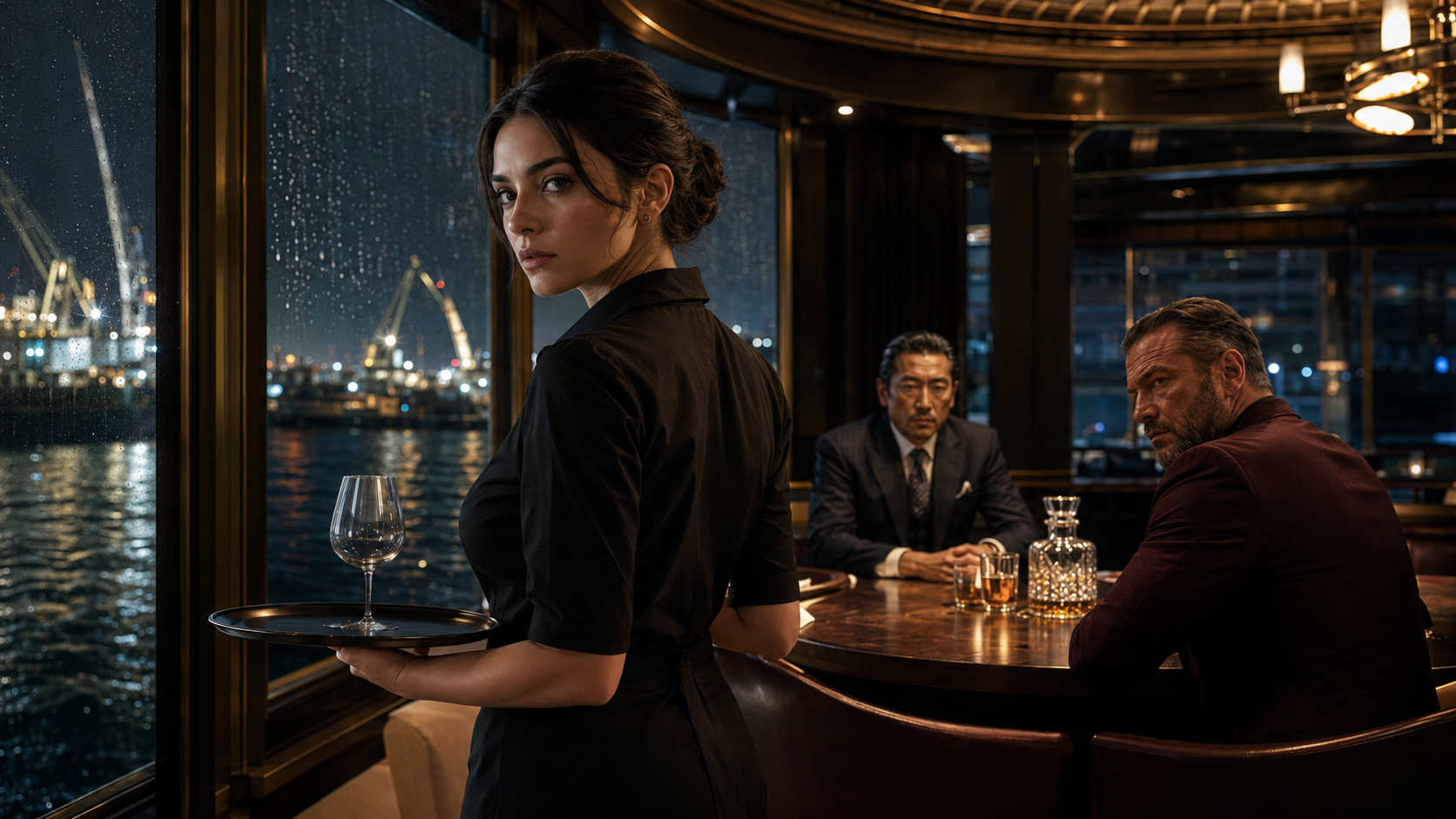
Nobody at the Lantern Room ever looked twice at Mira Vale.
That was the first rule of expensive places: the richer the guests, the less visible the staff became. Mira could pour wine beside a senator, clear plates from a table of billionaires, refill water for men who owned half the harbor, and none of them would remember the color of her eyes five minutes later.
She had learned to use that.
A woman who was ignored could hear everything.
And on the night the city nearly went to war, Mira heard too much.
The Lantern Room floated above the black water of Port Mercer, built on old pilings at the edge of the industrial district where the skyline met the cranes. From the dining floor, guests could see the whole harbor glittering through sheets of rain: cargo ships crawling like metal islands, tugboats nudging them into place, red warning lights blinking on the cranes, and beyond them the glass towers of downtown pretending the docks did not exist.
The restaurant smelled of cedar smoke, citrus peel, money, and secrets.
Mira moved between tables with a silver tray balanced on one hand. Her black uniform was plain, her hair pinned tightly at the nape of her neck, her face calm enough to be mistaken for empty. That was what people saw when they bothered to see her at all.
A quiet waitress.
A woman paid to smile and disappear.
At table twelve, a man in a navy suit snapped his fingers without looking up.
Mira turned before the sound finished.
“Yes, sir?”
“Another bottle,” he said, tapping the empty one with two thick fingers. “The same.”
“Of course.”
He did not thank her. Men like him believed gratitude was for equals.
Across the room, near the windows, the private table had been prepared for an hour. No menus. No flowers. No candles. Only a black lacquered surface polished until it reflected the ceiling lights like a pool of still water. Six chairs. Two bottles of untouched whiskey. Three security guards standing near the service door, trying not to look like security guards.
Mira had asked no questions.
Questions made people remember you.
At nine seventeen, the first party arrived.
Damon Strake came through the main entrance laughing too loudly. He wore a gray coat over a burgundy suit and moved like a man who believed every room had been waiting for him. His left ear was missing the lower half. Old dockworkers said it had been cut off in a union dispute twenty years ago. Damon said it had been bitten off by a dog. Nobody believed the dog story.
Behind him came four men with flat faces, wet shoulders, and hands that never drifted far from their jackets.
Mira watched them from the service station while polishing a glass that was already clean.
“American side is here,” whispered Tomas, the bartender.
Mira said nothing.
Tomas leaned closer. “You hear who they’re meeting?”
“No.”
“That’s why you’re alive,” he muttered. “You don’t ask.”
“I learned from the best.”
He snorted, but his smile died as the second party entered.
The restaurant changed.
It was not dramatic. No one screamed. No glass shattered. Music kept playing from the hidden speakers. Knives still touched porcelain. But the air tightened, as if every invisible wire in the room had been pulled at once.
Four Japanese men stepped inside first.
Then came the man everyone had been waiting for.
Kaito Ren.
Mira knew his name because the kitchen had been whispering it since lunch. He was younger than she expected, perhaps forty, perhaps less, dressed in a charcoal suit without a tie. He was not large. He did not need to be. He carried stillness like a weapon. His face was composed, almost gentle, but his eyes moved with cold precision over exits, windows, balconies, reflections, staff, guards, and finally Damon Strake.
No smile.
No bow.
No wasted movement.
Beside him walked an older man with silver hair and the calm posture of a priest. Behind them came two bodyguards, both silent, both dangerous in different ways. One was built like a wall. The other was lean, sharp-eyed, and almost bored.
Damon spread his arms.
“Kaito Ren,” he said. “Welcome to Port Mercer.”
Kaito looked at him.
The silver-haired man translated into Japanese.
Kaito answered.
The translator turned back to Damon. “Mr. Ren says he appreciates your hospitality.”
Mira lowered her eyes.
That was not what Kaito had said.
Not exactly.
The translator had softened it.
Kaito had said, This place smells like old fish and new lies.
Mira kept polishing the glass.
Tomas noticed.
“What?” he whispered.
“Nothing.”
But it was not nothing.
Kaito Ren’s Japanese was polished Tokyo boardroom speech. Formal. Controlled. Beautifully clean. But the final word had slipped. Not in standard Japanese. Not in the Osaka dialect Mira heard from tourists. Not in any version most translators would expect from a man like him.