It had been an old island turn of phrase.
A word Mira had not heard since her grandmother died.
Her hand tightened around the stem of the glass.
No.
She pushed the memory down.
That language belonged to a kitchen with paper walls, a woman humming while cutting bitter melon, and a little girl being told never to repeat family words in front of strangers.
Especially not dangerous strangers.
Table twelve snapped again.
Mira moved.
The negotiations began with whiskey.
Damon wanted control of Pier Nine, access to the bonded warehouses, and a guaranteed route through customs inspections twice a week. Kaito wanted silence, punctuality, and the return of three missing containers no one was admitting had been stolen.
They spoke through the silver-haired translator, whose name was Mr. Hoshino. He was good. Very good. He understood tone, insult, threat, and the delicate art of making greed sound like business strategy.
But he did not understand everything.
Mira did.
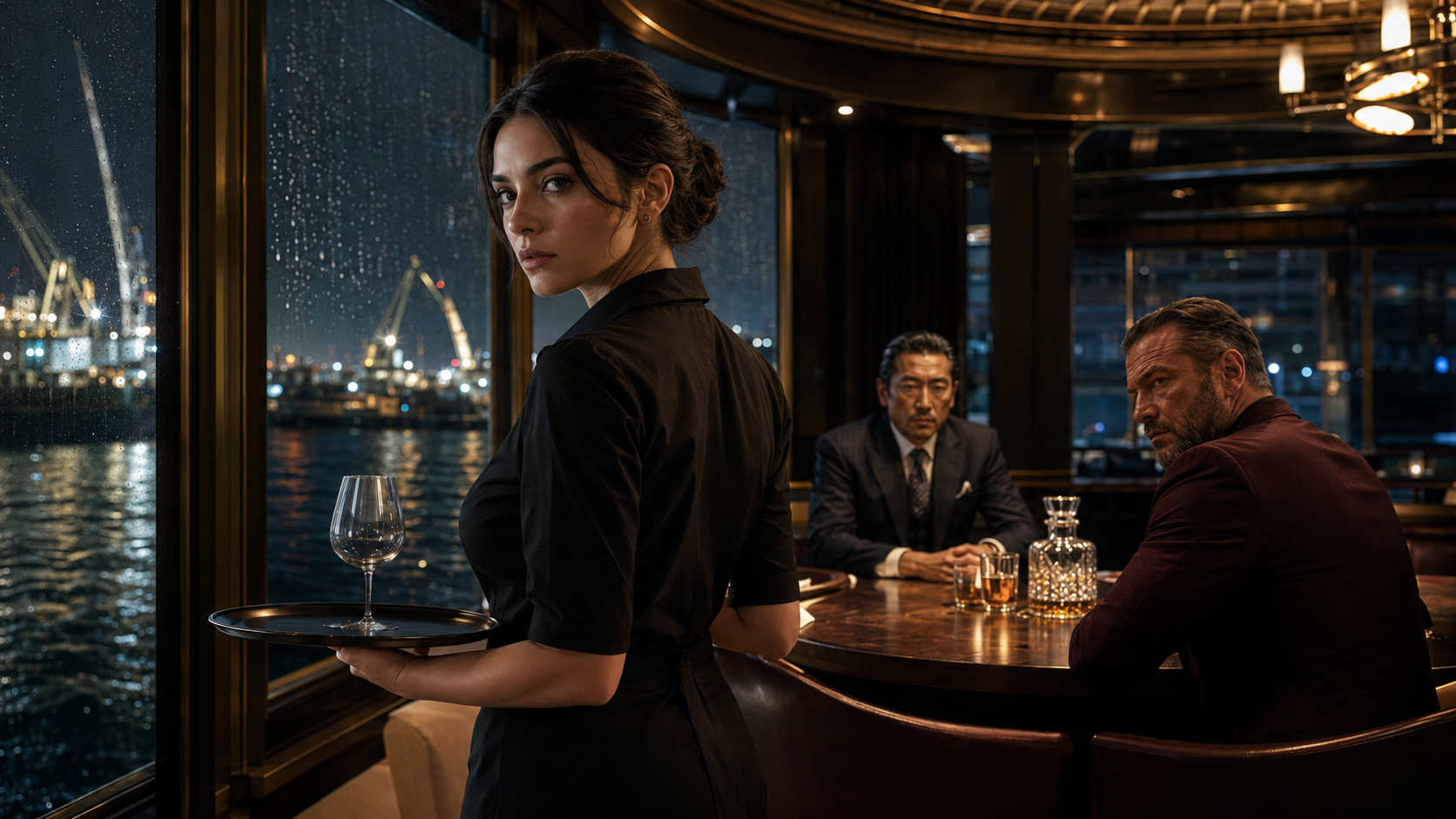
She drifted near the private table with a tray of water glasses.
Damon leaned back, smiling with too many teeth. “Tell him this city runs on arrangements. He wants his product moved, he respects the people who already own the roads.”
Mr. Hoshino translated.
Kaito listened.
Then he said in Japanese, “Roads can be bought. Rivers remember who poisoned them.”
Mr. Hoshino translated, “Mr. Ren says he respects established local influence, but he does not accept inflated costs.”
Damon laughed. “Inflated? That’s cute.”
Mira set down a glass beside Kaito.
His eyes did not move toward her.
But his fingers stopped for half a second on the table.
He had noticed her.
Not as a woman. Not as a waitress.
As a disturbance.
Mira stepped away.
The rain thickened against the windows.
By the kitchen door, Tomas watched with the pale fascination of a man observing a tiger from inside a cage he hoped was strong enough.
“Stop staring,” Mira murmured as she passed him.
“I’m not staring.”
“You are practically waving.”
“I’m nervous.”
“Then clean something.”
He grabbed a towel and began wiping the same section of bar.
At the private table, Damon’s smile had become meaner.
“You tell your boss,” Damon said, pointing at Mr. Hoshino with his glass, “that I did not invite him here so he could lecture me about costs. My people bled on these docks before he could spell America.”
Mr. Hoshino’s expression did not change.
He translated.
Kaito looked out at the harbor. For a moment, his reflection hovered in the rain-streaked glass like a ghost.
Then he answered quietly.
Mr. Hoshino translated, “Mr. Ren says blood is not a receipt.”
Damon’s men shifted.
Kaito’s men did not.
Mira felt the room lean toward violence.
She had seen it before. Not in rooms like this, not with silk napkins and three-hundred-dollar whiskey, but in apartments where men lowered their voices before raising their fists. Violence had a rhythm. It breathed in before it struck.
Damon placed a folder on the table.
“Fine,” he said. “Let’s talk real numbers. Forty percent of all Pacific freight through Port Mercer. Shared access to Warehouse Seven. And my approval on every outside contractor you bring within five miles of the harbor.”
Mr. Hoshino translated.
Kaito’s face did not move.
But the lean bodyguard’s eyes sharpened.
Mira felt it, too.
Warehouse Seven.
The words entered the room like a lit match.
Kaito answered in Japanese. His voice was soft.
Mr. Hoshino began to translate, then stopped.
Only for a breath.
A tiny break.
Almost invisible.
But Mira saw it.
Mr. Hoshino said, “Mr. Ren refuses Warehouse Seven.”
Damon’s smile faded. “Refuses?”
“He is prepared to offer you twenty-two percent and route protection fees. No warehouse access.”
Damon leaned forward. “You tell him Warehouse Seven is not optional.”
Mr. Hoshino translated.
Kaito spoke again, colder now.
“Ask him who told him to ask for it.”
Mr. Hoshino translated.
Damon lifted one shoulder. “Nobody tells me what to ask for.”
Mira was pouring water at the next table when Damon’s right-hand man leaned close to him and muttered something too low for most people to hear.
Most people.
Mira heard it.
“Rourke said don’t leave without Seven.”
The name went through her like a needle.
Rourke.
Not Damon Strake’s superior. Not a dock boss. Not even a local player.
Elias Rourke was a lawyer with clean hands and a charity board smile. He represented port unions, shipping companies, judges, and men who never appeared in the same room as a crime. If his name was in this room, then this was not a negotiation.
It was a trap.
Mira should have walked away.
She should have gone to the kitchen, untied her apron, taken her coat from the staff locker, and disappeared into the rain. That was what her grandmother would have told her.
When wolves argue, little birds do not sing.