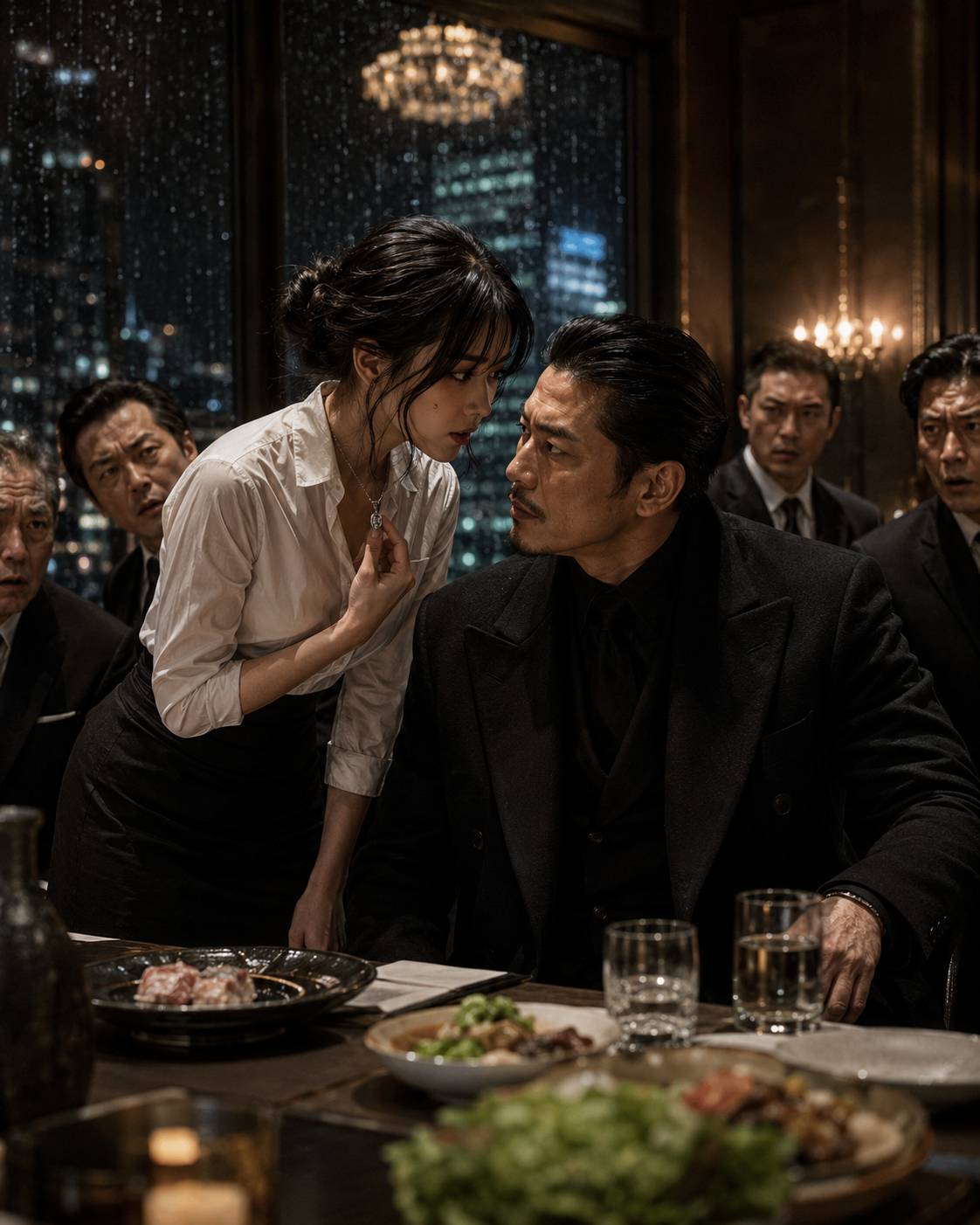
Kenji saw it too.
“Who taught you?” he asked.
“No one important.”
“People who say that are usually lying.”
Clara straightened.
“I am here to serve dinner, Mr. Arakawa. Not history.”
Marco slapped the table.
“What the hell is this? Why is the waitress talking?”
Kenji did not look away from Clara.
“Because she is better than the man you paid to lie to me.”
Oliver flushed. “I was not lying.”
Clara turned to him, her voice still calm. “You softened every threat, missed every insult, and failed to translate the only sentence in this room that mattered.”
Marco rose halfway out of his chair.
“Careful, sweetheart.”
Kenji’s fingers rested on the table.
Only that.
Still, Marco’s men stiffened.
Clara had seen storms gather with less warning.
She lifted one hand slowly, palm open, not toward Kenji or Marco, but toward the whole room.
“Everyone came here to leave richer than they arrived,” she said. “No one came here to explain gunfire to police over dessert.”
Marco’s eyes narrowed.
“You think you can talk to me like that?”
“No,” Clara said. “I think you can still take the twenty percent you were going to accept before someone told you to ask about Warehouse Nine.”
Kenji’s mouth curved slightly.
Not a smile.
Recognition.
Marco looked at his men. One of them gave the smallest nod. Clara saw the calculation move across the table. Twenty percent of Arakawa’s Pacific route was more than Santoro’s people made in months.
Marco sat back down.
“Fine. Twenty. No Warehouse Nine. But Carlo Vescari approves the final terms tomorrow.”
At that name, Kenji’s gaze hardened.
Clara heard it.
Carlo Vescari was not supposed to be part of this meeting. Not if this was only about shipping. Not if this was only about money.
Documents appeared. Pens moved. Men signed papers with expensive ink and murderous patience.
For five fragile minutes, Clara thought she had prevented a disaster.
Then she saw the window.
Not the window itself.
The reflection.
Outside, across the narrow service alley, a black maintenance van rolled to a stop with its headlights off. Rain ran down the glass, twisting the reflection, but Clara saw enough.
The side door opened.
A dark figure leaned out.
Not toward Marco.
Not toward Dante.
Toward Kenji.
Clara did not think.
She moved.
“Down!” she shouted in Japanese.
She slammed into Kenji’s side just as the window exploded.
The private dining room shattered into chaos.
Glass rained over the white tablecloths. Wine burst across marble. Men shouted in three languages. Someone screamed in the main restaurant beyond the doors. Kenji hit the floor with Clara beneath him, then rolled instantly, putting his body between her and the broken window.
A piece of glass had cut her wrist.
She barely felt it.
Dante Cross moved like a wall coming alive. Silas vanished into motion. Marco’s men were no longer pretending to be partners.
They were firing across the room.
At Kenji’s people.
“It was a trap,” Clara gasped.
Kenji looked down at her. No panic. No surprise. Just cold understanding.
“You saw it first.”
“The van. South alley. Two men, maybe three.”
“Stay low.”
He rose before she could answer.
Clara pressed herself against the carpet as the world tore itself apart above her. Marco backed toward the side exit, face twisted with fury. He had planned for Kenji to die in the first burst.
He had not planned for a waitress to ruin the timing.
Kenji moved through the chaos with terrifying calm. He did not waste movement. He did not shout. He simply advanced until Marco had nowhere left to go.
“Vescari sends his regards,” Marco spat.
Kenji’s voice was quiet.
“Then I will answer him in person.”
A final crack of sound split the room.
Then the gunfire faded.
The maintenance van screamed away into the rain.
For a few seconds, nobody moved.
Then the world returned.
Sprinklers hissed. Sirens rose in the distance. The main restaurant was full of terrified diners being pushed toward the exits. Dante pressed a hand to his wounded shoulder. Silas stood near the broken window, expression unreadable.
Kenji came back to Clara.
His coat was torn. A thin line of blood marked his cheek. He looked less like a businessman now and more like the kind of man people warned children about in whispers.
He crouched before her.
“You saved my life,” he said in Japanese.
Clara gave a shaky laugh. “I think I ruined the tasting menu.”
His eyes moved over her face, her cut hands, her ruined uniform.
“You are not a waitress.”
“I am absolutely a waitress.”
“Not anymore.”
Those two words unsettled her more than the bullets had.
Because they did not sound like possession.
They sounded like recognition.
And recognition was dangerous.
That was how lonely people became loyal to men who could destroy them.
Dante approached, pale but steady.