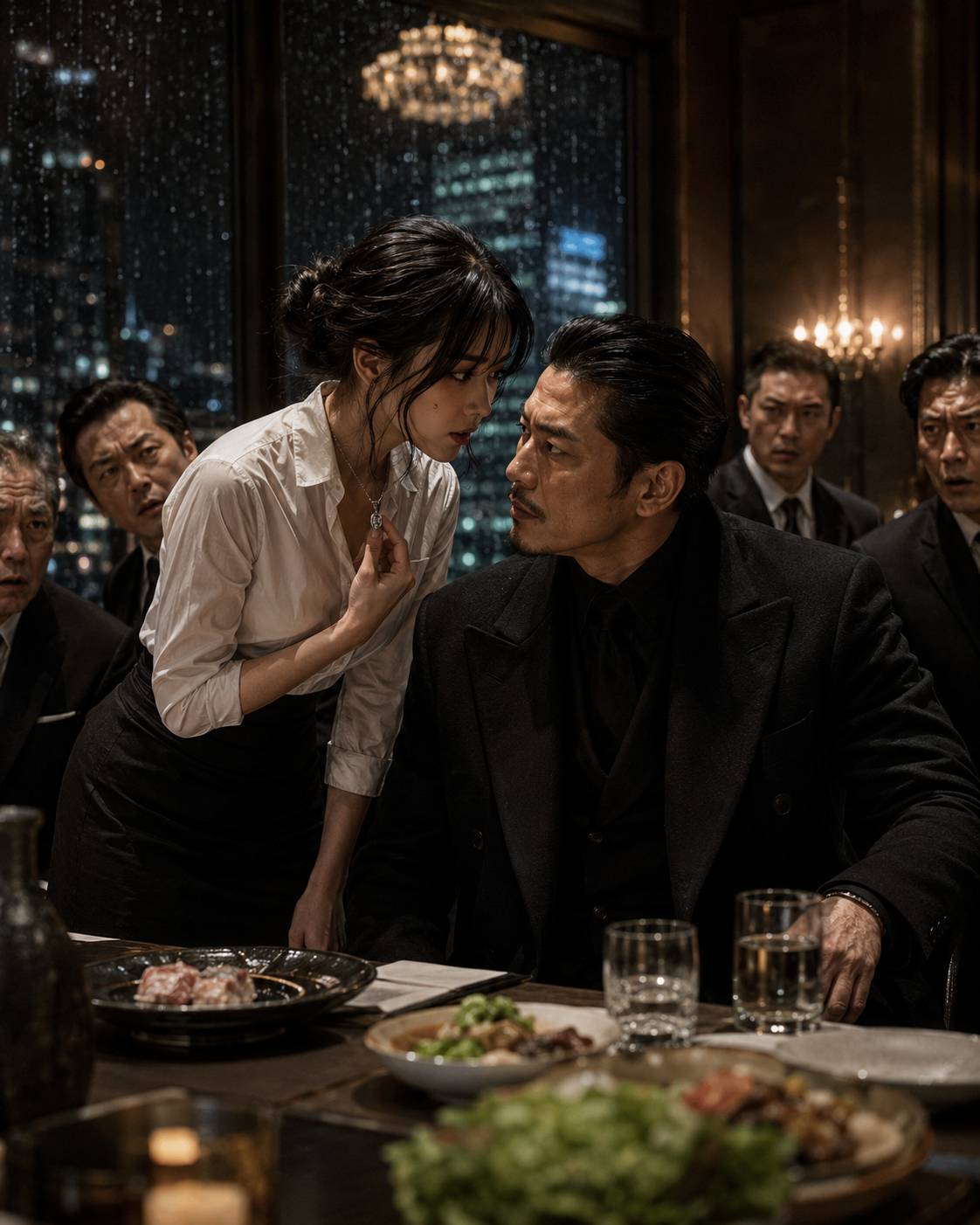
“Police in ninety seconds.”
Kenji stood and offered Clara his hand.
“We leave.”
Clara did not take it.
“No.”
The men around them froze.
Kenji looked at her. “No?”
“I saved you. That does not make me yours.”
A faint spark moved through his eyes.
“I did not say you were mine.”
“You said we leave.”
“Because if you stay, you die.”
The words landed harder than any command.
Kenji lowered his voice. “Santoro’s people will watch the footage. Vescari will learn you translated the warning, saw the shooters, and pulled me down before the first shot. He will not care that you carry plates for a living. He will make you an example.”
Clara looked around the ruined room.
Her job was gone.
Her anonymity was gone.
Her carefully built life had broken in less than thirty minutes.
Still, she lifted her chin.
“I have an apartment.”
“They will find it.”
“I have neighbors.”
“They will use them.”
“I have a choice.”
Kenji held her gaze.
“Yes,” he said. “You do.”
That stopped her.
He removed a clean handkerchief from his coat and wrapped it carefully around her bleeding hand without gripping her wrist.
“You can walk out the front door and trust a city that will pretend this room never existed. Or you can walk out the back with me and stay alive long enough to decide what happens next.”
Clara thought of her father’s last warning.
If they hear you speak that way, run.
So Clara ran.
But this time, she ran beside the danger instead of away from it.
The back exit opened into rain and flashing red light.
Black SUVs waited in the alley. Men with earpieces formed a wall around her. Dante climbed into one vehicle with a medic. Silas took the front passenger seat of another, calm as a knife in a drawer.
Kenji sat beside Clara in the center SUV.
He did not touch her unless necessary.
Somehow that frightened her more.
Men who grabbed were easy to hate. Men who gave space while taking control were harder to understand.
Chicago blurred beyond tinted glass. Rain turned neon signs into ribbons. Clara watched Sterling Room disappear behind police lights and emergency workers.
Her old life lay behind her in broken glass.
Kenji spoke rapidly into his phone in Japanese. He ordered roads watched, accounts frozen, safe houses opened, cameras erased, hospitals paid, names checked.
Clara listened despite herself.
His orders were ruthless, but not reckless. He wanted shooters found alive if possible. He wanted Vescari’s routes watched, not families touched. He wanted Santoro’s surviving men separated, not slaughtered.
Alive.
That word mattered.
When the call ended, Kenji looked at her.
“You are listening again.”
“I’m trapped in a car with you. Listening seems sensible.”
“You are angry.”
“I was shot at and then escorted into a stranger’s vehicle by criminals.”
“You chose to come.”
“I chose not to be murdered in my apartment.”
“That is still a choice.”
Clara laughed once, sharp and humorless.
“Men like you love saying that.”
The SUV went quiet.
Kenji studied her.
“Men like me?”
“Men with money. Men with private doctors. Men who create storms and then offer umbrellas.”
Silas glanced back from the front seat.
Kenji did not punish the insult.
He turned toward the window.
“Yes,” he said quietly. “That is what men like me often do.”
The honesty stole a little of her anger.
They stopped at a converted warehouse in the West Loop, the kind of building that looked industrial from the outside and untouchable from within.
Kenji’s penthouse was not what Clara expected.
No gold statues.
No velvet throne.
No ridiculous display of power.
It was quiet. Pale walls, dark wood, winter photographs of Lake Michigan, shelves of old books, a bonsai beneath a warm lamp, and a framed ink painting of a sparrow on a branch.
Clara stared at the sparrow too long.
Kenji noticed.
A doctor arrived and cleaned the cuts in her hands. No stitches. Just bandages and a warning to rest, which was funny because rest had not survived the evening either.
When the doctor left, Kenji brought her tea.
Clara stared at the cup.
“Is this safe?”
“Yes.”
“That is what someone would say if it wasn’t.”
“If I wanted you dead, Miss Bennett, tea would be an inefficient method.”
She took the cup because her hands were shaking and she hated that he saw.
For a while, neither spoke.
Then Kenji said, “Your father was not a restaurant supplier.”
Clara’s cup stopped halfway to her mouth.
There it was.
The door she had spent years holding closed.
“My father is dead.”
“That was not my question.”
“No,” she said. “It was a trap dressed as a statement.”
Kenji sat across from her, not beside her.
“My men heard your dialect. They saw your bow. Silas noticed your pendant. You reacted to Warehouse Nine as if it had a pulse.”
Clara’s fingers went to the silver charm beneath her blouse.