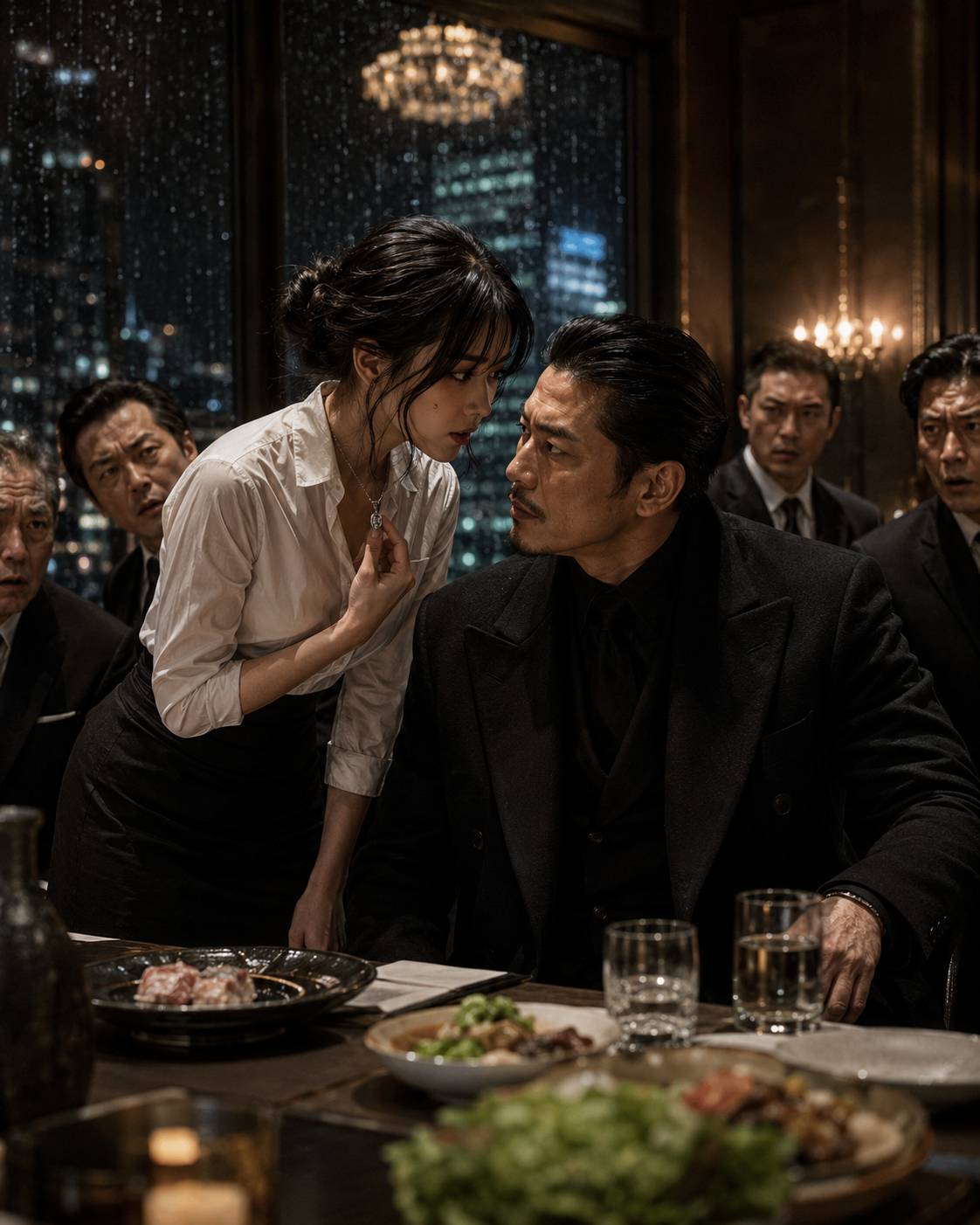
Nobody noticed the waitress until the room went silent.
That was how Clara Bennett had survived for twelve years.
She knew how to refill water without interrupting a sentence, how to replace a dirty plate before a rich man remembered he had finished eating, how to lower her eyes just enough to look harmless without looking afraid. At Sterling Room, one of Chicago’s most expensive private restaurants, invisibility was practically part of the uniform.
White blouse.
Black skirt.
Polished shoes.
Quiet hands.
No opinions.
No past.
No name worth remembering.
That night, the private dining room had been reserved under a false company name. Clara knew it was false because real executives did not arrive with men who scanned exits before removing their coats. They did not ask for the windows to be covered. They did not send the regular interpreter ahead to check every chair, every flower arrangement, every service door.
And they certainly did not make the manager whisper, “Clara, keep your head down tonight. These are not people you want noticing you.”
Clara had almost laughed.
That was exactly why she was good at her job.
The first group arrived at eight.
Marco Santoro entered like a man who believed the city owed him rent. Broad shoulders, silver tie, heavy rings, smile too bright to be friendly. His men spread behind him with the lazy confidence of people who had never cleaned up their own messes.
The second group arrived seven minutes later.
They did not smile.
At the center walked Kenji Arakawa.
He was not the tallest man in the room. He did not need to be. Power moved around him before he spoke, clearing space as if the air itself had learned discipline. His black coat was cut simply, his hair combed back, his face calm in the way deep water was calm.
Behind him came two men.
Dante Cross, broad, scarred, and suspicious of everything with a pulse.
And Silas Ward, thinner, quieter, with pale eyes that noticed too much.
Clara felt those eyes pass over her once while she poured tea.
She kept her breathing even.
She had spent half her life avoiding men who noticed too much.
The hired interpreter, Oliver Grant, stood near the table with a tablet in his hand and arrogance in his posture. He had been recommended by someone important, which meant no one had questioned whether he was good.
He was not.
Clara knew that within three sentences.
Marco leaned back and spoke first.
“Tell him Chicago is not Kyoto. He does not get to walk into my city and demand river access like he owns the bridges.”
Oliver translated into formal Japanese, stiff and wrong.
“Mr. Santoro welcomes your interest in local transportation and hopes for mutual respect.”
Clara kept her face blank.
Kenji’s eyes did not move, but something in his expression sharpened.
Marco continued, “We give him twenty percent of the river intake, no more. He stays away from Dock Nine. And if he tries to bring Osaka rules here, I’ll feed his empire to the unions piece by piece.”
Oliver swallowed and translated, “Mr. Santoro offers a fair partnership of twenty percent and asks that certain docks remain under local management.”
Clara placed a bowl of miso soup beside Kenji.
His gaze flicked to her hands.
Just once.
Then Marco said the sentence that made her blood turn cold.
“And tell him if he touches Warehouse Nine, I’ll make sure the old ghosts in that place wake up hungry.”
Oliver hesitated.
He did not know how to translate that.
Because he did not understand what had just been said.
But Clara did.
Warehouse Nine.
Old ghosts.
Her fingers tightened around the tray.
Kenji noticed.
So did Silas.
Clara lowered her eyes quickly, but it was too late.
Oliver began, “Mr. Santoro says there may be complications regarding storage—”
“No,” Clara said.
The word left her mouth before fear could stop it.
Every head turned.
The manager, standing near the service door, went white.
Marco stared at her as if the furniture had interrupted him.
Oliver blinked. “Excuse me?”
Clara looked at Kenji.
And in a soft Osaka dialect she had not spoken aloud in years, she said, “He did not say storage. He warned you away from Warehouse Nine because someone told him it matters.”
The room changed.
Not loudly.
No chair overturned. No man shouted. No glass broke.
But the air shifted as if a wire had been pulled tight across every throat.
Kenji looked at her fully now.
For the first time that evening, the invisible waitress became the most important person in the room.
“You understand Kansai-ben,” he said in the same dialect.
Clara’s heart slammed once against her ribs.
“I understand enough.”
Dante Cross stepped closer. His hand did not move toward a weapon, but his whole body became one.
Silas Ward watched Clara’s neck.
She remembered the silver pendant under her collar and felt a flash of panic.