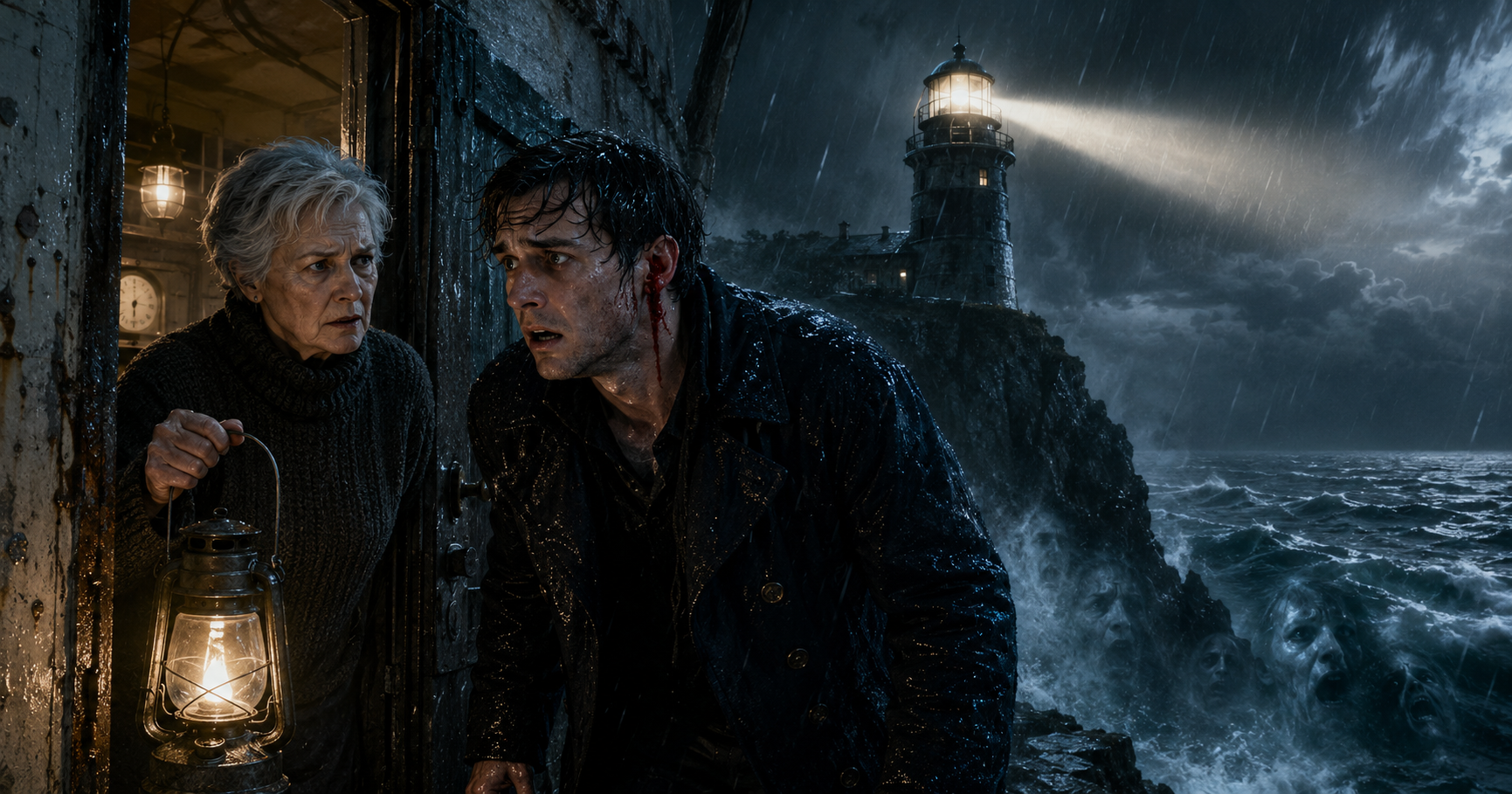
“DON’T LET ME HEAR IT AGAIN!”
The cry rose above the wind and struck the lighthouse door a heartbeat before the man did.
Miriam Voss barely managed to lift the iron latch before Ellis Rook collapsed across the threshold.
Rainwater streamed from his coat. One boot was missing. Blood covered the left side of his neck and disappeared beneath the collar of his sweater. He pressed both hands over his ears as though trying to hold his skull together.
Behind him, the midnight sea battered the cliffs of Griefwater Point.
The old lighthouse trembled with every wave.
Miriam dragged Ellis inside and forced the door shut. Wind screamed through the narrowing gap until the lock caught.
“Ellis, look at me.”
He remained on his knees.
His shoulders shook.
“Please,” he whispered. “Make it stop listening.”
Miriam stared at him.
“Listening to what?”
Ellis slowly raised his head.
He was thirty-two, strong, stubborn and usually incapable of admitting fear. He maintained the hydrophones and navigation buoys along the northern coast. Three weeks earlier, he had repaired the lighthouse generator while joking that the building was old enough to remember the invention of darkness.
Now his face looked gray.
A thin line of blood ran from his left ear.
Miriam reached toward him.
Ellis recoiled so violently that his back struck the door.
“No!”
“I need to examine you.”
“You can’t touch it.”
“Touch what?”
His eyes shifted toward the spiral staircase leading down to the sealed lower chambers.
“The thing that followed me from the listening station.”
The lighthouse lantern rotated overhead.
A blade of white light crossed the windows, swept over the black sea and vanished into the storm.
Miriam had lived at Griefwater Point for twenty-seven years. Before that, she had worked as an emergency surgeon in the naval hospital at Caldrin Bay. She had removed bullets, pieces of machinery, fishhooks and shattered bone from men who had believed themselves impossible to kill.
She did not believe in ghosts.
She did not believe the stories fishermen told about drowned voices beneath the cliffs.
But she believed Ellis was injured.
That was enough.
“Come into the radio room,” she said.
“I can hear them in there.”
“The radio hasn’t worked in twelve years.”
“They don’t need the radio.”
He winced and clutched the side of his head.
Something moved beneath the skin below his ear.
Miriam saw it clearly.
A narrow ripple traveled down his jaw, paused near his throat and then slid upward again.
It was not a vein.
It was not a muscle spasm.
It moved with purpose.
Ellis saw the change in her expression.
“You believe me now.”
“I believe something is inside you.”
“That isn’t the worst part.”
Miriam placed his arm over her shoulder and helped him stand.
“What is the worst part?”
Ellis leaned close enough that she smelled saltwater and blood on his breath.
“It knows which voices you’ll answer.”
The radio room occupied the eastern side of the lighthouse. Its walls were crowded with rusted instruments, dead monitors and emergency maps whose coastlines had faded to pale blue veins. A heavy wooden desk stood beneath the window.
Miriam pushed the maps aside and made Ellis sit beneath the brightest lamp.
“Hands on your knees,” she instructed.
“I might hit you.”
“Then I’ll hit you back.”
“I’m serious.”
“So am I.”
She opened the medical cabinet mounted beside the radio equipment. Most of its contents were old but usable: gauze, antiseptic, surgical scissors, a battery-powered examination lamp and a collection of instruments left from her hospital years.
Ellis watched her select a narrow otoscope.
“What are you doing?”
“Looking.”
“It doesn’t like light.”
“That gives us something in common.”
Lightning flashed beyond the window.
For an instant, the ocean became a field of white teeth.
Miriam tilted Ellis’s head and directed the examination light into his ear.
The outer canal was swollen. Blood coated the skin. Deeper inside, beyond the reach of her smallest forceps, something pale opened and closed.
At first she mistook it for torn tissue.
Then it unfolded.
Four translucent structures pressed against the walls of the ear canal. They resembled the wings of an insect formed from wet glass. At their center was a dark bead no larger than a pepper seed.
The bead rotated toward the light.
Miriam drew back.
The object had no visible eye.
Nevertheless, she felt it looking at her.
“What did you see?” Ellis asked.
“Something attached near the eardrum.”
“Attached?”
“Possibly embedded.”
“Get it out.”
“You just told me not to touch it.”
“I changed my mind.”
“You’re in shock. You don’t get to change your mind every ten seconds.”
A deep note rolled through the lighthouse.
It was lower than thunder.
The glass in the windows vibrated.