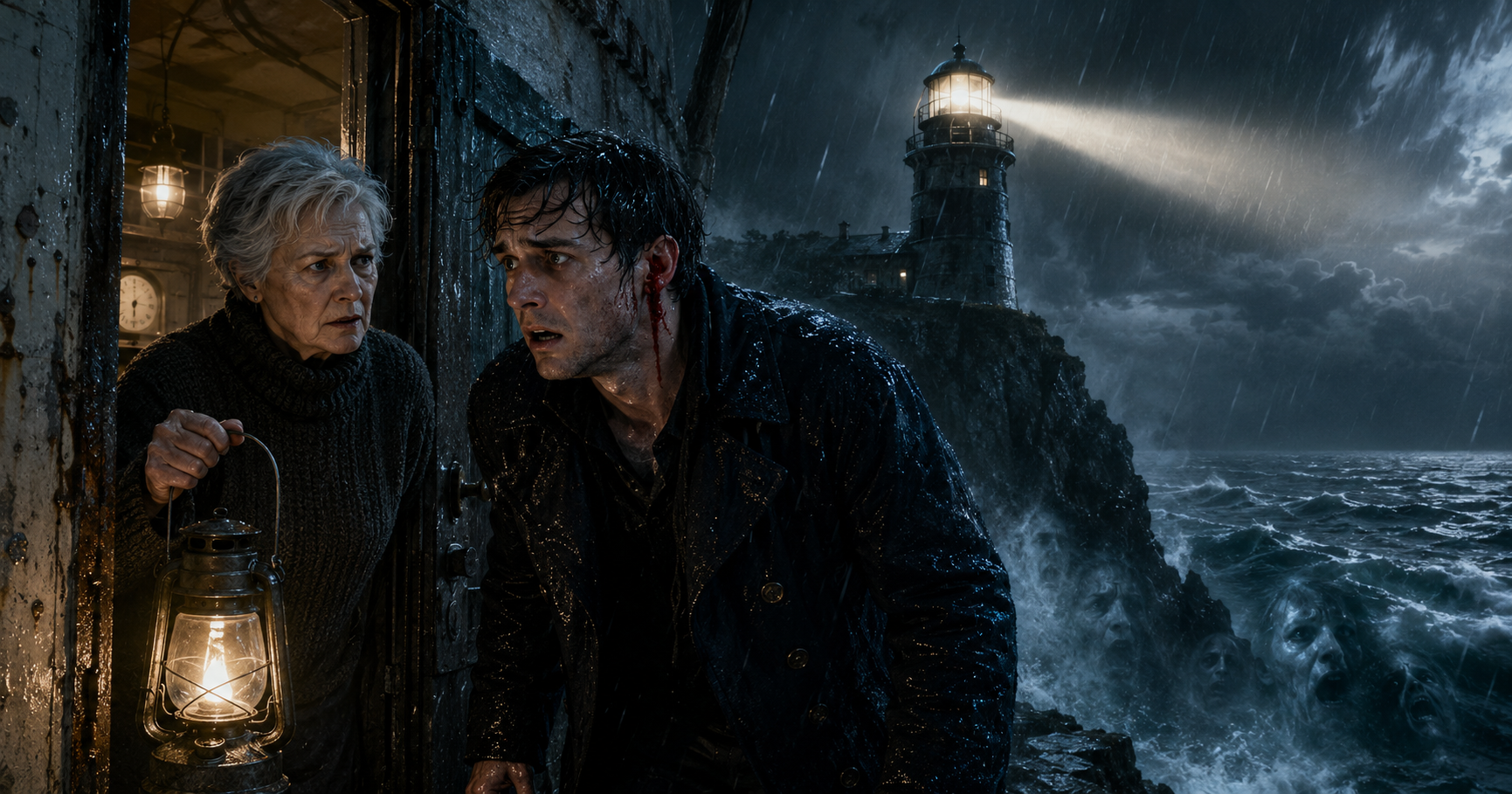
Miriam looked toward the ceiling.
Ellis closed his eyes.
“No,” he whispered.
The note sounded again.
This time it came from beneath them.
From the abandoned foghorn chamber at the base of the lighthouse.
“That system has no power,” Miriam said.
“It isn’t the horn.”
“Then what is it?”
Ellis looked at her with an expression of absolute exhaustion.
“It’s the mouth underneath it.”
Miriam cleaned the blood from his neck while he told her what had happened.
At sunset, Ellis and another technician, Naomi Kells, had sailed to Platform Nine, a concrete listening station built into the reefs three miles north of Griefwater Point. The navy had abandoned it after the northern sonar program ended.
A recent undersea landslide had exposed a maintenance entrance beneath the platform. Ellis and Naomi had been ordered to inspect the damage before the next tide.
They entered through a corroded steel hatch.
The corridor beyond it should have ended after twenty meters.
Instead, it descended.
The station plans showed no lower level, but the stairs continued beneath the waterline. Every landing was dry. The air grew warmer as they went down.
At the bottom, they discovered a circular chamber lined with hundreds of brass listening tubes.
Each tube entered the wall.
Each tube was shaped like a human ear.
“There was a chair in the center,” Ellis said. “Leather straps on the arms. A metal hood above it.”
Miriam stopped cleaning his wound.
“A restraint chair?”
“I don’t know.”
“You know exactly what a restraint chair looks like.”
Ellis said nothing.
“What did Naomi do?”
“She heard her father.”
“Her father lives in Bellstrand.”
“He died last winter.”
The lighthouse groaned.
Ellis continued in a quieter voice.
“Naomi heard him inside one of the tubes. He said he was cold. He asked her to come closer.”
“And she did.”
“I tried to stop her.”
“But she did.”
Ellis nodded.
“She put her ear against the tube. At first she smiled. Then she started crying. She said he had forgiven her.”
“For what?”
“She never told me.”
“What happened next?”
“She answered him.”
Miriam waited.
Ellis’s fingers tightened around his knees.
“The moment she spoke, every tube in the chamber answered.”
The lamp above them flickered.
“Hundreds of voices,” Ellis said. “Men, women, children. Some were begging. Some were laughing. Some were praying. They all spoke at once, but I understood every word.”
Miriam felt a pressure building behind her eyes.
“What did they say?”
“My name.”
The pale thing inside Ellis’s ear shifted.
He gasped and gripped the desk.
Miriam steadied him.
“Where is Naomi?”
“I don’t know.”
“You left her?”
“The lights went out. Something opened beneath the chair. I heard water, but none came into the room. Naomi began singing.”
“Singing what?”
“A lullaby.”
Ellis looked toward the dead radio.
“My mother used to sing the same one.”
Static burst from the radio speaker.
Both of them froze.
The equipment was disconnected from the power supply.
Miriam knew because she had cut the cables herself years ago.
The static thickened.
A woman’s voice emerged from it.
Soft.
Distant.
Almost buried beneath the hiss.
“Miri?”
Miriam’s breath stopped.
No one had called her that for twenty-seven years.
Ellis turned toward her.
“You know the voice.”
The speaker crackled.
“Miri, are you there?”
Miriam remembered a red scarf blowing along a harbor wall.
Two girls running through summer rain.
A hand squeezing hers beneath a hospital blanket.
Celia.
Her younger sister.
Lost during the Griefwater evacuation.
No body had ever been recovered.
“Miri,” the radio whispered. “I waited for you.”
Miriam moved toward the desk.
Ellis caught her wrist.
“Don’t answer.”
“That recording can’t exist.”
“It isn’t a recording.”
“My sister disappeared before this equipment was installed.”
“Miriam.”
Celia’s voice came from the speaker again, clearer now.
“You promised you would come back.”
Miriam’s eyes filled with tears.
She remembered the promise.
She had never spoken of it to anyone.
On the night of the evacuation, Miriam had been ordered to treat the injured aboard a rescue vessel. Celia had remained in the lighthouse with six communications officers.
Miriam had promised to return before the last boat left.
She had not returned.
The storm had swallowed the lighthouse road, the communications room and everyone inside it.
Only the upper tower survived.
“Miriam,” Ellis said firmly. “Look at me.”
She forced herself to turn away from the radio.
The voice continued.
“You left me here.”
Miriam pulled the radio cable from the wall.
The speaker kept talking.
“You heard me calling.”
She seized a brass lamp and smashed it into the radio.
The casing split.
Vacuum tubes shattered.