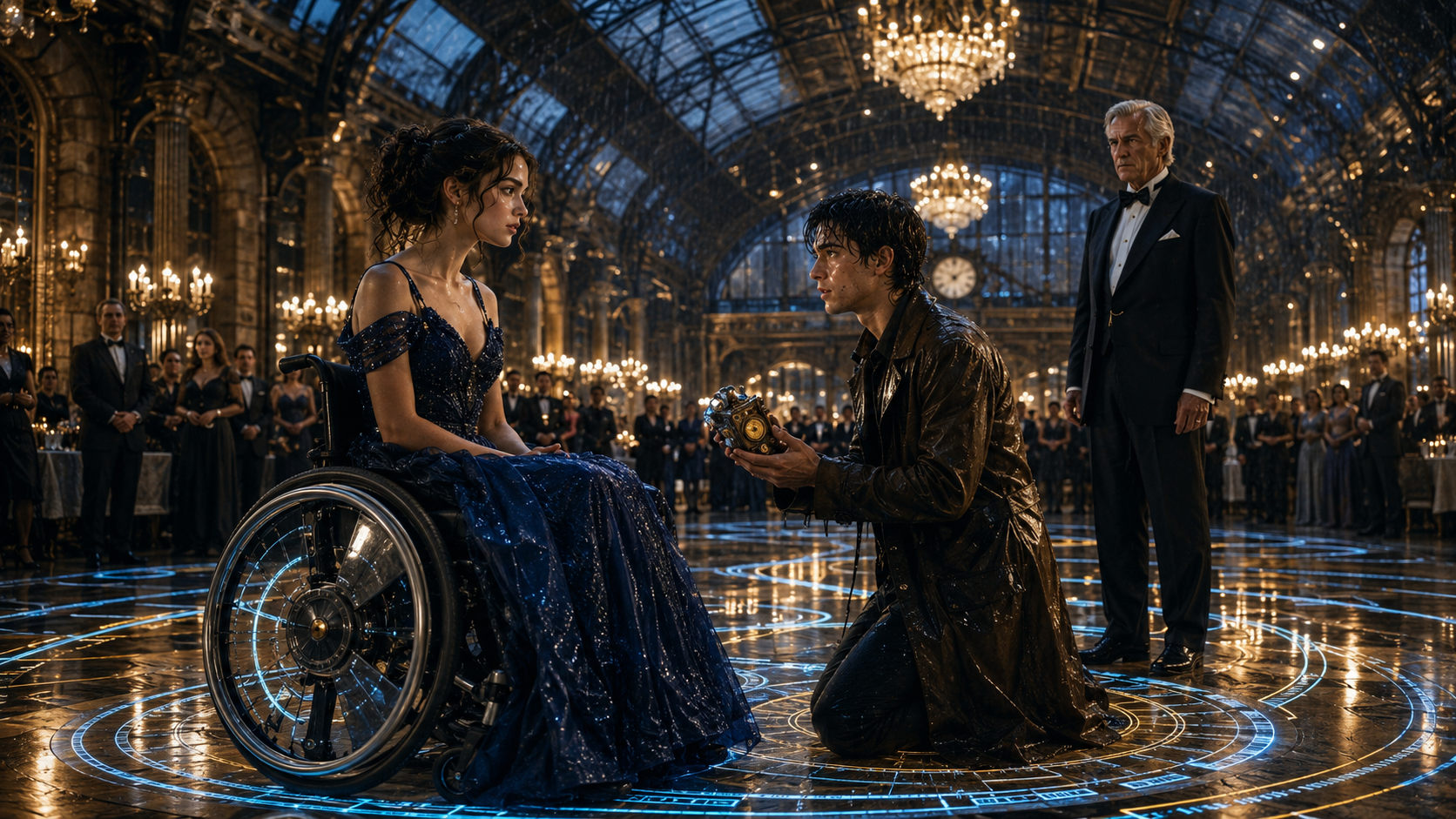
The Stranger at the Midnight Gala Asked the Billionaire’s Daughter to Lead the Dance

By the time the orchestra began its first waltz, Meridian Hall no longer looked like an abandoned railway station.

Thousands of candles glowed beneath the restored glass roof. White roses climbed the iron columns, crystal chandeliers hung above the old platforms, and waiters moved through the crowd carrying silver trays of champagne.

Politicians, actors, investors, and heirs had gathered to celebrate the launch of the Sterling Foundation’s newest project: a revolutionary mobility system known as Aster One.

At the center of the ballroom sat seventeen-year-old Mira Sterling.

Her midnight-blue dress had been designed to fall perfectly around her wheelchair. Tiny silver threads shimmered across the fabric whenever she moved, making her look as though she were wrapped in a piece of the night sky.

Guests stopped beside her every few minutes.

They praised her courage.

They told her she was inspiring.

They spoke slowly and gently, as though the accident that had damaged her spine had also taken away her ability to understand ordinary conversation.

Mira smiled because she had been trained to smile.

Her father had taught her how.

Conrad Sterling stood a few steps away, surrounded by reporters and potential investors. Tall, silver-haired, and perfectly composed, he possessed the calm confidence of a man who had never been forced to accept the word no.

“Tonight is not merely about technology,” he announced from the stage. “It is about giving independence back to those who have lost it.”

The audience applauded.

A spotlight found Mira.

She lifted one hand and smiled again.

Nobody noticed that her fingers were clenched around the edge of her chair.

Aster One was being presented as her father’s greatest invention. Its sensors could respond to body movement, guide a wheelchair through crowded rooms, and communicate with lights, doors, and other devices.

The newspapers called it a miracle.

Mira called it familiar.

The first time she saw the design, she had recognized the curved control panel, the circular movement patterns, and the sequence of blue, gold, and white lights.

She had drawn those patterns when she was nine years old.

But she had not drawn them alone.

“Ladies and gentlemen,” Conrad continued, “my daughter’s strength inspired every detail of this system.”

Mira looked at him.

He did not look back.

A sudden metallic sound came from the entrance.

One of the golden doors had been pushed open.

Cold rain blew into the ballroom.

The orchestra lost its rhythm.

A young man stood in the doorway.

He was perhaps eighteen, with dark hair plastered against his forehead and rain running from his worn brown coat. Heavy work boots left muddy marks across the polished floor. A canvas bag hung from one shoulder, and he carried a small brass device in his right hand.

Two security guards immediately approached him.

“This is a private event,” one said.

“I know.”

“Invitation?”

“I wasn’t invited.”

Several guests laughed.

Conrad stopped speaking.

The young man looked past the guards, past the reporters, and past the enormous Aster One display.

His eyes found Mira.

For the first time that evening, her practiced smile disappeared.

The young man raised two fingers to his lips and whistled three notes.

Low.

High.

Low.

Mira’s heart seemed to stop.

She had not heard that signal in eight years.

“Julian?” she whispered.

The guards seized his arms.

“Wait!” Mira called.

Her voice cut through the ballroom.

Everyone turned toward her.

Conrad stepped down from the stage.

“Mira, you don’t know this person.”

“Yes,” she said. “I do.”

Julian Cross did not resist as the guards held him. He simply watched her with the same serious gray eyes she remembered from childhood.

His face had changed.

His voice would be deeper now.

But the three-note signal belonged to only one person.

Conrad approached him.

“How did you get inside?”

“Through the maintenance tunnel beneath Platform Nine.”

“That tunnel has been locked for years.”

Julian glanced at the brass device in his hand.

“Locks are only difficult when you don’t know who built them.”

Conrad’s expression hardened.

“Remove him.”

Mira moved her wheelchair forward.

“I said wait.”

The guests exchanged surprised looks. Mira had appeared beside her father at hundreds of public events, but she had never interrupted him before.

Julian gently pulled his arms free when the guards hesitated.

Then he walked toward her.

Mud darkened the floor behind him. Diamonds flashed as people moved out of his way. The orchestra had stopped completely, leaving only the sound of the rain striking the glass roof.

When Julian reached Mira, he lowered himself onto one knee.

Conrad’s jaw tightened.

Julian placed the brass device on the floor between them.

It resembled an old railway switch, though several wires and tiny lights had been added to its sides.

“Mira Sterling,” he said, “will you finish the dance we started?”

A wave of whispers passed through the room.

Mira stared at him.

“That dance was a game.”

“No,” Julian replied. “That was the beginning.”

Conrad stepped closer.

“You need to leave.”

Julian leaned toward Mira before the guards could reach him again.

His voice dropped to a whisper.

“Your mother hid the original designs inside Signal Box Nine.”

Mira’s breath caught.

Behind her, a champagne glass slipped from someone’s hand and shattered.

Conrad had gone completely still.

Julian noticed.

“So you do remember,” he said.

Conrad recovered quickly.

“This boy is lying.”

“Then let us open the signal box,” Mira answered.

“There is nothing inside it.”

“You answered very quickly.”

“Mira, this is neither the time nor the place.”

She looked around at the cameras, investors, and enormous screens displaying the Sterling Foundation logo.

“It seems like the perfect place.”

Eight years earlier, Meridian Hall had not contained chandeliers or marble bars.

It had been a silent railway station waiting to be demolished.

Mira had visited it during the long months following her accident. Her mother, Evelyn Sterling, believed the open space would make physical rehabilitation feel less like a punishment.

Julian’s father had been the station’s final caretaker.

While the adults discussed legal documents, Mira and Julian explored the empty platforms.

At first, she had refused to speak to him.

She was angry at her body, angry at her parents, and angry at every doctor who promised that time would make things easier.

Julian never told her to be grateful.

He never called her brave.

He simply tied pieces of colored glass to the wheels of her chair and watched them throw light across the station floor.

One afternoon, he painted circles on the ground with blue chalk.

“What are those?” Mira asked.

“Dance steps.”

“I can’t do dance steps.”

“Then we’ll use dance wheels.”

He stood inside the first circle while she positioned her chair inside the second.

When she turned left, he moved right.

When she rolled backward, he stepped forward.

They collided constantly.

They argued.

They laughed.

Eventually, they created a sequence of movements that carried them across the entire platform.

Evelyn watched from the shadows.

Instead of stopping them, she brought an old box filled with discarded railway switches, wires, and colored signal lamps.

Over the following weeks, the three of them built a simple system. When Mira turned her chair, sensors activated lights along the platform. Julian added music using parts from a broken station clock.

They called it the Signal Dance.

Evelyn called it the future.

Then everything changed.

Julian’s father was accused of stealing an expensive necklace from the Sterling family. He lost his job and was ordered to leave the property.

Julian disappeared without saying goodbye.

Conrad told Mira that the boy had used her friendship to get close to the family.

Mira had wanted to believe he was wrong.

But she had been nine years old, frightened and exhausted, while her father had seemed certain of everything.

Months later, Evelyn Sterling died from a sudden illness.

The station was closed.

The Signal Dance became a memory.

Until Aster One appeared.

In the ballroom, Conrad turned to the head of security.

“Call the police.”

Julian lifted the brass controller.

“Before they arrive, perhaps your investors would like a demonstration.”

He pressed a switch.

Nothing happened.

Several guests laughed nervously.

Then Mira’s wheelchair gave a quiet electronic tone.

A blue light appeared beneath her left wheel.

A second light glowed beneath the right.

Across the ballroom, hundreds of small lamps embedded in the floor began turning on.

Blue.

Gold.

White.

The light formed two circles around Mira and Julian.

Exactly like the chalk circles from their childhood.

Mira looked toward the Aster One display.

“You connected this to the foundation’s system?”

“I didn’t need to,” Julian said. “The system recognized its original controller.”

Conrad pointed at the guards.

“Take that device from him!”

Mira rolled between them.

Nobody moved.

Julian extended his hand, not to lift her from the chair, but to wait for her decision.

“Do you remember the first movement?” he asked.

Mira looked down at the circle of light.

“Blue means turn.”

“And gold?”

“Move forward.”

“White?”

She raised her eyes to his.

“Trust your partner.”

Julian smiled.

The orchestra conductor watched them uncertainly.

Mira turned toward him.

“Play something.”

Conrad shook his head.

“Do not encourage this performance.”

For several seconds, the conductor remained frozen.

Then an elderly cellist raised her bow.

A single low note filled the hall.

The violinists joined her.

The melody grew.

Mira turned her chair.

Blue light swept across the floor.

Julian stepped around her, matching the movement. She rolled forward as the lamps changed to gold. He moved backward, never touching her, never directing her.

She was leading.

The music accelerated.

Mira moved between circles of light while Julian followed. Every turn activated another part of the hall. Lamps climbed the old iron columns. Golden lines raced beneath the tables. The restored railway clock began chiming above the stage.

The audience watched in silence.

For the first time that evening, nobody looked at Mira with pity.

They looked at her because she commanded the room.

When the final white light appeared, Julian offered his hand.

Mira took it.

Together they completed one slow turn beneath the glass roof.

The orchestra stopped.

Applause exploded through Meridian Hall.

Conrad climbed onto the stage.

“That is enough!”

The applause faded.

He faced the guests.

“This individual has illegally entered private property, interfered with protected technology, and manipulated my daughter.”

Julian picked up the controller.

“I didn’t come here to manipulate her.”

“Then why are you here?”

“To return what belongs to her.”

He opened his canvas bag and removed a weathered metal folder.

Conrad’s face changed.

Mira noticed immediately.

“What is that?” she asked.

“Your mother’s archive.”

“My mother’s documents are kept in the family vault.”

“Those are the documents your father allowed you to see.”

Julian placed the folder on Mira’s lap.

Inside were dozens of sketches.

Some were drawn in a child’s handwriting.

Others contained Evelyn Sterling’s notes.

At the bottom of the first page were three names:

Evelyn Sterling.

Mira Sterling.

Julian Cross.

Mira turned another page.

It contained the earliest design for the responsive movement system now called Aster One.

“This is impossible,” Conrad said.

Julian looked at him.

“My father never stole your necklace. You planted it in his workshop because Evelyn planned to register the invention in our names.”

“That is absurd.”

“You needed my family gone before you could take control of the project.”

Conrad laughed, but there was no confidence in the sound.

“Do you expect anyone here to believe the son of a thief?”

A woman stepped away from the crowd.

She wore a plain black suit and carried a leather case. Mira recognized her as Celeste Arden, her mother’s former attorney.

“I believe him,” Celeste said.

Conrad stared at her.

“You were not invited.”

“No,” Celeste replied. “But Evelyn was very clear that I should attend tonight.”

She opened her case and removed a sealed document.

“Eight years ago, Evelyn Sterling established a private trust containing all intellectual property connected to the Signal Project. Control of that trust transfers to Mira on her eighteenth birthday.”

Conrad looked toward the railway clock.

It was three minutes before midnight.

Mira’s voice was quiet.

“You knew.”

“I built that technology into something useful.”

“We built it.”

“You were a child drawing circles on a floor.”

“And Julian?”

“His father was an employee. Anything produced on my property belonged to my company.”

Celeste shook her head.

“Not according to the signed agreement.”

Conrad turned toward Mira.

“Everything I have done was for you.”

“No,” she said. “Everything you did was in my name. That is not the same thing.”

“I gave you the best doctors, the best equipment, every possible opportunity.”

“You also turned me into the face of a foundation I never controlled.”

“You needed protection.”

“I needed the truth.”

The great clock began to move.

One minute before midnight.

Conrad stepped down from the stage and lowered his voice.

“Mira, think carefully. Without me, the foundation collapses. The investors leave. The technology disappears.”

She looked around the ballroom.

A few hours earlier, the room had belonged entirely to him.

Now every camera was pointed at her.

Julian stood beside her, but he did not speak.

He had returned the choice to her.

He was not there to rescue her.

He was there to make sure she could finally rescue her own name.

The clock struck midnight.

Celeste handed Mira the document.

“Happy birthday.”

Mira signed the final page.

Conrad closed his eyes.

“As the controlling trustee,” Celeste announced, “Mira Sterling now possesses the authority to determine the future of the Signal Project and all systems developed from it.”

Mira looked at the giant Aster One display.

“Tomorrow, every design will be reviewed by an independent team.”

She turned toward the reporters.

“The project will continue, but its patents will be licensed affordably to hospitals, schools, and public transportation networks. The foundation will also be renamed.”

Conrad’s face became pale.

“You cannot erase my work.”

“I am not erasing it. I am separating it from what you stole.”

“And what will you call this new foundation?”

Mira looked down at the glowing circles.

“The Open Floor.”

The guests began applauding again.

This time, Mira did not smile because she had been trained to do so.

She smiled because the decision was hers.

Conrad walked out of Meridian Hall before the orchestra began playing again.

No guards followed him.

No reporters asked him to stay.

Julian watched the golden doors close.

“I’m sorry it took me eight years,” he said.

Mira touched one of the faded childhood drawings.

“You came back.”

“My father kept the folder hidden after your mother gave it to him. I only found it when he died last winter.”

“I’m sorry.”

“He never stopped believing the truth would matter someday.”

Mira looked at the muddy footprints Julian had left across the marble floor.

“What happens to you now?”

“I go back to repairing station clocks.”

“That sounds terribly dramatic.”

“It is mostly dust and broken springs.”

She glanced at the brass controller.

“And occasionally stolen inventions?”

“Returned inventions.”

The musicians waited.

Around them, guests stepped back to clear the floor.

Mira positioned her chair inside the blue circle.

Julian moved into the gold one.

“Ready?” he asked.

She shook her head.

“No.”

He looked surprised.

Mira pointed toward the opposite circle.

“You are standing in the wrong place.”

Julian laughed and moved where she directed him.

The music began.

Mira turned first.

Blue light traveled beneath her wheels, racing outward until the entire station glowed.

Julian followed.

Under the midnight glass, they completed the dance that two children had invented before either of them understood how much it was worth.

They did not dance because Mira needed to be fixed.

They did not dance so the guests could call her courageous.

They danced because movement had never belonged to only one kind of body.

And for the first time in her life, the floor changed for Mira instead of demanding that Mira change for it.

The Stranger at the Midnight Gala Asked the Billionaire’s Daughter to Lead the Dance
Teen who wasn’t expected to live 18 months graduates high school