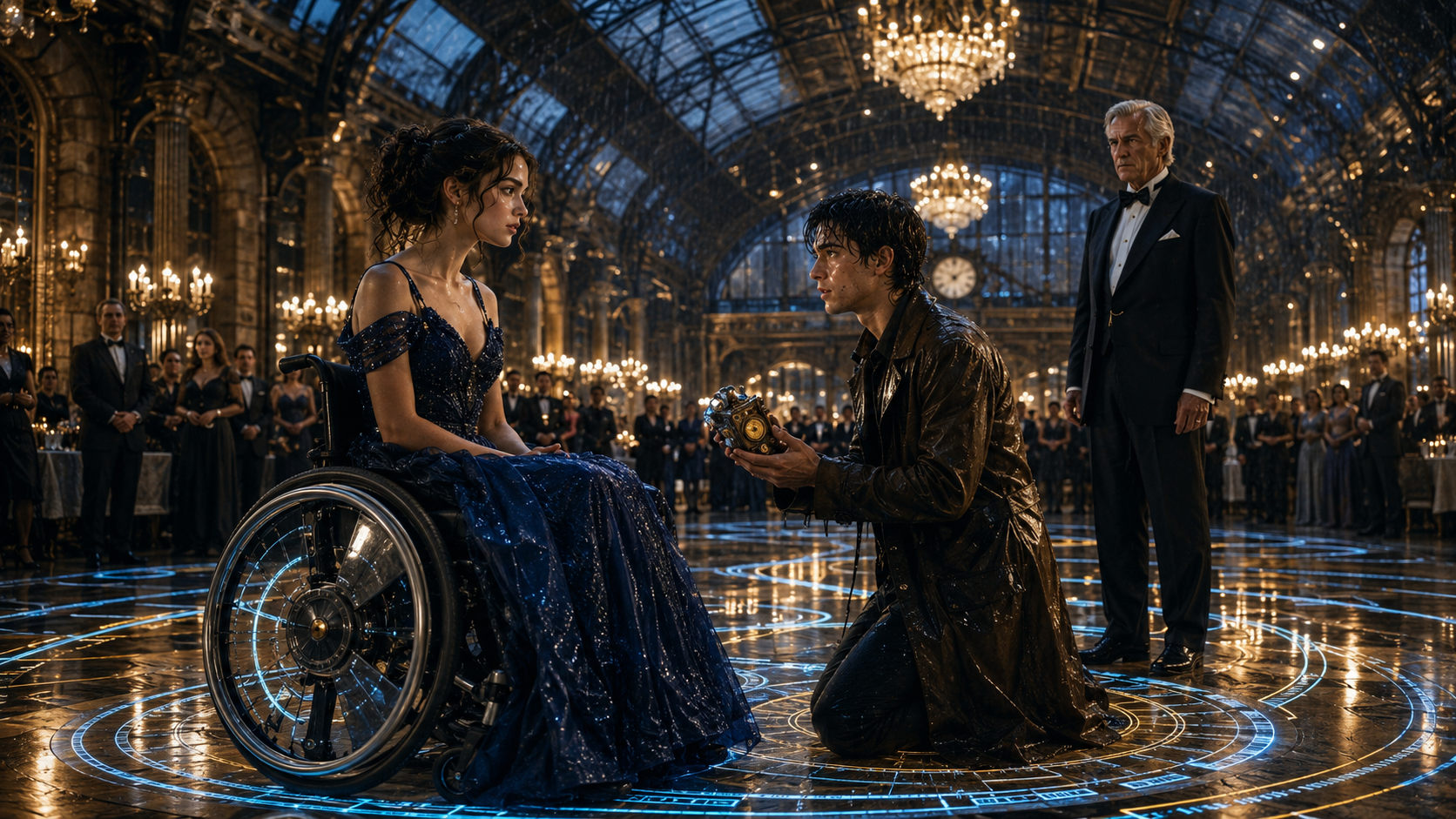
It resembled an old railway switch, though several wires and tiny lights had been added to its sides.
“Mira Sterling,” he said, “will you finish the dance we started?”
A wave of whispers passed through the room.
Mira stared at him.
“That dance was a game.”
“No,” Julian replied. “That was the beginning.”
Conrad stepped closer.
“You need to leave.”
Julian leaned toward Mira before the guards could reach him again.
His voice dropped to a whisper.
“Your mother hid the original designs inside Signal Box Nine.”
Mira’s breath caught.
Behind her, a champagne glass slipped from someone’s hand and shattered.
Conrad had gone completely still.
Julian noticed.
“So you do remember,” he said.
Conrad recovered quickly.
“This boy is lying.”
“Then let us open the signal box,” Mira answered.
“There is nothing inside it.”
“You answered very quickly.”
“Mira, this is neither the time nor the place.”
She looked around at the cameras, investors, and enormous screens displaying the Sterling Foundation logo.
“It seems like the perfect place.”
Eight years earlier, Meridian Hall had not contained chandeliers or marble bars.
It had been a silent railway station waiting to be demolished.
Mira had visited it during the long months following her accident. Her mother, Evelyn Sterling, believed the open space would make physical rehabilitation feel less like a punishment.
Julian’s father had been the station’s final caretaker.
While the adults discussed legal documents, Mira and Julian explored the empty platforms.
At first, she had refused to speak to him.
She was angry at her body, angry at her parents, and angry at every doctor who promised that time would make things easier.
Julian never told her to be grateful.
He never called her brave.
He simply tied pieces of colored glass to the wheels of her chair and watched them throw light across the station floor.
One afternoon, he painted circles on the ground with blue chalk.
“What are those?” Mira asked.
“Dance steps.”
“I can’t do dance steps.”
“Then we’ll use dance wheels.”
He stood inside the first circle while she positioned her chair inside the second.
When she turned left, he moved right.
When she rolled backward, he stepped forward.
They collided constantly.
They argued.
They laughed.
Eventually, they created a sequence of movements that carried them across the entire platform.
Evelyn watched from the shadows.
Instead of stopping them, she brought an old box filled with discarded railway switches, wires, and colored signal lamps.
Over the following weeks, the three of them built a simple system. When Mira turned her chair, sensors activated lights along the platform. Julian added music using parts from a broken station clock.
They called it the Signal Dance.
Evelyn called it the future.
Then everything changed.
Julian’s father was accused of stealing an expensive necklace from the Sterling family. He lost his job and was ordered to leave the property.
Julian disappeared without saying goodbye.
Conrad told Mira that the boy had used her friendship to get close to the family.
Mira had wanted to believe he was wrong.
But she had been nine years old, frightened and exhausted, while her father had seemed certain of everything.
Months later, Evelyn Sterling died from a sudden illness.
The station was closed.
The Signal Dance became a memory.
Until Aster One appeared.
In the ballroom, Conrad turned to the head of security.
“Call the police.”
Julian lifted the brass controller.
“Before they arrive, perhaps your investors would like a demonstration.”
He pressed a switch.
Nothing happened.
Several guests laughed nervously.
Then Mira’s wheelchair gave a quiet electronic tone.
A blue light appeared beneath her left wheel.
A second light glowed beneath the right.
Across the ballroom, hundreds of small lamps embedded in the floor began turning on.
Blue.
Gold.
White.
The light formed two circles around Mira and Julian.
Exactly like the chalk circles from their childhood.
Mira looked toward the Aster One display.
“You connected this to the foundation’s system?”
“I didn’t need to,” Julian said. “The system recognized its original controller.”
Conrad pointed at the guards.
“Take that device from him!”
Mira rolled between them.
Nobody moved.
Julian extended his hand, not to lift her from the chair, but to wait for her decision.
“Do you remember the first movement?” he asked.
Mira looked down at the circle of light.
“Blue means turn.”
“And gold?”
“Move forward.”
“White?”
She raised her eyes to his.
“Trust your partner.”
Julian smiled.
The orchestra conductor watched them uncertainly.
Mira turned toward him.
“Play something.”
Conrad shook his head.
“Do not encourage this performance.”