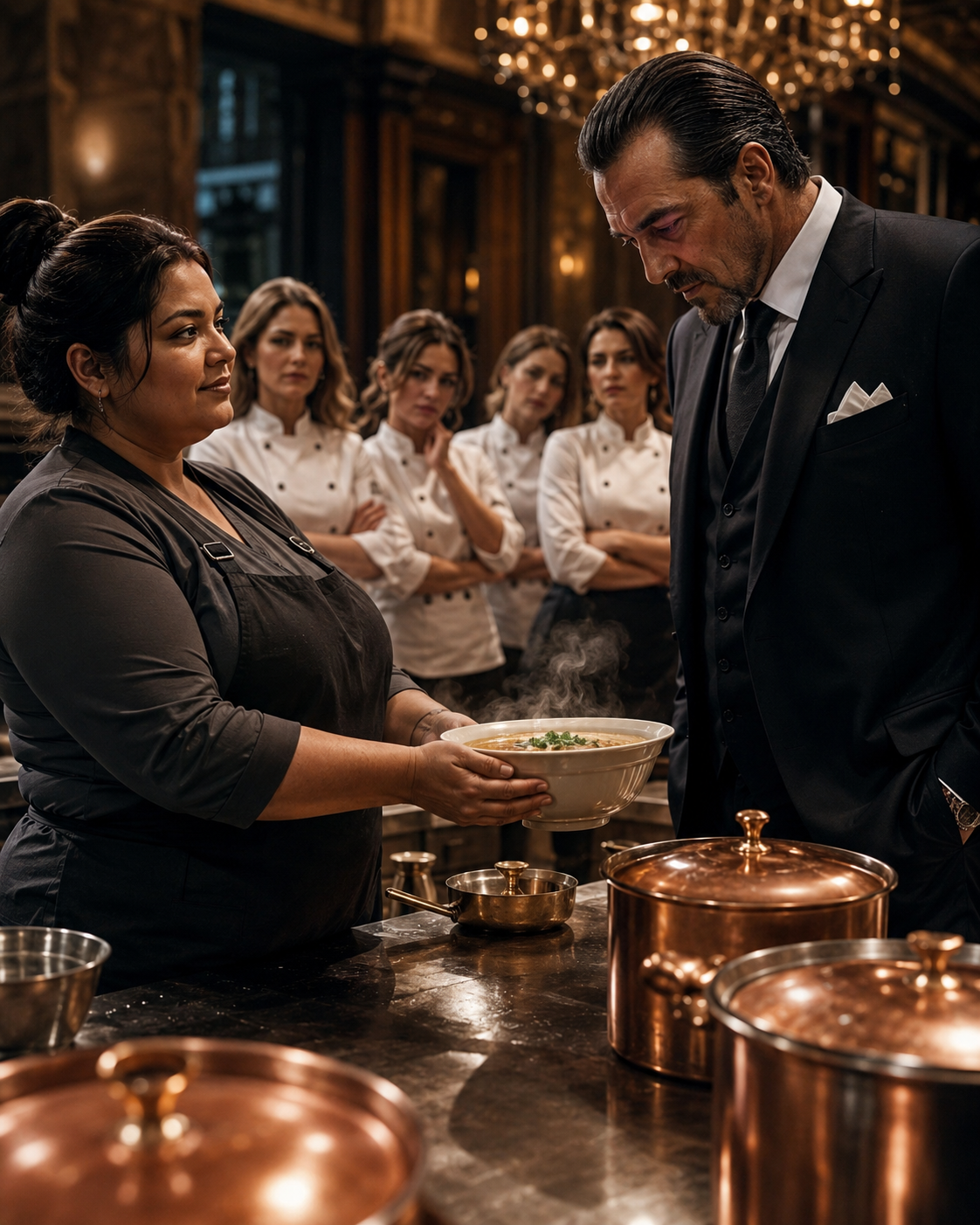
Julian’s voice cracked. “Mr. Vale, she does not have access to—”
“She does now.”
Celia did not know whether to feel fear or victory.
Both arrived together.
She entered the purchasing office for the first time in three years.
It was smaller than she expected, lined with filing cabinets, receipt trays, ledgers, and the quiet arrogance of paper. In the kitchen, truth steamed and burned and spoiled if neglected. Here, truth hid under signatures.
Edwin followed her in, wringing his hands.
“You shouldn’t be here.”
“No,” Celia said, pulling open the dairy drawer. “I should have been here sooner.”
He lowered his voice.
“You don’t understand the house.”
“I understand what comes through the door.”
“That is not the same thing.”
She found the Northwell folder.
Too thin.
Premium dairy for a house the size of Blackthorne Hall should have filled half a drawer. There were invoices, yes. Clean ones. Neat ones. Too neat. Each amount rounded almost perfectly. Each delivery recorded without correction, adjustment, spoilage, or delay.
No real kitchen was that tidy.
She searched the adjacent folders.
Meat.
Oil.
Imported spices.
Produce.
The same pattern repeated in small, careful ways. Not enough to startle someone reading numbers. Enough to offend someone who cooked with the ingredients.
Italian olive oil that tasted flat.
Saffron too bright.
Black pepper that lost heat in the pan.
Wild mushrooms that arrived already sweating in their crates.
She pulled six folders, then paused.
At the back of the drawer was a narrow envelope with no label.
Inside were duplicate delivery slips.
Not from Northwell.
From a wholesaler Celia had never seen listed.
Cheap cream. Common oil. Substitute spices. Bulk produce. Paid in cash.
Her pulse slowed instead of quickening.
Fear, she had learned, was loud at first. Then it became useful.
She took the envelope and returned to the kitchen.
Marcellus stood exactly where she had left him.
The five chefs were gone. Their perfume lingered, but faintly now, losing its fight against onions and stock.
The Moretti guests had arrived. Celia could hear voices beyond the service corridor.
She placed the folders on the steel table.
“The dinner can still be served,” she said.
Marcellus watched her face.
“And the theft?”
“It can wait until dessert.”
A faint flicker touched his mouth. Not quite a smile.
“You are very calm for a woman standing in the middle of a betrayal.”
“No,” Celia said. “I am calm because I have stood in the middle of one for years. I just finally know its name.”
Vivienne’s eyes sharpened.
Celia opened the envelope.
“This is not one mistake. It is a system. Cream, oil, saffron, pepper, mushrooms, veal. Premium prices on paper. Cheaper products at the door. The difference disappears before the kitchen can complain.”
Marcellus looked at Edwin.
Edwin lifted both hands.
“I only filed what I was given.”
“By whom?”
Edwin’s mouth trembled.
Vivienne stepped in smoothly. “This is clearly distressing, but now is not the time to interrogate frightened staff. The Morettis are waiting. Let Celia cook, since you insist, and we will review the matter tomorrow.”
Celia heard it then.
Not in Vivienne’s words.
In their timing.
She wanted the dinner to happen before the truth did.
Celia looked toward the dining room.
“Mr. Vale,” she said, “what was the planned second course?”
Julian answered automatically. “Veal medallions with mushroom cream.”
Celia closed her eyes.
Of course.
The wrong cream. The wrong mushrooms. The wrong veal.
A dish built from lies.
“Do not serve it.”
Julian hissed, “You have no authority to—”
Marcellus turned his head.
Julian stopped.
Celia opened the meat drawer in the refrigerator and pulled out the prepared tray. The veal looked acceptable under the glaze. Expensive lighting could forgive it. Hungry men might forgive it. But as she leaned closer, she smelled the faint sour dampness of meat pushed one day too far and hidden under herbs.
Not rotten.
Not unsafe in the dramatic way stories preferred.
Worse.
Humiliating.
A dish that would not harm the guests but would insult them. Enough to make the Morettis believe Marcellus Vale had served them inferior food at a reconciliation dinner. Enough to turn a fragile peace into mockery.
She stepped back.
“This dinner was meant to fail.”
The kitchen absorbed the words.
Julian whispered, “No.”
Marcellus did not look at him.
He looked at Vivienne.
For the first time, Vivienne’s smile disappeared.
Only for a second.
But the house saw it.
“Explain,” Marcellus said.
Celia answered before Vivienne could.