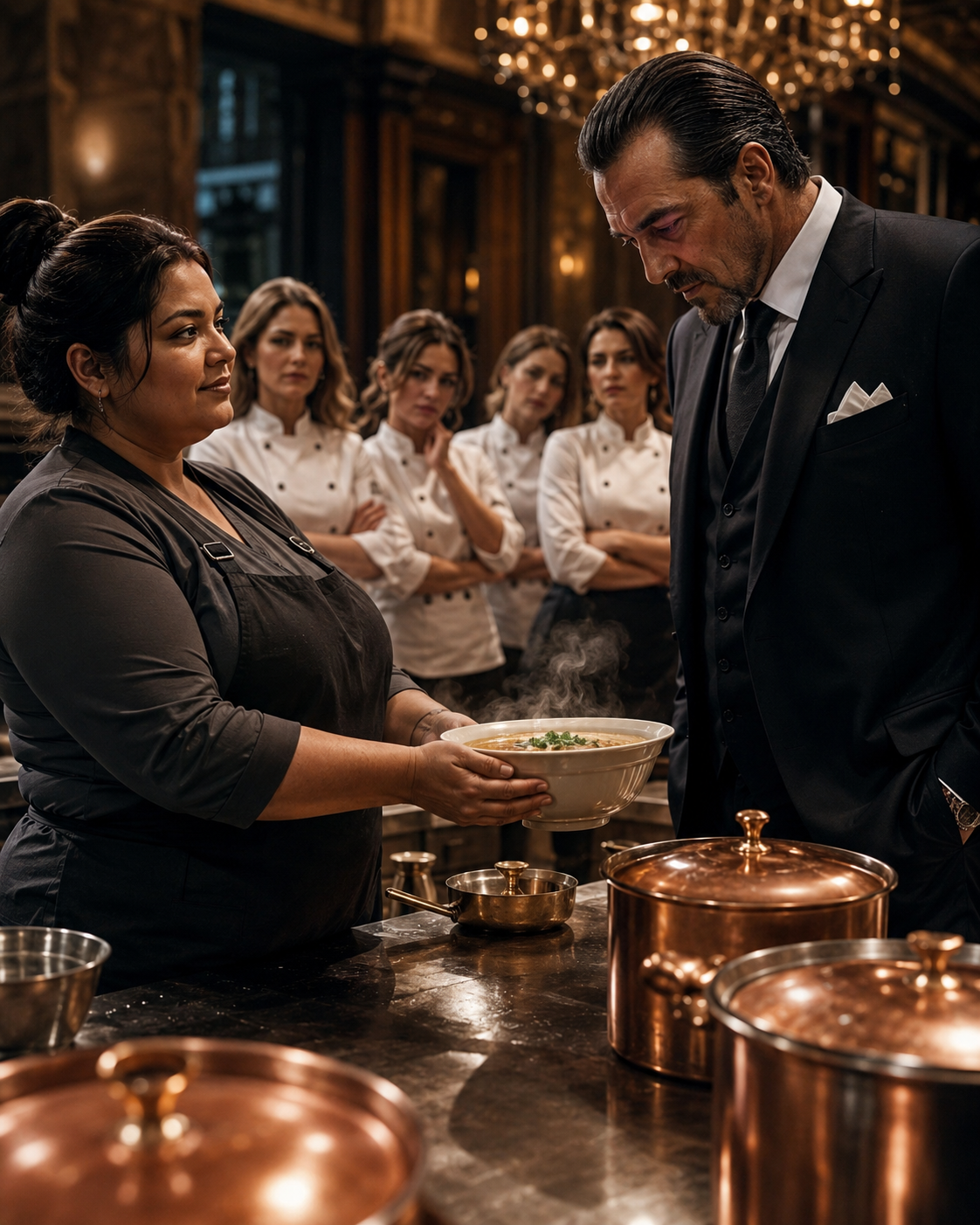
“Someone replaced key ingredients for weeks, not just to steal money, but to make the kitchen unreliable. Tonight’s menu depends on the worst substitutions. The soup dulls the first impression. The veal insults the table. The cream sauce breaks under heat. The mushrooms taste old. If the Morettis leave angry, everyone blames the kitchen. Or the new chefs. Or me, if I am foolish enough to take charge without checking.”
Marcellus’s voice was soft.
“Were you meant to take charge?”
Celia turned toward Julian.
His face betrayed him before his mouth could lie.
He looked at Vivienne.
There it was.
The thread.
Celia followed it.
Julian had mocked her for years, but mockery was simple. He wanted praise, authority, and applause. He was too vain to build a system this clean.
Edwin was frightened, not clever.
The five chefs had been decoration.
Vivienne had access to contracts, schedules, menus, guest lists, and trust.
Vivienne had made sure the glamorous chefs arrived with cameras. If the dinner failed, their embarrassment would be loud enough to cover the deeper theft. If the staff soup had remained in the back, the false cream might have passed as nerves or bad technique.
But Celia’s soup had reached Marcellus.
And Marcellus had remembered Ruth Ward.
A dead woman’s recipe had pulled a living lie into the light.
Vivienne lifted her chin.
“You are all being manipulated by a kitchen maid who has mistaken resentment for insight.”
Celia felt the words land where they were meant to.
On her body.
On her apron.
On every year she had stood behind thinner women, louder men, cleaner titles.
She took one breath.
Then another.
“No,” she said. “I have mistaken nothing.”
She walked to her soup pot and ladled a spoonful into a tasting cup. Then she took Sabine Frost’s truffle cream and placed it beside her own.
“Mr. Vale, taste them one after the other.”
He did.
Celia spoke so the whole kitchen could hear.
“The first soup is trying to impress you. The second is trying to feed you. The first hides cheap cream under perfume. The second uses scraps honestly. That is the difference between a kitchen and a performance.”
She turned to Vivienne.
“And that is why you kept me at the sink. Not because I was untrained. Because I would taste the difference.”
Vivienne’s face hardened into something truer than elegance.
“You have no idea what I have carried for this house.”
Marcellus’s jaw tightened.
Vivienne laughed once.
“Oh, don’t look wounded, Marcellus. You trusted men who feared you, women who flattered you, cooks who lied to you, accountants who smiled at you. I kept the house running while you played king in the dining room.”
Celia heard a few staff members inhale.
Vivienne had not confessed to everything.
But anger often opened the door before proof walked in.
Marcellus remained still.
“Why?”
Vivienne’s eyes flashed.
“Because loyalty is a word powerful men use when they want underpaid people to feel noble about being used.”
Celia almost understood her.
That was the terrible part.
Almost.
Then she looked at the folders, at the false invoices, at the dinner meant to collapse, at the staff who would have taken the blame, and understanding hardened into refusal.
“You were used,” Celia said quietly. “So you decided to use everyone below you.”
Vivienne turned on her.
“Do not speak to me as if we are the same.”
“We are not.”
The words came out before Celia knew she would say them.
“I made soup.”
The kitchen held its breath.
Marcellus looked at Celia, and something like respect settled plainly on his face.
Not surprise.
Recognition.
“Can the dinner be saved?” he asked.
“Yes.”
“How?”
Celia tied her apron tighter.
“No cream. No veal. No performance.”
Julian made a strangled sound. “There is no time for a new menu.”
“There is enough time for an honest one.”
She began moving before anyone gave permission.
“Marco, pull the root vegetables from cold storage. Roast them hard. Tess, strain the chicken stock. Use the clear pot, not the cloudy one. Andre, slice bread from staff loaves, oil, salt, grill it. Lina, bring the black cabbage and fennel. No mushrooms. No saffron. No cream. We serve broth first, then roasted vegetables with lemon, then herb chicken, then pears in red wine if the fruit is still good.”
Nobody moved.
Celia turned.
“Now.”
They moved.
Not because she shouted.
Because her voice held the shape of the kitchen as it should have been all along.
For the next forty minutes, Blackthorne Hall became honest.
Celia worked the stove with a calm that frightened people more than panic would have. She tasted everything. She corrected salt by instinct. She turned ingredients others had dismissed into dishes that felt deliberate, intimate, impossible to mock.
Marcellus stayed near the pass.
He did not interfere.