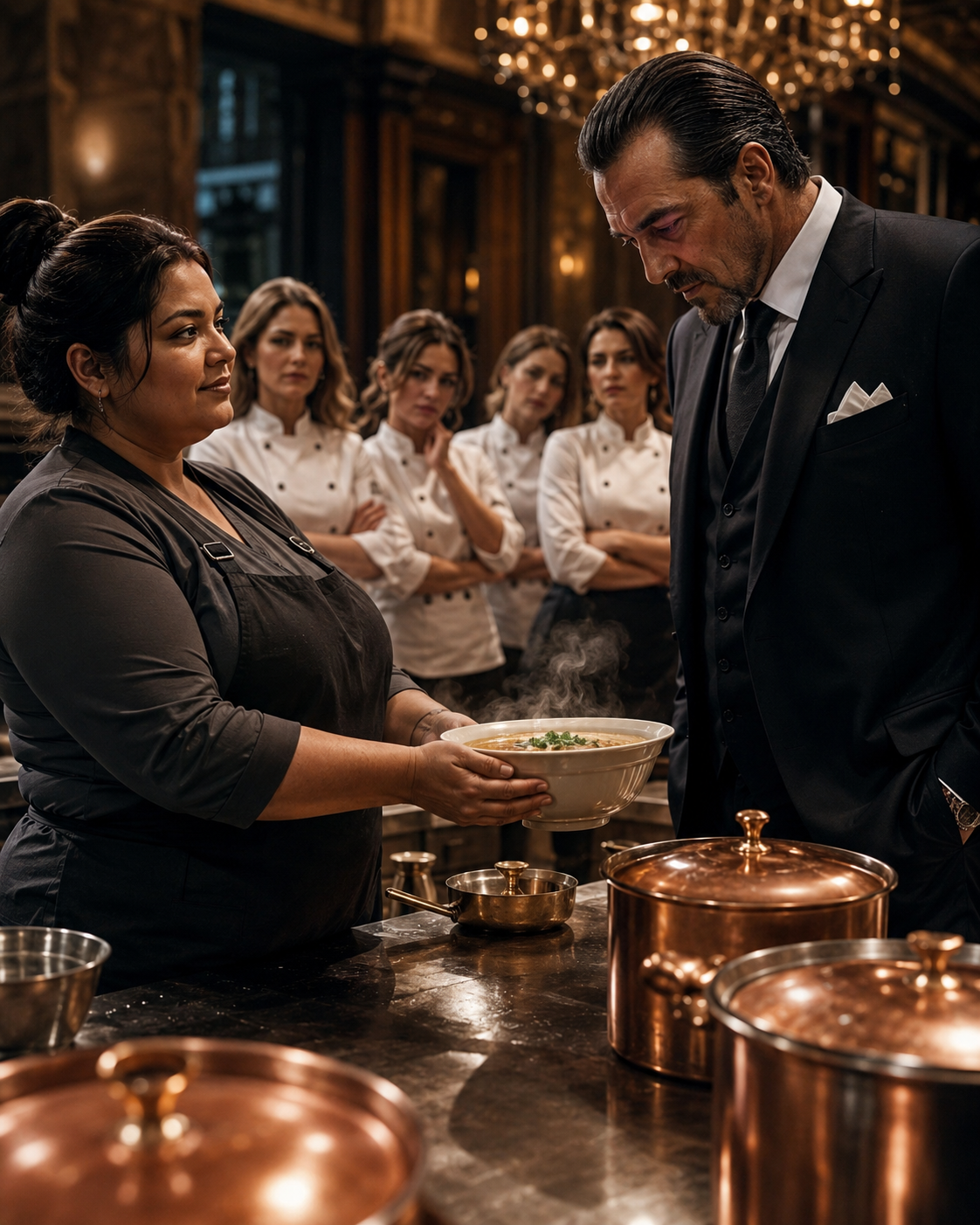
For three years, Celia Ward had worked in the lower kitchen of Blackthorne Hall without once being invited to step through the carved oak doors of the formal dining room.
She knew the room anyway.
She knew it by sound.
The thin ring of crystal when the staff polished glasses too quickly. The restless scrape of expensive chairs across old Italian marble. The soft, measured voices of men who never raised their tone because the world had already learned to listen. The nervous laughter of guests who came to Blackthorne Hall hoping to be seen, then spent the evening wishing they were invisible.
Celia was invisible by profession.
Kitchen maid, they called her, though the title had never fit. She washed copper pots until her wrists ached. She trimmed vegetables when the junior cooks fell behind. She hauled flour sacks from the delivery corridor. She cleaned grease traps no one else wanted to acknowledge existed. She rewrote ruined sauces in silence, saved collapsed custards before banquets, corrected stocks by scent alone, and watched men with whiter jackets and thinner patience receive praise for dinners she had quietly rescued.
She was thirty-two, broad-shouldered, soft around the middle, and built like a woman who had carried too much for too long. In another house, perhaps, her strength might have been admired. In Blackthorne Hall, it made her useful.
Useful people were rarely celebrated.
That evening, however, the house had decided to celebrate food.
Not Celia’s food.
That would have been too honest.
The celebration had been arranged for the arrival of five glamorous chefs hired by Marcellus Vale’s household director to modernize the kitchen. They came through the front entrance instead of the service door, which told Celia everything she needed to know before she saw them.
They arrived laughing under camera lights, each one beautiful in a way that seemed professionally maintained. Polished hair. Sharp cheekbones. White jackets fitted like eveningwear. Gold knives in leather rolls. Perfume strong enough to challenge the garlic roasting in the ovens.
Their names had been printed on ivory place cards for the private tasting: Sabine Frost, Lila March, Evangeline Cole, Maris Bell, and Thea Rourke.
Celia’s name appeared nowhere.
She stood near the dish sink with wet sleeves and a flour mark on her cheek while the five women walked the kitchen as if it were a stage built for them.
“They’re smaller than I imagined,” one of them said, glancing at the ovens.
Another laughed. “Everything important is smaller from the outside.”
Celia lowered her eyes and kept scrubbing the copper pot in front of her.
She had learned early that people revealed themselves most honestly when they believed the room contained no one worth impressing.
At the far end of the kitchen, Julian Crest, the executive chef, clapped his hands twice.
“Attention. Tonight must be perfect. Mr. Vale is hosting a private reconciliation dinner with the Moretti family, and Mrs. Drayton wants the new chefs presented before the first course. No mistakes. No delays. No improvising from the lower staff.”
His gaze landed on Celia for the last sentence.
She did not answer.
Julian hated silence unless he was the one creating it.
“Ward,” he said. “You’ll stay out of the front line tonight.”
“As usual,” murmured one of the junior cooks.
A few people laughed carefully.
Celia rinsed the pot and set it upside down to dry.
Julian’s jaw tightened.
“You will prepare staff soup and keep the prep stations clean,” he continued. “The tasting menu belongs to Chef Frost and her team.”
Sabine Frost smiled without looking at Celia. “How kind.”
Celia turned back to the sink.
The first warning came an hour later.
Not from a shout.
Not from a broken plate.
From cream.
The cream had arrived that afternoon in the usual glass bottles with the usual green seal from Northwell Dairy. Celia had unpacked it herself because the delivery boys always left the crates too close to the freezer door, where the cold could shock the fat and ruin it.
She had known something was wrong the moment she lifted the bottle.
A fraction too heavy.
Not spoiled. Not dangerous. Nothing obvious enough to make a fool of someone who complained. But wrong.
Real Northwell cream had a clean, sweet thickness that clung to the glass as if reluctant to leave. This cream moved heavily and left a dull line behind it. When warmed, it would behave just well enough to pass for expensive, unless the cook understood what it was trying to hide.
Celia had mentioned it to Edwin Pike, the purchasing clerk, three weeks before.
He had smiled at her over his ledger.
“Paperwork says Northwell.”
“I know what the paper says.”
“Then there is no problem.”
“There is if the food tells a different story.”