He had looked at her then the way certain men looked at women they had decided were large enough to be useful but not important enough to be heard.
“Celia, you wash pans. Let the people upstairs handle suppliers.”
So she had done what she always did.
She adjusted.
She worked around the lie.
Tonight, as Sabine Frost’s team prepared a truffle cream velouté for the tasting menu, Celia smelled the lie rise from the saucepan.
The soup looked beautiful. Pale gold, glossy, strained smooth as silk. It would photograph well. It might even impress people who ate with their eyes.
But beneath the truffle oil and roasted shallots, the cream broke half a second early.
Celia knew it the way another woman might know her child’s voice in a crowded street.
She glanced toward Julian.
He stood beside Sabine, nodding as she plated a spoonful for him.
“Elegant,” he said.
“It’s meant to be,” Sabine replied.
Celia looked away.
She was not supposed to save them tonight.
She was not supposed to save anyone.
Still, old habits were stubborn. While the glamorous chefs arranged microgreens with tweezers, Celia took the vegetable trimmings from the prep bins, the chicken bones saved from lunch, the bruised fennel no one wanted, and the last bundle of parsley stems. She set a pot over a low flame and began making soup for the staff.
The kind of soup no one photographed.
The kind that kept people standing.
She roasted the bones until the kitchen smelled warmer. She browned onions until their sweetness deepened into something almost sad. She crushed peppercorns with the flat of a knife, added celery leaves, bay, a heel of parmesan, and the last spoonful of good butter she had hidden in a covered dish behind the pickled lemons.
She did not touch the false cream.
Instead, she clarified the broth with patience, folded in white beans, shaved fennel, black cabbage, and threads of lemon peel so thin they almost vanished. The soup became clear but rich, humble but layered, the kind of dish that told the truth slowly.
At eight-thirty, Marcellus Vale entered the kitchen.
Conversations died as if someone had closed a hand around the room.
Marcellus never needed to announce himself. The house did it for him.
He was forty-six, broad in the shoulders, dressed in a dark suit without a single unnecessary detail. His hair had begun to silver at the temples, which somehow made him look less old than sharpened. He carried power quietly, and that made it heavier. Men like Julian performed authority. Marcellus simply possessed it.
Behind him came Vivienne Drayton, the household director, immaculate in a black dress and pearl earrings. Vivienne had run Blackthorne Hall for eleven years. She knew every contract, every account, every staff rotation, every imported bottle, every person allowed through every door.
Marcellus trusted her completely.
That was why no one questioned her.
“Mr. Vale,” Julian said, stepping forward. “We are ready.”
“Are you?”
“Of course.”
Marcellus looked at the five chefs, then at the plates arranged beneath the warming lights, then at the room itself. His gaze passed over Celia once without stopping.
She was used to that.
Sabine Frost lifted a small porcelain bowl with both hands.
“Our opening soup,” she said. “White truffle cream, smoked leek, and winter herbs.”
Marcellus accepted it.
Everyone watched.
He tasted one spoonful.
His face did not change, but the room felt the change anyway.
He set the bowl down.
“No.”
Sabine blinked.
Julian’s mouth opened slightly.
Vivienne smiled with practiced calm. “Perhaps it needs a touch more salt.”
Marcellus turned his head. “I said no.”
One word. Quiet. Final.
Sabine’s cheeks colored. “Mr. Vale, with respect, that soup is balanced.”
“No,” he said again. “It is dressed.”
Silence tightened.
“The cream is heavy,” Marcellus continued. “The truffle is covering something. The finish is dull.”
Celia’s hand paused over the ladle in her own pot.
Marcellus turned toward the stove where her soup simmered.
“What is that?”
Julian moved quickly. “Staff meal.”
“I asked what it is.”
Celia dried her hands on her apron. “White bean and fennel broth, sir.”
“Who made it?”
She did not look at Julian.
“I did.”
Marcellus studied her now. Properly this time.
“Bring me a bowl.”
Julian laughed once, too sharply. “Mr. Vale, I don’t think—”
Marcellus did not raise his voice.
“That is fortunate, Julian, because I did not ask you to think.”
No one laughed after that.
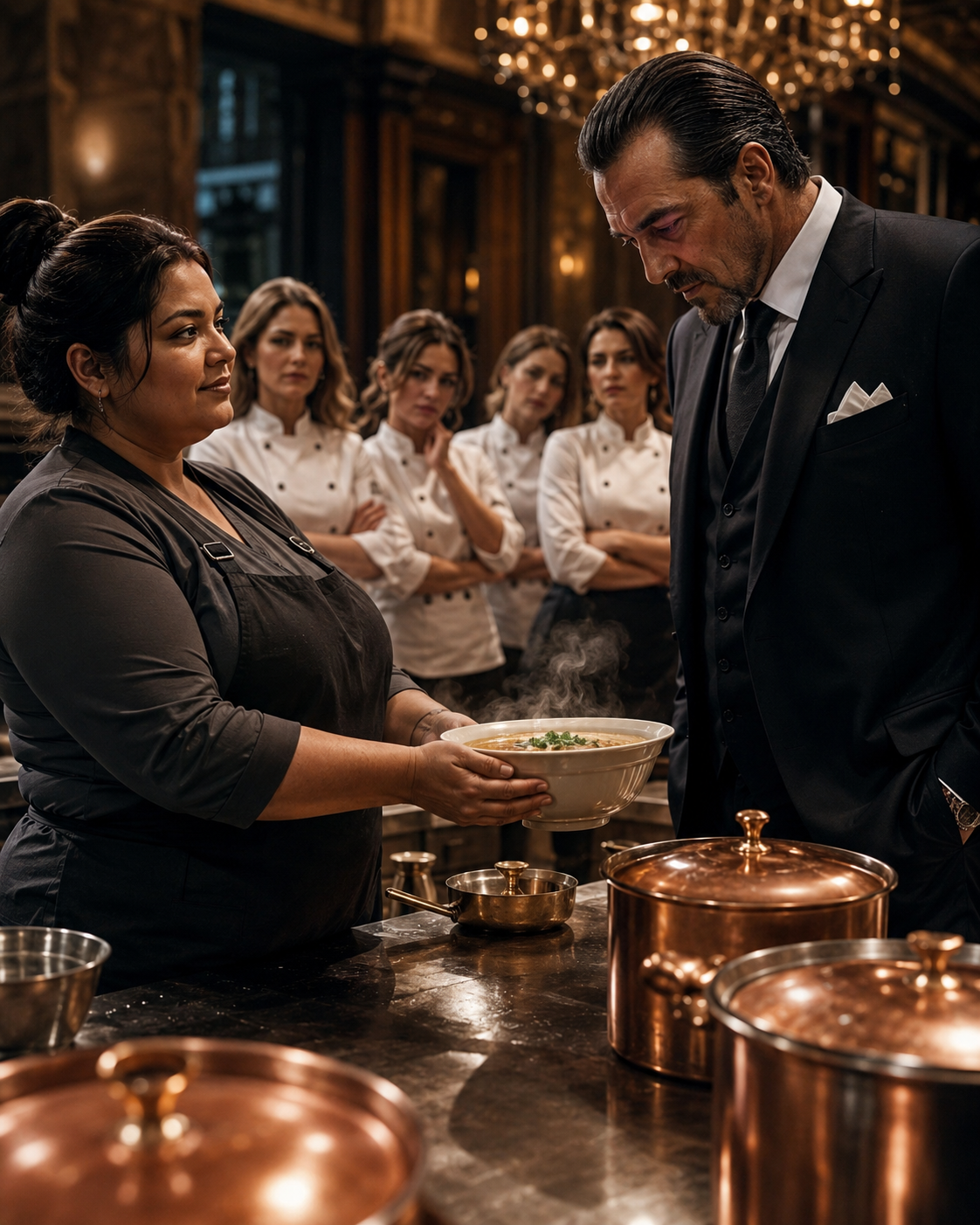
Celia took a plain bowl from the lower shelf, ladled the soup carefully, wiped the rim with a clean cloth, and carried it to him. She expected him to taste it standing there in the middle of the kitchen like a judge inspecting evidence.
Instead, he took the bowl from her with both hands.
That small courtesy unsettled her more than his power.
He tasted.