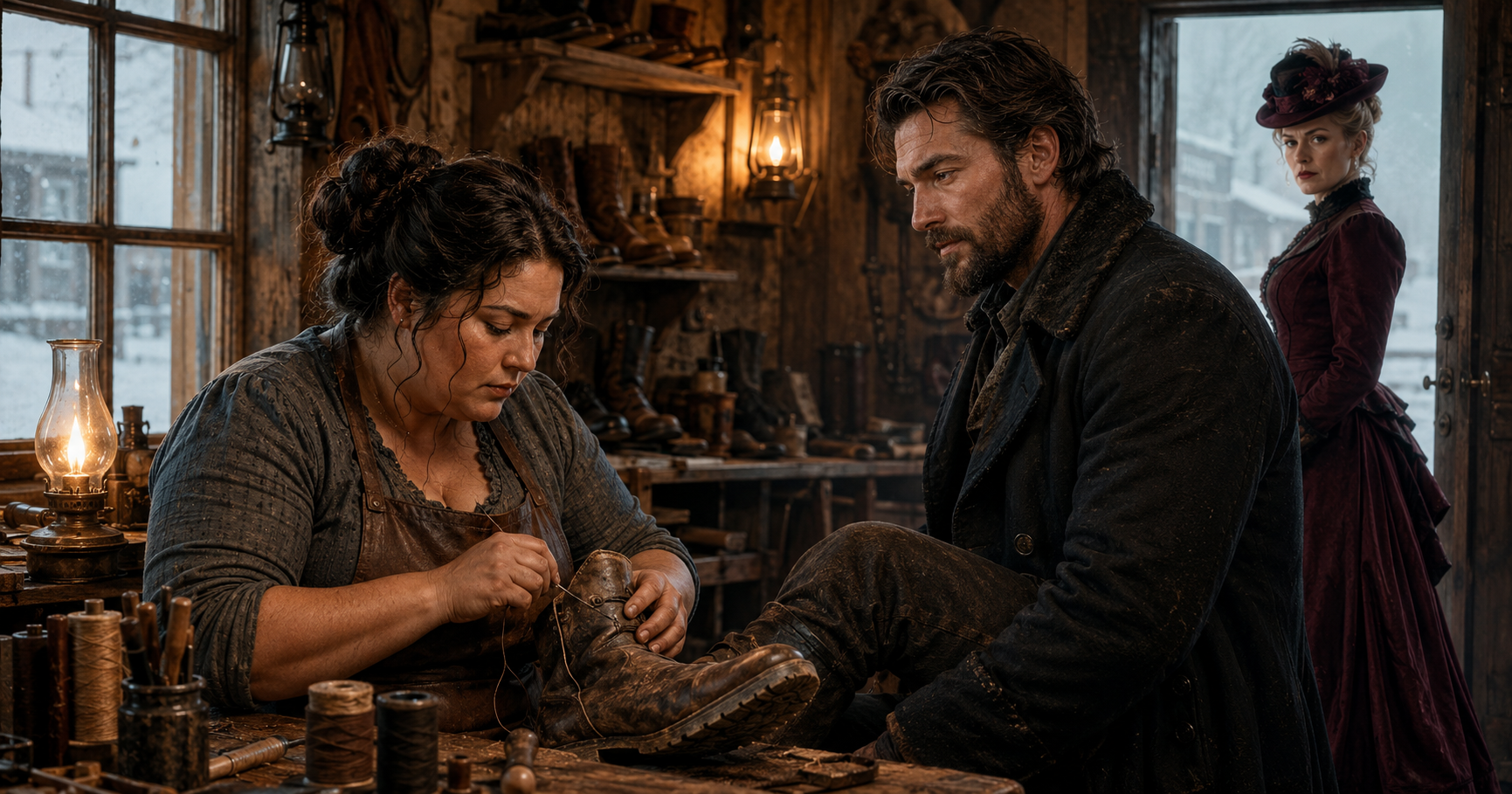
And he did.
For three weeks, Caleb Rusk came down from Wolf Ridge with leatherwork that should have been done years earlier. He brought broken straps, cracked reins, split saddle skirts, and one pair of snowshoes so badly laced that Tessa called them a personal insult.
He paid exactly what she charged.
When she undercharged, he knew.
“That is worth more,” he said one morning.
“It is worth what I say.”
“No. It is worth what the work says. You have been listening to people who want you grateful for crumbs.”
Tessa snapped the thread with her teeth. “You make a habit of saying dangerous things.”
“No. True things.”
“Truth is usually dangerous.”
“Only to liars.”
That afternoon, Vivian Warde walked into the shop.
The room changed around her, as rooms always did. Even dust seemed to settle more politely.
“Tessa,” she said. “I hear Mr. Rusk has become your most faithful customer.”
Tessa kept stitching.
“He breaks things.”
“Yes. Men do.” Vivian smiled. “A clever woman learns which broken things are worth repairing.”
Caleb, who had been standing near the shelf, turned.
Vivian looked at him directly.
“I was disappointed you declined my invitation,” she said. “I had hoped we might discuss the northern water road.”
“There is nothing to discuss.”
“My company could improve the pass.”
“My land is not a pass.”
“It could be. With profit to everyone.”
“No.”
Vivian’s smile thinned. “You refuse very quickly for a man who lives alone.”
“I refuse quicker for people who don’t listen the first time.”
Tessa set the boot down.
Vivian’s gaze moved to her.
“And you,” she said softly, “should be careful what kind of attention you mistake for affection.”
Tessa felt heat crawl up her neck.
Caleb stepped forward.
Tessa lifted one hand.
“No,” she said.
He stopped.
The room held its breath.
Tessa looked at Vivian.
“For years,” Tessa said, “you have walked into this room and spoken as if I were the bench, the lamp, the floor. Something useful. Something broad enough to hold your weight. You may insult me if it brings you comfort. But do not call it advice.”
Vivian’s eyes hardened.
“Do you know what people are saying?”
“Yes.”
“And you don’t mind?”
“I have survived worse than being discussed by people who cannot mend their own buttons.”
The silence after that was not empty. It was crowded with every insult Tessa had swallowed since girlhood.
Vivian drew on her gloves one finger at a time.
“I see,” she said.
“No,” Tessa replied. “I don’t think you do.”
Vivian left.
Caleb said nothing until the door closed.
Then he said, “You did not need me.”
Tessa picked up the boot again.
“No.”
A moment passed.
Then she added, “But I noticed you stopped when I asked.”
Caleb’s voice was low.
“I will always stop when you ask.”
That should not have meant as much as it did.
By the end of winter, Bramble Ford had decided Caleb Rusk was bewitched.
It was the only explanation people liked. A man refusing Vivian Warde could be called stubborn. A man spending his money in Tessa Marlowe’s shop could be called charitable. But a man walking beside Tessa after church, carrying her mother’s medicine basket, listening while she spoke, and looking at her as if the rest of the street had vanished?
That needed a darker explanation.
Vivian provided one.
The letter arrived on a Thursday, folded in thick cream paper and sealed with black wax.
Tessa opened it at the bench.
Her mother, Mara Marlowe, watched from the stove, wrapped in a shawl, color finally returning to her face.
Tessa read the letter once.
Then again.
Caleb, who had come to collect a repaired bridle, saw her expression change.
“What is it?”
Tessa laid the paper flat.
The Warde Holdings Office claimed that the building behind Mercer’s Dry Goods had never belonged to the Marlowe family. According to their records, Tessa’s father had leased the workroom from the Warde estate and had failed to pay rent for six years before his death. With interest, fees, and penalties, Tessa owed one hundred and eighty-seven dollars.
If payment was not made within seven days, the shop would be seized.
Mara made a sound like the beginning of a prayer.
Caleb picked up the paper.
His face did not change, but the air around him did.
“This is a lie,” Tessa said.
“Yes.”
“You don’t know that.”
“I know her.”
Tessa took the letter back.
“My father bought this room from old Mr. Bellamy. Paid in repairs, labor, and cash. There was a paper.”
“Where?”
Tessa looked toward the shelves. Toward the old boxes. Toward the drawers that held twenty years of receipts, patterns, cracked tools, and memories that had no labels.
“I don’t know.”
That was the cruelty of it.
Her father had been careful. Her father had kept things. Her father had believed paper mattered because poor people without paper were called liars.