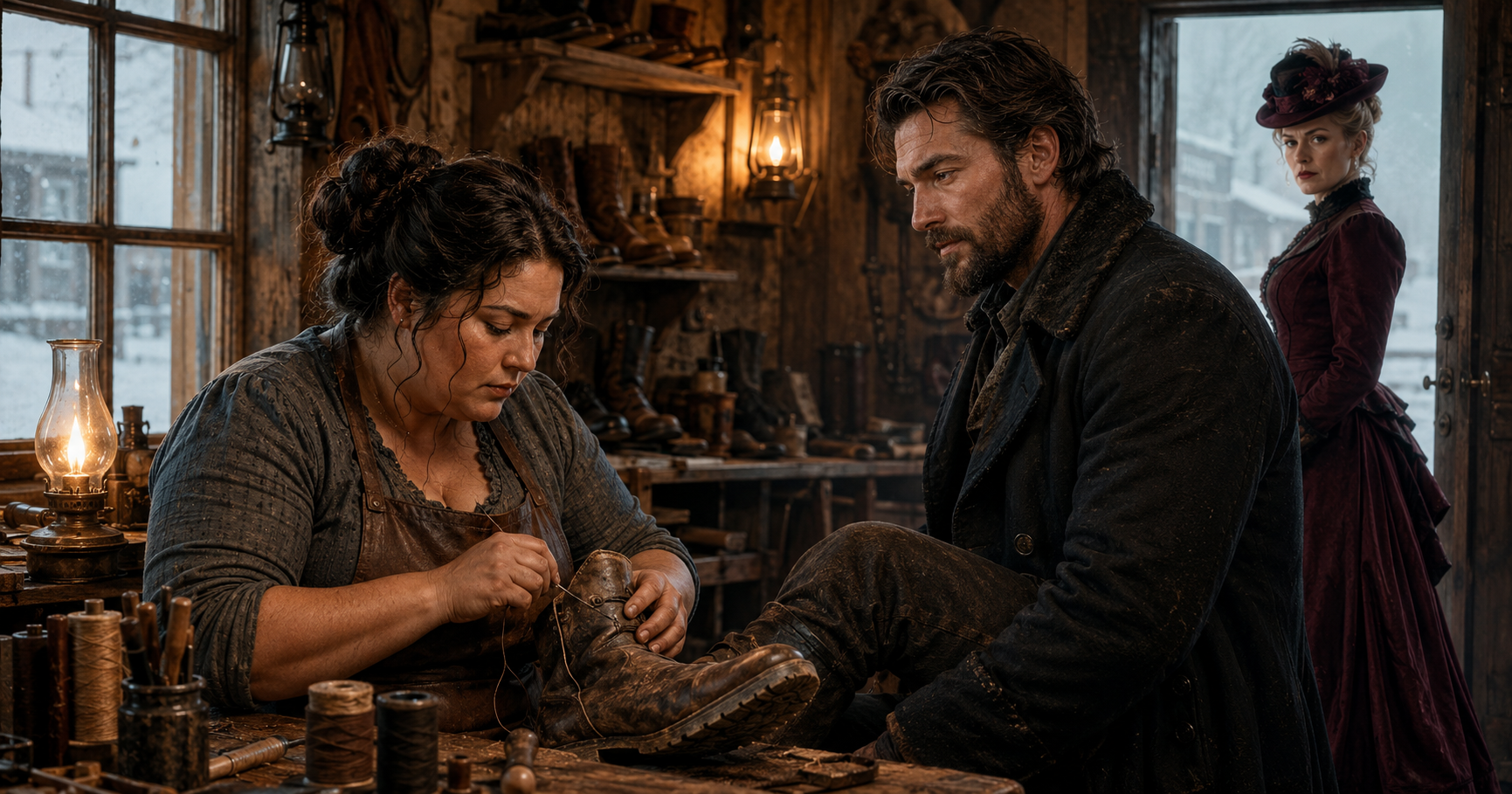
But after his death, grief had turned the house inside out. Creditors came. Neighbors helped. Things were moved, sold, boxed, burned.
A paper could disappear.
A lie with a seal could grow teeth.
Caleb put his hat on the bench.
“I can pay it.”
“No.”
“Tessa.”
“No.” She looked at him. “If you pay a false debt, it becomes history.”
“Then we fight it.”
“How? Vivian owns the office. Vivian owns the clerk who stamped this. Vivian owns half the men who will be asked to judge it.”
“She does not own you.”
Tessa laughed bitterly.
“Not yet.”
Caleb leaned close, his voice quiet enough that Mara could not hear.
“Tell me what you need.”
Tessa looked down at her hands. Thick fingers. Scarred knuckles. A burn mark on one thumb. Hands made for holding things together.
“I need proof.”
That night, Tessa did not sleep.
She searched every box in the shop. Caleb searched with her, careful with each scrap as if the smallest receipt might carry a pulse. Mara sat by the stove and named places where her husband had hidden important things.
“Under the flour bin.”
Nothing.
“Behind the loose brick.”
Nothing.
“In the hymn book.”
Only a pressed wildflower and a lock of Tessa’s baby hair.
Near midnight, Caleb found an old account book wrapped in oilcloth. Tessa opened it with shaking hands.
It was her father’s repair ledger. Page after page of names, dates, charges, payments. Saddles. Harness. Boots. Trunks. Belts. Hinges. Everything Bramble Ford had brought to Samuel Marlowe when it broke.
Near the back, she found several entries marked Warde Estate.
Harness repair. Fence straps. Coach leather. Winter saddle stitching.
Paid by credit toward property transfer.
Her breath stopped.
“Property transfer,” Caleb said.
Tessa ran her finger beneath the words.
“It proves there was an agreement.”
“But not the deed.”
“No.”
Still, it was something.
By morning, she had more.
Mrs. Ada Bell, who ran the boarding house, remembered the sale because Samuel Marlowe had repaired every chair in her dining room to celebrate. Old Mr. Mercer remembered helping carry the new sign into the shop. Reverend Pike remembered blessing the room because Mara had insisted a workplace deserved blessing as much as a nursery.
But remembering was not paper.
And Vivian Warde had paper.
The hearing was set for Monday.
On Sunday evening, Vivian came alone.
Tessa was oiling a pair of Caleb’s reins when the door opened. Caleb had gone to the north farms to find a man who had witnessed the sale. Mara slept behind the curtain. The stove ticked softly.
Vivian entered in a black wool coat, elegant as a blade.
“You could still avoid embarrassment,” she said.
Tessa did not stand.
“Yours or mine?”
Vivian’s mouth tightened.
“I tried to be generous.”
“You tried to steal my shop.”
“I tried to correct a record.”
“You forged a record.”
Vivian’s eyes flashed.
“Careful.”
There it was again.
Careful.
Tessa rose so suddenly the chair scraped behind her.
“No,” she said. “I have spent my life careful. Careful not to take too much room. Careful not to eat too much. Careful not to speak too loudly. Careful not to make beautiful people uncomfortable by standing where they had to see me. I am done being careful with people who mistake cruelty for breeding.”
Vivian stepped closer.
“You think this is about you?”
Tessa went still.
Vivian smiled then. It was a small, cold thing.
“Caleb Rusk owns the only clean northern water route into three thousand acres of grazing land. My company needs that road. I offered marriage because marriage is cleaner than litigation. He refused. Then he began spending his days here with you.”
The truth settled into the room.
Not jealousy.
Not pride.
Land.
Water.
Power.
Tessa whispered, “You came after my shop to punish him.”
“To teach him consequence.”
“And me?”
Vivian looked her up and down.
“You were the easiest place to press.”
For one second, the words found every old bruise.
Then Tessa smiled.
It surprised both of them.
“You made a mistake,” Tessa said.
Vivian’s face darkened.
“Did I?”
“Yes. You thought soft ground meant weak ground.”
The hearing room was full by nine the next morning.
People came for justice, gossip, fear, or the rare pleasure of watching someone else fall. Judge Alder Crane sat at the front with his spectacles low on his nose and Vivian’s stamped notice on the desk before him.
Vivian sat beside her attorney in dove-gray silk.
Tessa sat alone.
Caleb had not returned.
The whisper moved through the room quickly.
He ran.
He changed his mind.
Maybe Vivian was right.
Tessa heard it all.
She folded her hands and stared forward.
Vivian’s attorney presented the claim smoothly. The Warde estate, he said, had discovered an unpaid lease. The defendant had occupied the property for years without proper settlement. The estate had been patient. The estate had been generous. The estate now sought lawful recovery.