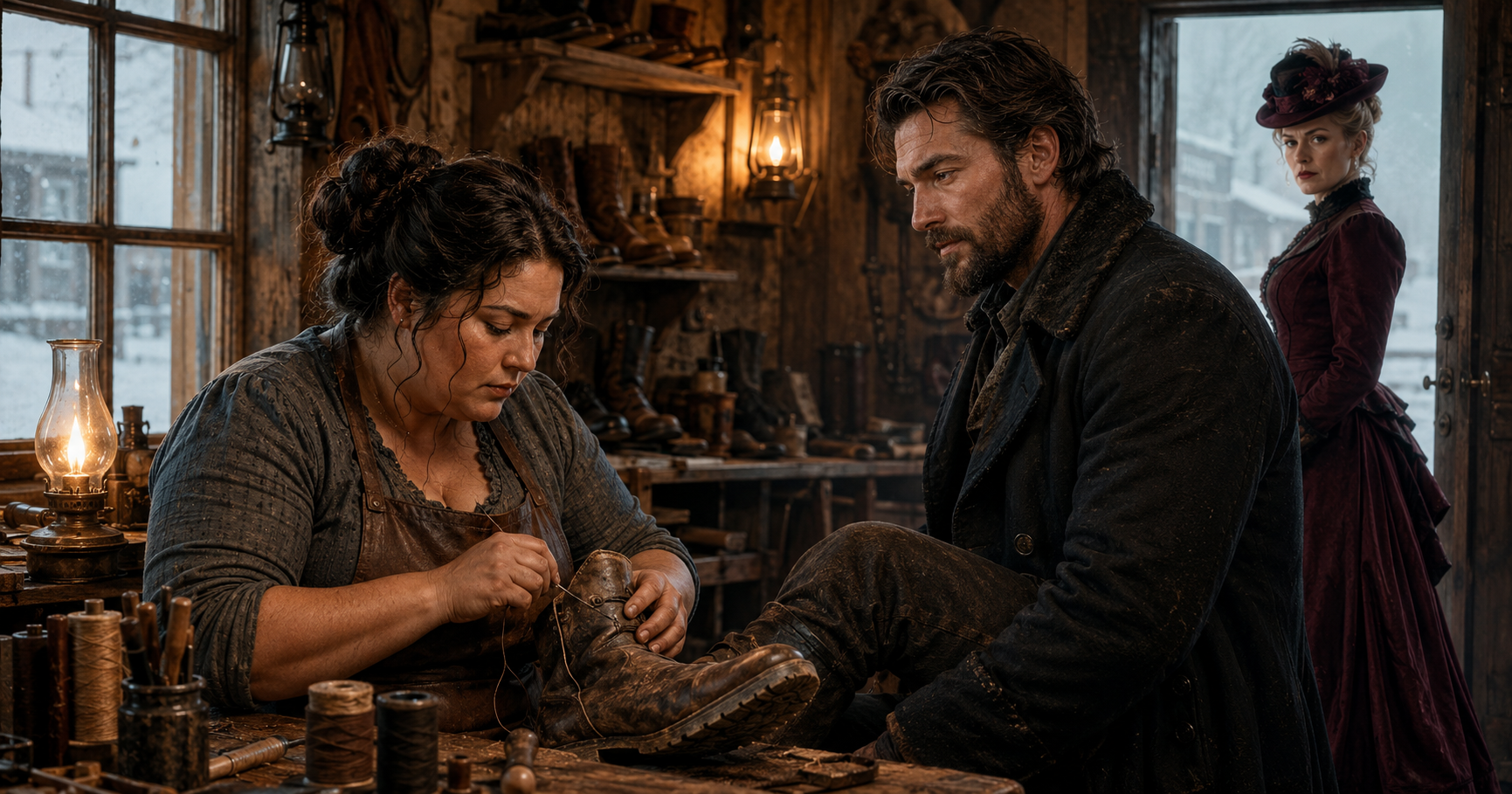
Caleb turned his head at last. “Do you doubt her work?”
Vivian blinked. “Not at all. I only meant—”
“Then let her work.”
The room went still.
Tessa kept her eyes on the boot, but her fingers tightened around the thread.
Vivian gave a small laugh. “You are very direct.”
“I try to save words.”
“So I’ve heard.”
“Then believe what you heard.”
For the first time in Tessa’s memory, Vivian Warde had no immediate answer.
She left with her smile still intact, but her silence was sharp enough to cut cloth.
Tessa tied the stitch, trimmed the thread, and set the boot down.
“You should not have done that,” she said.
Caleb inspected the repair.
“Done what?”
“Spoken to her that way in front of people.”
“She spoke to you that way in front of people.”
“That is different.”
“No.”
He said it so simply that Tessa looked up.
Caleb put money on the bench. Too much.
“The repair is twenty cents,” she said.
“The repair saved the boot.”
“That is still twenty cents.”
“Then the rest is for saving me from walking home with one foot frozen.”
Tessa almost pushed the coins back. Then her mother coughed behind the curtain. A long, tearing cough that bent the air around it.
Caleb’s gaze moved toward the sound, but he asked no question.
That was the second strange thing.
People in Bramble Ford loved questions when they had no intention of helping.
Tessa took the money.
Caleb stood, pulled on the repaired boot, and tested his weight.
“Good work,” he said.
“I know.”
The words slipped out before she could soften them.
Caleb looked at her again.
This time, the almost-smile became real.
“Yes,” he said. “You do.”
He came back two days later with the other boot.
By then, Vivian had already sent three ladies into Tessa’s shop to discuss Caleb Rusk in voices meant to be overheard.
“He cannot live like a hermit forever.”
“A mountain man needs a respectable woman.”
“Not every kindness is charity.”
Tessa said nothing. She repaired a saddle strap, stitched Mrs. Bell’s glove, and listened to her mother breathe behind the curtain.
When Caleb returned, he brought no gossip with him. Only the second boot, worse than the first.
“You try to destroy these on purpose?” Tessa asked.
“Rocks do most of it.”
“Rocks are innocent. This is neglect.”
“I’ll apologize to the boot.”
“You should.”
He sat while she worked. He did not stare at her body or look around for something cleaner to touch. He watched her hands. He watched how she heated the leather just enough, how she pulled the thread with even pressure, how she pressed the seam flat with the bone handle.
After a while, he said, “Who taught you?”
“My father.”
“Where is he now?”
“Under the old cedar behind the church.”
Caleb lowered his eyes.
Tessa expected the usual apology. The soft, useless kind people gave when grief made them uncomfortable.
Instead, he said, “Mine is above the north ravine. My wife too.”
Tessa’s hand slowed.
The whole town knew Caleb had buried a wife. They used it to explain him, the way people used one fact to avoid learning the rest.
“I’m sorry,” she said.
“She hated town,” he replied. “Would have hated being talked about in it.”
“That must make Bramble Ford difficult.”
“It makes people difficult.”
Tessa could not help it. She laughed once, under her breath.
Behind the curtain, her mother coughed again.
This time, Caleb spoke.
“She needs a doctor.”
“She has had one.”
“Then she needs medicine.”
“She has had some of that too.”
“Not enough.”
Tessa looked up sharply. “You always this bold with strangers?”
“No.”
“Then why with me?”
His answer came slowly, as if he disliked using words before he was sure they were true.
“Because you are tired, and I know what tired looks like when it has stopped asking for permission.”
The room felt suddenly too small.
Tessa returned to the boot.
“Medicine costs money.”
“I have money.”
“That is not an invitation.”
“I know.”
“Do you?”
Caleb leaned forward, elbows on his knees, his large hands loose between them.
“I don’t buy people,” he said. “I don’t rescue people so they owe me. I don’t put a hook in kindness. If you need help and don’t want mine, say so, and I’ll shut my mouth.”
Tessa believed him.
She hated that she believed him.
“My mother needs a full winter course,” she said. “Twelve dollars.”
“I’ll pay.”
“No.”
“You just said—”
“I said what it costs. I did not say you could pay it.”
“Then let me earn the right to help.”
That made her pause.
“Earn it how?”
He looked at the boot in her hands.
“My cabin needs repair. Harnesses. Roof straps. Snow shoes. A pack saddle. Things I have let go too long. Come up when weather clears. Price the work. Charge me full.”
“I do not climb mountains to chase payment.”
“I’ll bring the work down.”
“Then do that.”
He nodded once.