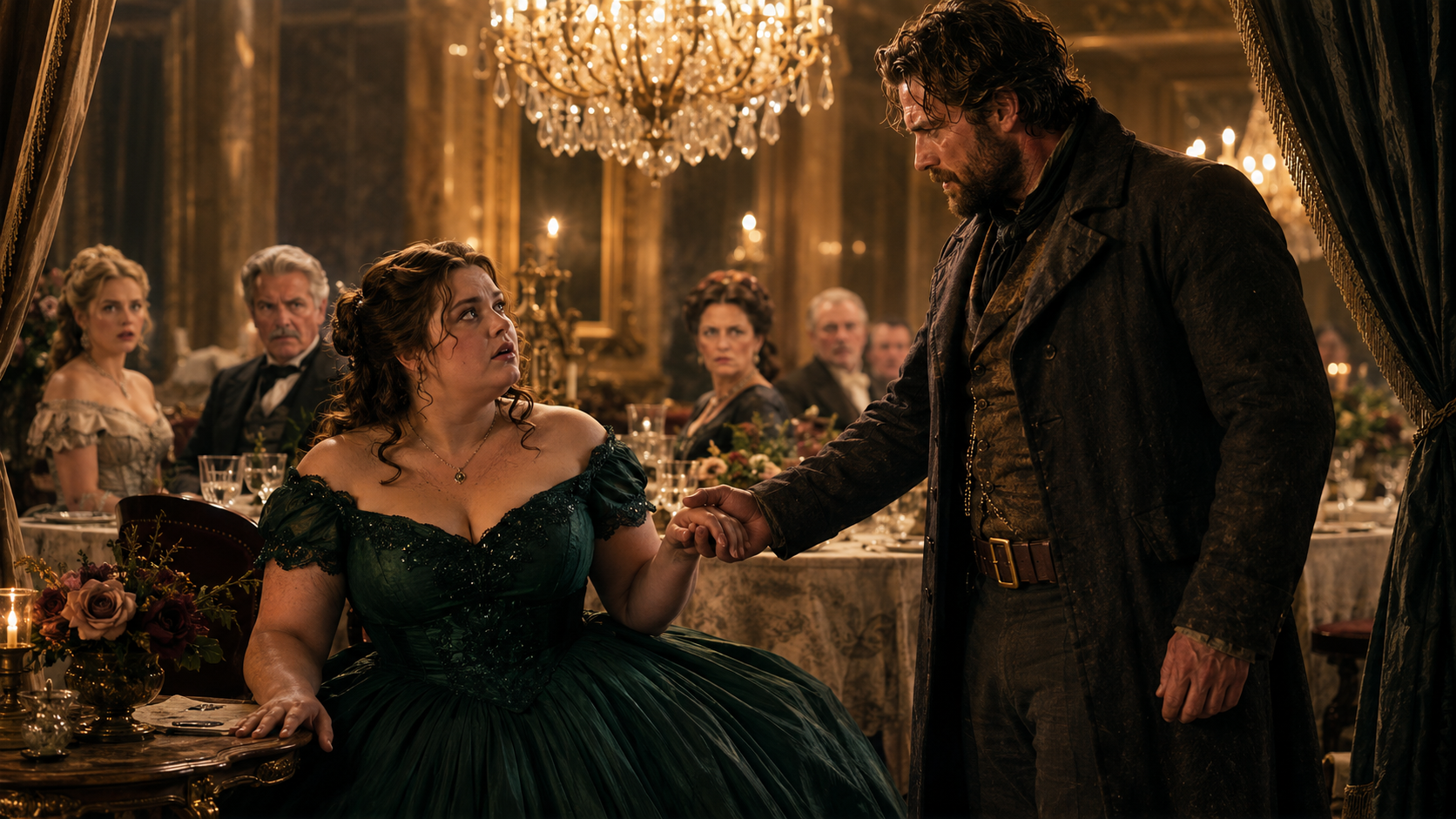
“I would like to see your library,” she said.
Rowan opened the carriage door.
“Then you shall.”
The ride to Blackthorn Ridge took nearly three hours. At first Mara sat stiffly beneath the fur blanket Rowan placed over her knees. The road climbed through pine forest silvered with frost. Below, Pineford dwindled into scattered yellow lights. Above, the stars looked sharp enough to cut skin.
Rowan did not crowd her with talk.
That, too, felt like kindness.
At last Mara asked, “Did my grandfather know you?”
Rowan nodded. “A little. I was seventeen when he found me sleeping in an abandoned line shack. He gave me breakfast instead of calling the sheriff.”
“That sounds like him.”
“He said rich men usually hate land because land refuses flattery.”
Mara smiled. “That definitely sounds like him.”
“He spoke of you once.”
Her heart tightened. “What did he say?”
Rowan watched the road ahead.
“He said his eldest granddaughter had more mountain in her than anyone in the family.”
Mara turned toward the window quickly.
Tears blurred the trees.
For so long she had remembered herself through her mother’s disgust that she had nearly forgotten there were other mirrors.
Blackthorn House appeared near midnight.
It was not the crude cabin Pineford gossip described. It rose from a shelf of stone above a dark alpine lake, built of timber, granite, and glass. Warm light spilled from tall windows. Smoke curled from three chimneys. The house looked less like a mansion than something grown by the mountain itself — sturdy, weathered, impossible to intimidate.
An older woman named Mrs. Arden met them at the door with no visible surprise.
“Miss Holloway,” she said kindly, “there is hot water in the blue room. You look half-frozen and entirely done with nonsense.”
Mara blinked.
Then she laughed again.
Rowan glanced at Mrs. Arden. “She usually likes people.”
“I like this one,” Mrs. Arden said. “She looks as if she might finally make you lose an argument.”
The inside of the house stole Mara’s breath. There were iron lamps, woven rugs, mineral samples, framed maps, and a hearth large enough to stand inside.
But the library stopped her completely.
It rose two stories high.
Books lined every wall. Rolling ladders leaned against carved rails. A huge table dominated the center, covered in surveys, drafting tools, ledgers, and open atlases. Near the fire stood two leather chairs facing each other like they had been waiting for debate.
Mara stepped inside as if entering a chapel.
Rowan remained by the doorway.
“I have wanted a room like this all my life,” she said.
“I thought you might.”
She turned. “You thought?”
His expression softened.
“I hoped.”
The vulnerability in that one word made her chest ache.
That night, behind a locked door in the blue room, Mara removed the corset. The relief was so overwhelming she gripped the bedpost. Her body expanded into breath.
She looked at herself in the mirror: hair loose, arms full, belly soft, hips wide, waist refusing to become what her mother had demanded.
Nothing about her matched the delicate illustrations in fashion books.
But for the first time, Mara wondered whether the mirror had been innocent all along.
Perhaps the cruelty had never been in the glass.
The next morning, she expected regret.
It did not come.
Work came instead.
Lawyers arrived by noon. Surveyors by evening. Over the next weeks, the codicil was validated. Holloway Timber’s accounts were opened. The company was found solvent only because debts had been shuffled like cards in a crooked game. Tobias had stolen funds outright. Lionel Crane’s bank had enabled Edmund’s reckless borrowing, expecting to seize assets after winter.
Rowan could have crushed them all.
Mara chose reconstruction.
Not soft forgiveness.
Not surrender.
Reconstruction.
Tobias was prosecuted when proof of theft became impossible to bury. Lionel returned to the city disgraced. Edmund was removed from control but allowed to advise on old contracts under supervision, which humbled him more than poverty might have. Beatrice remained in the east wing for three months, then moved to a smaller house in town, where she discovered how quickly callers vanished when fortune no longer sat in the parlor.
Rosalie surprised everyone.
The first week, she refused to speak to Mara.
The second, she sent a note with only two words.
I’m sorry.
Mara did not answer at once.
Some apologies are not doors. They are seeds. They require weather.
In December, Rosalie came to Blackthorn House wearing a plain wool coat instead of satin. Her face looked thinner, her eyes less certain.
“I do not know who I am if no one is admiring me,” she confessed beside the library fire.
Mara, who knew something about being misnamed by other people’s eyes, poured tea.
“Then perhaps you can begin there.”