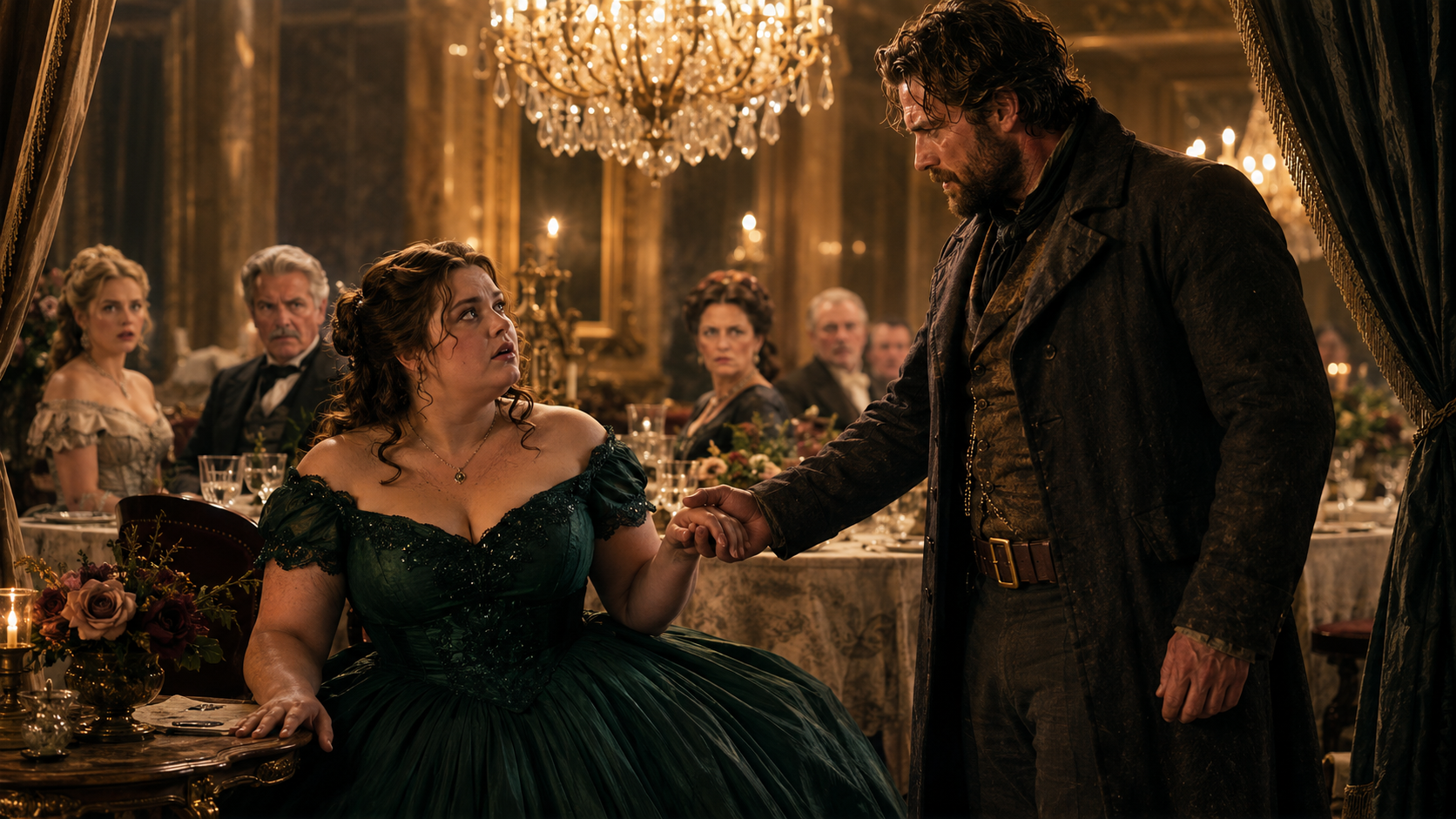
It was not sisterhood restored in an afternoon. Wounds made over decades do not close because someone cries prettily. But it was a beginning, and Mara had decided beginnings mattered.
By spring, the safer route over the upper shelf was approved. No blasting was done in Raven Hollow. Workers were paid through winter. A relief fund was established for widows and injured laborers. Mara opened a reading room in Pineford for girls and working women, stocked with newspapers, scientific journals, novels, maps, and practical manuals.
The town that had watched her humiliation now watched women enter that room with ink on their fingers and questions in their mouths.
Some people still whispered.
Mara learned whispers could not kill a woman who had heard worse at her own dinner table.
As for Rowan Vale, he did not ask her to marry him that night.
Or that month.
He argued with her.
Constantly.
About road grades. About contracts. About whether coffee could reasonably replace breakfast. About whether a library required four copies of the same engineering volume because one had better notes in the margins.
He listened when she was right.
He admitted, with visible suffering, when he was wrong.
And one late May evening, on the cedar balcony overlooking the black lake, he stood beside her while sunset turned the peaks copper.
“I have a question,” he said.
Mara smiled without looking at him. “That sounds dangerous.”
“It is.”
“Business?”
“No.”
She turned.
Rowan Vale, who had faced blizzards, collapsing mines, armed claim jumpers, and Edmund Holloway’s rage without blinking, looked almost nervous.
“I loved you first for your mind,” he said. “Then for your courage. Then for the way every room becomes larger when you stop trying to make yourself small.”
Mara’s throat tightened.
He took a small velvet box from his pocket.
“I do not want to rescue you,” he said. “You have done that yourself. I do not want to own you. I have seen what men become when they mistake ownership for love. I want to build beside you. Fight beside you. Read beside you. Grow old being corrected by you.”
She laughed through tears.
He opened the box.
Inside lay a gold band set with a deep blue stone the color of twilight snow.
“Mara Elise Holloway,” Rowan said, voice rough, “will you marry me?”
She looked at the ring.
Then at the man.
Then at the mountains that had never apologized for taking up space.
“Yes,” she said. “But I will not promise to stop correcting you.”
His smile broke open.
“I was counting on that.”
They married in September, not at the Grand Alder Hotel, but in the meadow below Blackthorn Ridge. Workers, clerks, widows, schoolgirls, servants, surveyors, and a few humbled members of polite society stood together beneath yellow aspens.
Beatrice attended in gray.
She did not cry.
She did not apologize.
But when Mara passed her after the ceremony, Beatrice lowered her eyes.
It was not enough.
But it was something.
Edmund came too, older now, quieter. He stood at the edge of the meadow and watched his eldest daughter marry the man who had exposed him, spared him, and replaced him. After the ceremony, he approached Mara.
For a long moment, he said nothing.
Then he removed his hat.
“Your grandfather would have been proud,” he said.
Mara waited for more.
No full confession came. No miraculous transformation. No perfect ending tied with ribbon.
But his voice broke on the last word.
Mara accepted that as the first honest thing he had given her in years.
“Thank you,” she said.
She did not embrace him.
She did not need to.
That evening, as lanterns glowed in the trees and fiddles played near the lake, Rowan drew Mara into a dance. She moved with more confidence now. Her body had not become smaller. Her hunger had not disappeared. Her mind had not softened. Her waist had not narrowed into acceptability.
She had simply stopped treating herself as a problem to be solved.
Rowan’s hand rested at her back.
“Do you remember the first time we danced?” he asked.
“At the hotel?”
“When your father threatened me in front of two hundred people?”
“When you revealed you owned his debt in front of two hundred people?”
“I thought it went rather well.”
“It was a disaster.”
“A useful disaster.”
She laughed and leaned closer. “I was terrified.”
“I know.”
“I thought you might be using me.”
“I know that too.”
“Were you?”
Rowan’s face sobered.
“At first, I thought justice would be enough. Then I met you properly and realized justice without dignity is only another form of power. I did not want to become another man making choices over your head.”
Mara studied him.
That was why she loved him, she thought. Not because he had arrived like a flawless hero from the mountains and made everything simple. Nothing had been simple. Love never was, not real love. Real love came with truth, restraint, apology, and the daily decision to see another person whole.
“You gave me the paper,” she said.
“You claimed the life.”
The music carried them beneath the aspens.
Far below, Pineford glimmered in the valley, no longer a kingdom ruled by one family’s pride, but a town slowly learning that worth was not measured by waistlines, dowries, surnames, or seats at a table.
And Mara, once hidden beside a service door at a feast meant to erase her, danced beneath the open sky with her head high, her laughter warm, her body strong, her mind free, and her future no longer waiting for permission.