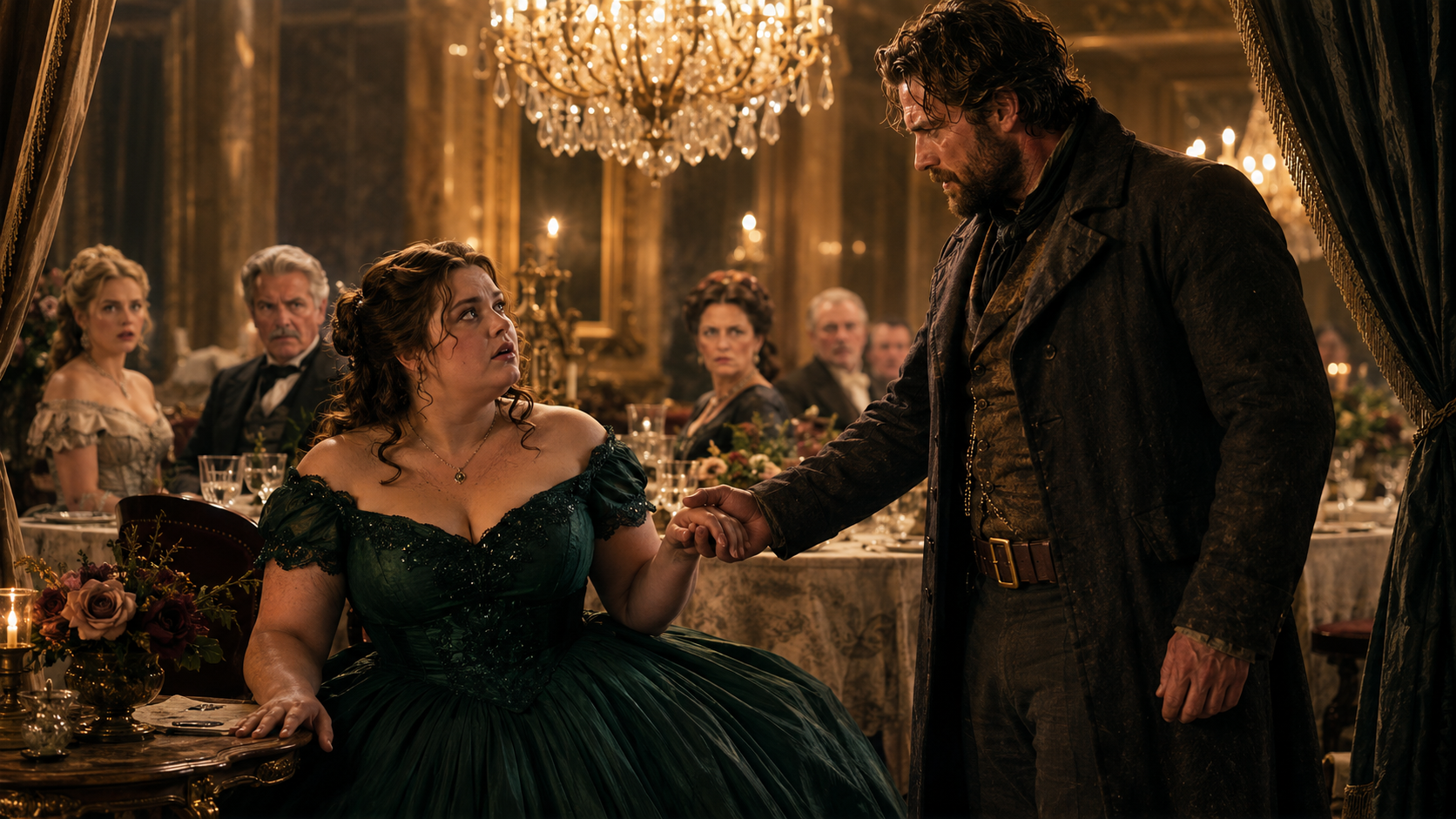
“I understand more than you hoped I would.”
Beatrice softened her face like a woman changing masks. “Mr. Vale, you are a man of influence. Surely you see that my daughter is not accustomed to attention. She has never been courted. She may mistake gratitude for something romantic.”
Mara wished the floor would open.
There it was: the secret shame laid bare.
No man had courted her. No one had brought flowers. No one had waited beneath windows or asked her to dance. She had told herself books and maps were better companions than shallow men, but absence still left a shape.
Rowan’s face changed.
Not with pity.
With anger so controlled it frightened her.
“Mrs. Holloway,” he said, “your daughter saved lives because she saw what powerful men refused to see. She spoke truth at a table where cowards lied for profit. If that makes her unsuitable for your society, then your society is poorer than the mining camps you pretend to despise.”
Beatrice recoiled.
Rowan turned to Mara.
His voice softened. “Did she hurt you?”
Mara looked at the creased fabric where her mother’s fingers had gripped her arm.
“No,” she lied.
Rowan did not believe her.
But he respected her answer enough not to expose it.
Instead, he offered his arm.
“The orchestra has started again,” he said. “Will you dance with me?”
Mara stared at him.
“I do not know how.”
“I do.”
“I am not graceful.”
“I did not ask for graceful.”
“People will stare.”
“They already are.”
“My mother will never forgive me.”
His gaze held hers. “Perhaps the question is whether you are ready to stop forgiving her for things she has never regretted.”
That sentence opened something.
Mara looked at Beatrice, trembling with rage. She looked at Rosalie, beautiful and frightened, dependent on applause that could vanish in a moment. Then she looked at Rowan Vale.
For the first time in her life, she did not ask what would make her family less ashamed.
She asked what would make her feel alive.
“Yes,” she said. “I will dance.”
They entered the ballroom together.
The crowd parted again, but this time Mara lifted her head.
When Rowan guided her onto the floor, his hand at her back did not push her smaller. It held her steady. The music rose. He moved, and somehow she followed. At first she counted steps in panic. Then she stopped counting.
The room blurred.
Her skirt swung. Her breath loosened. Her body, so often treated as a burden, became motion.
For one dazzling minute, Mara Holloway was not the large daughter, the hidden daughter, the family embarrassment in dark fabric.
She was a woman dancing in the center of the room while everyone who had dismissed her watched.
Edmund shattered the moment.
“Vale!”
The music faltered.
Edmund pushed through the crowd with Lionel Crane and Mara’s uncle Tobias behind him.
“That is enough,” Edmund barked. “Remove your hands from my daughter.”
Rowan stopped, but he did not release Mara.
Edmund’s face was purple. “You think owning a mountain pass gives you the right to insult my family?”
“No.”
“You think because Mara wrote some foolish letter, you can parade her like a prize?”
Rowan’s voice dropped. “Careful.”
“You be careful,” Edmund snapped. “You need my timber contract as much as I need your pass. Continue this insult, and I take my business elsewhere.”
Lionel Crane went pale.
Rowan noticed.
So did Mara.
A faint smile touched Rowan’s mouth.
“Tell him, Crane.”
Lionel swallowed. “Mr. Holloway—”
“Tell him.”
Edmund turned. “Tell me what?”
Lionel’s voice thinned. “The city consortium no longer holds your principal notes.”
Edmund stared. “What?”
Rowan’s arm remained steady around Mara’s waist.
“Four weeks ago, I purchased the Holloway Timber debt from Crane’s consortium. Last week, I acquired the lien on your mill. Yesterday morning, the deed of trust on your house was transferred to my office.”
Beatrice made a sound like breaking glass.
“You are lying,” Edmund said.
“I rarely need to.”
“You are a road owner.”
“I am many things you failed to count.”
Rowan looked around the ballroom, letting every guest hear him.
“While you borrowed money to host dinners you could not afford, I bought paper. While you used your daughter’s intelligence and called it useless, I read the work that crossed my desk without her name on it. While you risked workers’ lives to strengthen your bargaining position, I bought the debts proving you are not master of this valley. You are a debtor wearing another man’s crown.”
The silence was absolute.
Tobias stepped away from Edmund as if ruin were contagious.
Rowan continued. “I can call the loans by Monday. The mill, the house, the accounts — everything.”
Rosalie began to cry, not delicately, but with open fear as the young men who had circled her all evening backed into the crowd.
Beatrice looked from Edmund to Rowan to Mara.