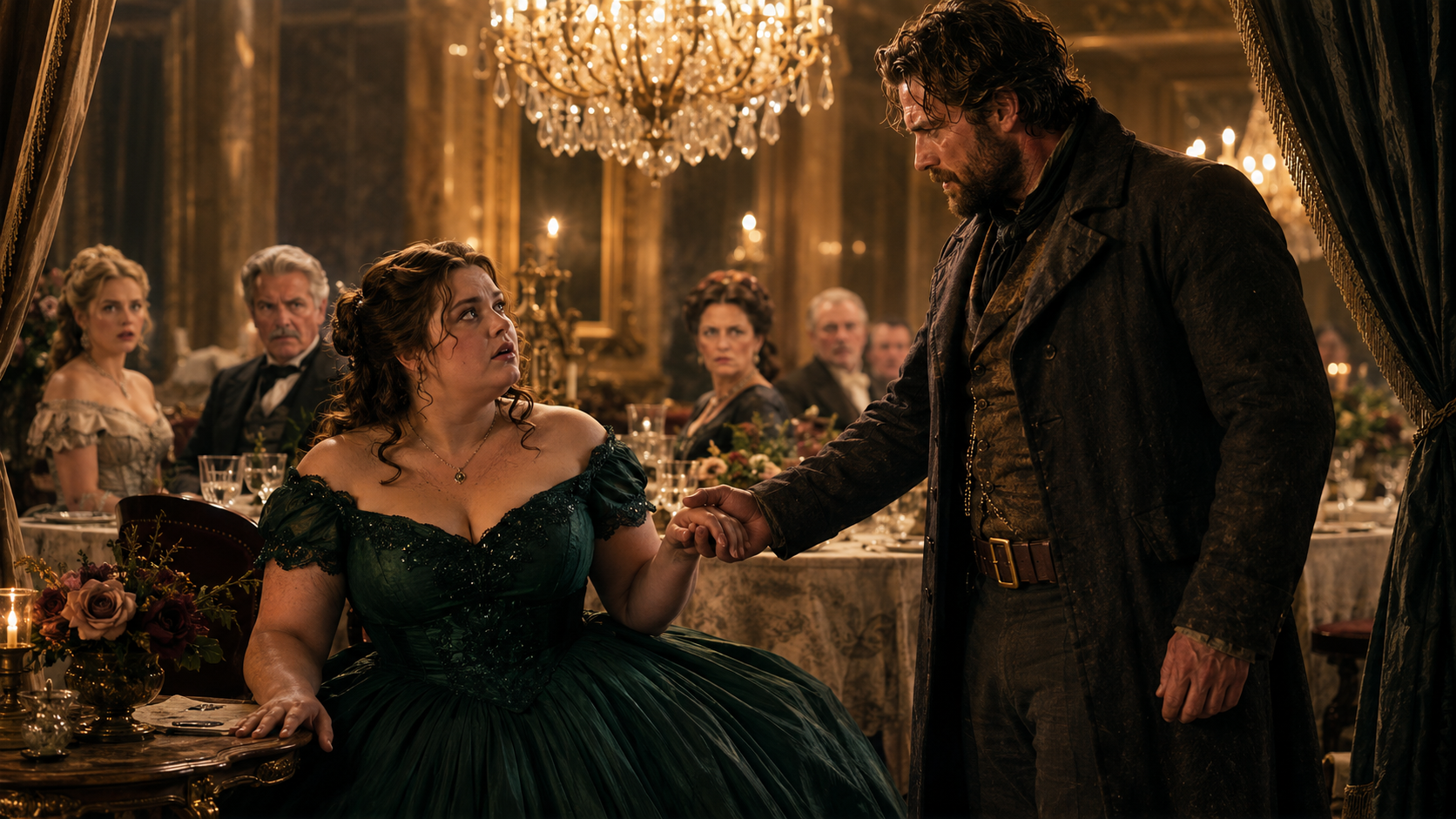
Then her expression changed with horrifying speed.
The disgust vanished.
Tenderness arranged itself across her face like a costume.
“Mara,” she whispered. “My darling girl.”
Mara went cold.
Beatrice reached for her. “You must help us. Mr. Vale respects you. We all saw it. Tell him family matters. Tell him your father made mistakes, but he loves you. Tell him not to destroy what your grandfather built.”
What your grandfather built.
The words struck Mara strangely.
Her grandfather, Silas Holloway, had died when she was twelve. He was the only person in her family who had never asked her to eat less, speak less, or be grateful for tolerance. He had taken her riding through timber roads, taught her to read contour lines, and told her once that land did not care whether a person looked pretty standing on it.
He had also left rumors.
A disputed parcel.
A missing codicil.
A family argument overheard through locked doors.
Edmund saw her expression. “Beatrice, stop.”
Rowan’s eyes narrowed.
Mara turned to her father. “What did Grandfather build?”
“This is not the time.”
“It seems exactly the time.”
Rowan spoke quietly. “There is something else.”
Mara looked up at him.
For the first time all night, he seemed uncertain.
“I meant to show you privately,” he said. “Not like this.”
He reached inside his coat and withdrew a folded document sealed in oilskin.
Edmund lunged.
Rowan turned his shoulder, blocking him with almost no effort.
The room erupted in whispers.
“What is that?” Mara asked.
Rowan handed it to her.
Edmund’s voice cracked. “That paper is invalid.”
Mara unfolded it with shaking hands.
The legal language was dense, but she had copied enough contracts to understand what mattered.
It was a certified copy of Silas Holloway’s final codicil.
Her eyes moved down the page.
Blackthorn Ridge water rights.
Northern pass easement.
One-third interest in the original Holloway mountain tract.
Left not to Edmund.
Not to Tobias.
Not to Rosalie.
To Mara Elise Holloway, upon her twenty-fifth birthday, held in trust until such time as she demonstrated sufficient knowledge of the land to manage it.
Mara could not breathe.
“I do not understand.”
Rowan’s voice was low. “Your grandfather knew your father would sell the mountain blind. He wanted the land controlled by the child who understood it.”
Mara looked at Edmund. “You hid this from me.”
His face twisted. “You were a girl.”
“I am twenty-seven.”
“You were unmarried. Unprepared.”
“I prepared your surveys.”
“You were not fit to manage—”
“Because I am fat?” Mara asked.
The word cracked across the ballroom.
Beatrice flinched as if the vulgarity mattered more than the theft.
Mara’s voice shook, but it did not break.
“Because I embarrassed you? Because no man wanted me? Because you could use my mind in private but not admit in public that I had one?”
Edmund said nothing.
That was answer enough.
Rowan looked at Mara, not at him.
“The pass your father needs crosses land that is partly yours. I suspected it when I reviewed old boundary filings. After your letter saved my men, I searched harder. The county clerk found the codicil last month.”
Mara’s throat tightened. “Why did you not tell me sooner?”
“Because I wanted proof before I placed hope in your hands.”
Edmund laughed bitterly. “How noble. You mean you wanted leverage.”
Rowan’s face hardened.
“At first, yes.”
The admission shocked the room.
It shocked Mara most.
Rowan turned fully to her.
“I will not lie to you. When I learned he had hidden your inheritance, I intended to use the truth against him. Then I learned you wrote the warning. Then I heard you speak tonight. And when I saw where they seated you, I understood that giving you the paper was not enough. You needed the room to see you receive what was always yours.”
Mara stared at him.
Her mother’s warning had been hanging over her heart all evening: he is using you.
The truth was more complicated.
He had come with a weapon.
But he had placed it in her hands.
“What happens now?” she asked.
Rowan nodded toward the document.
“That depends on you.”
The ballroom waited.
All her life, decisions had been made around Mara as if she were a heavy piece of furniture. Where she sat. What she wore. Whether she ate. Whether she spoke. Whether she was lovable. Whether she was useful.
Now the most powerful people in Pineford stood silent while she held a paper that could change the valley.
Beatrice began to cry, but Mara recognized the sound. It was not sorrow. It was strategy.
“Mara,” her mother pleaded, “think of your sister.”
Mara looked at Rosalie, trembling in her silk gown. Rosalie had been cruel, yes. But she had also been raised inside the same gilded cage, praised only for beauty and terrified of losing the one currency she had been taught to spend.