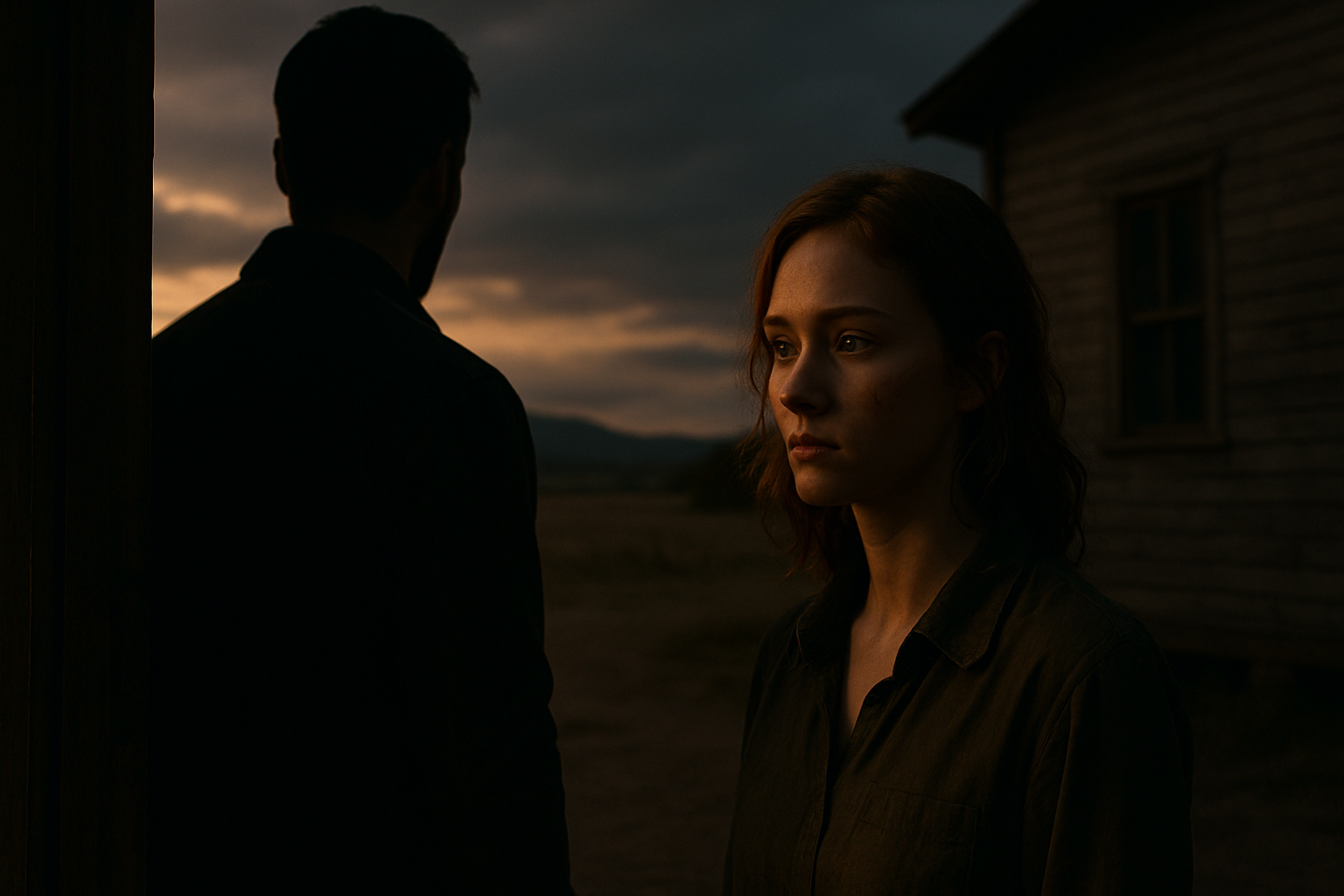
Willa rode ahead, her hat low, her posture easy in the saddle. June followed, holding the flower jar like it was something sacred. Wyatt brought up the rear, watching them move across land that had once been the center of every fight and every loss.
The spring waited beneath the cottonwood.
Water slipped over stones with a sound too gentle for all it had survived.
Willa dismounted first. For a long while, she stood at the edge of the spring without speaking.
“She should be here,” she said at last.
Wyatt removed his hat.
“Yes.”
No excuse followed. No attempt to soften the truth. He had learned that some griefs did not want comfort. They wanted witnesses.
June knelt and placed the wildflowers near the cottonwood’s roots.
“She was scared,” June said. Her voice wavered. “But she still got us here.”
Willa wiped her eyes with the heel of her hand, impatient with her own tears.
“She always did things the hard way.”
Wyatt’s mouth moved toward a smile.
“She loved dramatically.”
June laughed, though it broke halfway through. “That sounds like Mama.”
They spread the blanket in the shade.
The meal was simple: cold chicken, biscuits, peaches, a jar of Mrs. Harlan’s pickles that Willa claimed could wake the dead and June said should not be tested near family graves. They ate slowly. The horses cropped grass nearby. The cottonwood leaves rattled overhead like quiet applause.
For a while, none of them spoke.
The silence was not empty anymore.
Then Willa leaned back on her hands and looked at Wyatt.
“Did you ever want children?”
The question came gently, which somehow made it hurt more.
Wyatt kept his eyes on the spring. The water flashed in pieces between the stones.
“I stopped letting myself want anything after the fire.”
“That’s not an answer.”
He looked at her then.
Her face was Caroline’s and not Caroline’s. Her eyes were sharper. Her mouth more guarded. But there was something of him in her too, something stubborn in the bones, something that would rather bleed than bend falsely.
“Yes,” he said. “I wanted them. I wanted you before I knew your names.”
Willa’s face crumpled so suddenly it seemed to surprise her. June reached for her hand.
Wyatt stayed where he was.
Every instinct in him wanted to fix it—to stand, to apologize again, to gather the pain in his arms and carry it somewhere far from them. But he had learned, slowly and poorly, that love was not always repair. Sometimes love was staying present while the hurt told the truth.
“I’m still angry,” Willa said.
“I know.”
“At Mama too.”
“I know.”
“At you sometimes, even though that’s not fair.”
Wyatt nodded.
“I can take unfair.”
She laughed wetly, pressing her fingers beneath her eyes. “That may be the most father thing you’ve ever said.”
The word hung there.
Father.
Not accusation.
Not demand.
Not even forgiveness.
A beginning.
Wyatt bowed his head, not trusting his face.
June squeezed Willa’s hand and looked out across the grass, blinking hard.
The wind moved over them.
Somewhere in its passing, Caroline seemed less absent than before.
Months later, Mercy Ridge held its first Founders’ Fair since the trial.
Wyatt did not want to go.
He said so at breakfast while June was rolling pie dough and Willa was cleaning mud from her boots at the back door.
“No,” he said.
June did not look up. “That was not a question.”
“I’m not going to stand around while half the town pretends it didn’t spit when I passed.”
Willa scraped her boot with unnecessary force.
“That is exactly why we should go.”
Wyatt frowned.
“I don’t follow.”
“Of course you don’t,” she said. “You’ve been alone too long. People get used to your absence, then call it peace. We should inconvenience them.”
June pointed her rolling pin at Willa. “That is the most beautiful thing you have ever said.”
“I’ve said better.”
“No, that had structure.”
Wyatt looked between them and realized, with resignation and a strange warmth, that he was outnumbered in his own kitchen.
So they went.
June baked six peach pies and entered them under the name Calder-Ward. She wrote it carefully on the card herself, then stared at it for a moment too long before sliding it into place.
Willa saw, but said nothing.
The fairgrounds had been strung with bunting. Children raced between booths with sticky hands. Fiddle music rose from a platform near the church tent. Cattle lowed in temporary pens. Women gossiped beneath parasols. Men pretended not to gossip while standing in tight circles doing exactly that.
When Wyatt stepped from the truck, conversations thinned.
Not stopped.
Thinned.
Like grass bending under wind.
He felt the old instinct rise: turn away, keep to the edge, let them have their town and their whispers. But June came around the truck carrying a pie box, and Willa shut the door hard enough to make two men by the feed display look over.
“You coming?” Willa asked.
Wyatt put on his hat.
“Yes.”
They walked in together.
Mrs. Harlan cried when June’s pie won a blue ribbon.