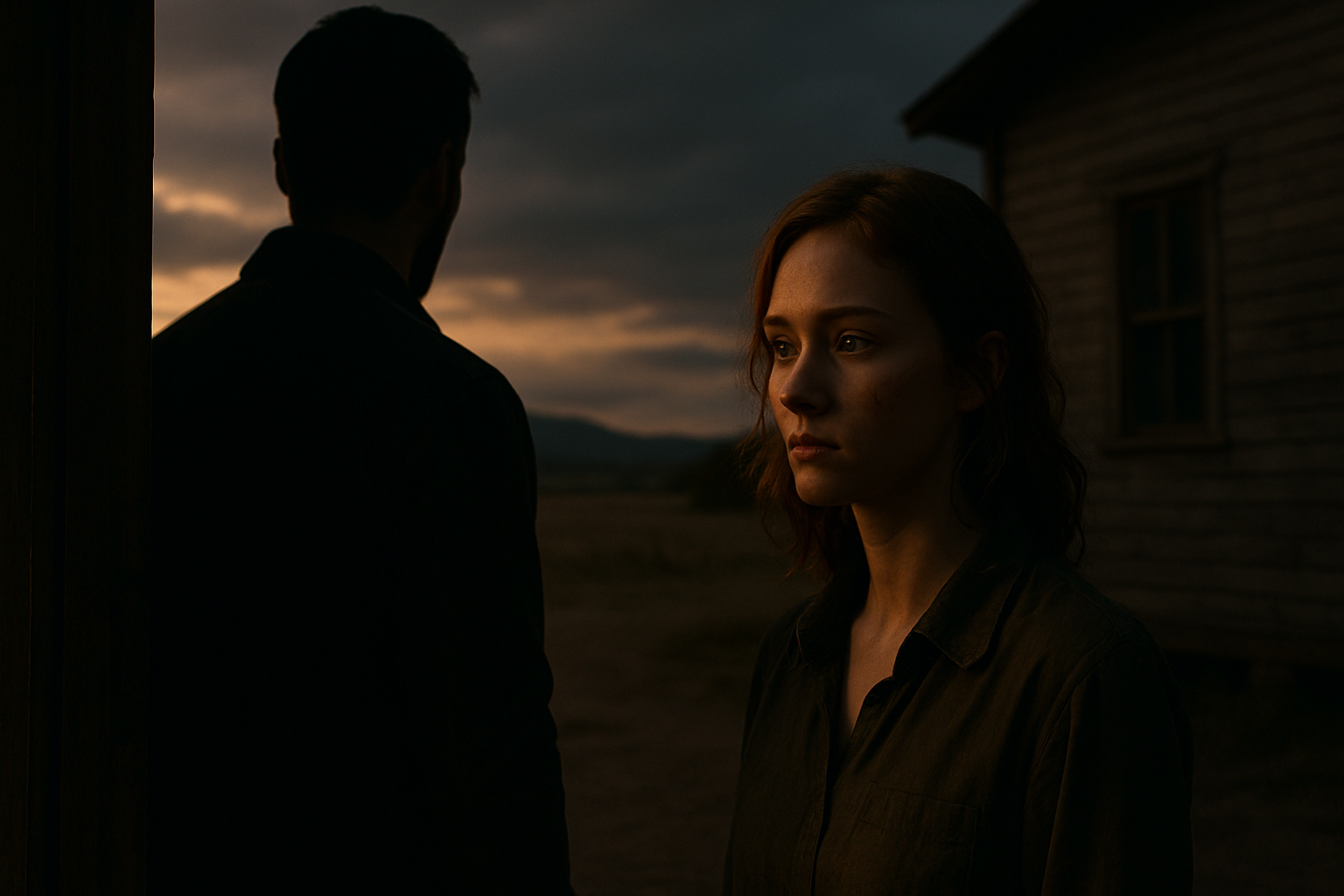
To be fair, Mrs. Harlan had cried when June entered the pies, cried when Pastor Bell tasted one, and cried when a child dropped lemonade near the judging table because “life is brief and floors can be mopped.”
Pastor Bell announced the prize like it was national news.
“Blue ribbon for June Calder-Ward,” he said, voice ringing across the fairgrounds. “Peach pie.”
June turned scarlet.
Willa clapped loud enough for three people.
Wyatt stood behind them, smiling before he knew he had allowed it.
Near sunset, when the fairgrounds had gone honey-colored and the heat began to loosen its grip, a little boy with a cowlick and a paper sack of taffy stopped in front of Wyatt.
He stared openly at Wyatt’s face.
His mother, several paces behind, saw too late what was happening.
“Does that hurt?” the boy asked loudly.
The mother gasped. “Eli!”
She reached for him, horrified, but Wyatt lifted a hand—not to stop her exactly, but to ask for patience.
Then he crouched, slow enough not to scare the child.
“Sometimes,” Wyatt said.
The boy touched his own cheek in sympathy. “Mine hurt when I fell off my bike.”
Wyatt nodded solemnly.
“Scars remember.”
The boy considered this with the grave attention only children can give to painful truths.
“Does it remember fire?”
Wyatt’s breath caught.
The mother whispered, “Eli, please—”
“Yes,” Wyatt said.
The boy looked troubled. Then he reached into his paper sack, pulled out a piece of taffy wrapped in waxed paper, and offered it.
“This helps mine.”
Wyatt stared at the candy in the boy’s small hand.
Then he took it.
“Thank you.”
The boy nodded, satisfied, and ran back toward the pie table as though he had completed important business.
June watched from a few feet away, smiling softly.
Willa came up beside Wyatt with two cups of lemonade.
“You handled that better than the entire adult population of Mercy Ridge,” she said.
Wyatt turned the taffy once in his fingers.
“I had a good teacher.”
“Who?”
Wyatt looked at June.
June’s smile faded into something tender.
“You asked me once if it still hurt,” he said.
June’s eyes shone. “And you said sometimes.”
“It does,” Wyatt said. “But not the same way.”
Willa handed him the lemonade.
Around them, Mercy Ridge moved in ordinary noise: fiddle strings, children shrieking with laughter, horses stamping, old women bargaining over quilt squares, Pastor Bell trying and failing to throw a ring over a milk bottle while Mrs. Harlan accused him of lacking faith.
The plains stretched gold beyond the fairground.
The same land that had once held Wyatt in exile.
Only now, he was not standing outside life watching it happen to others.
He was inside it.
With two daughters who had arrived like a burden and become proof that stolen years did not have to mean an empty future.
At dusk, the three of them walked back to the truck together.
A man Wyatt barely knew tipped his hat.
“Evening, Calder.”
Wyatt nodded.
Then the man hesitated and added, “Ladies.”
Willa lifted her chin, waiting for the familiar smirk.
It did not come.
The man simply stepped aside to let them pass.
June whispered, “Progress?”
Willa said, “Don’t get sentimental. It scares me.”
Wyatt opened the truck door.
Willa climbed in first, then June. Before Wyatt shut it, Willa looked back at him.
“You know,” she said, “when Pastor Bell dropped us off that first day, I thought this place looked like the end of the world.”
Wyatt glanced toward the darkening road.
“It was,” he said. “Mine.”
June leaned forward from the middle seat.
“And now?”
Wyatt looked at the two women in his truck.
Caroline’s daughters.
His daughters.
Broad and bright and wounded and alive.
Women who had been called too much all their lives and had turned out to be exactly enough to bring a dead ranch back to breathing.
“Now,” he said, “it looks like home.”
They drove toward the ranch under a sky crowded with stars.
Behind them, Mercy Ridge glittered small and uncertain, a town learning—slowly, awkwardly—that truth did not vanish because people refused to speak it.
Ahead, the windmill turned above the house.
The porch light burned.
The land waited.
Not empty anymore.
Not silent.
Not cursed.
Just scarred.
And healing.
By dawn, the rain had washed the ash from the chapel steps, but nothing could cleanse the house itself.
Veyr Hall stood black-windowed against the pale morning, its towers rising like accusing fingers above the valley. Servants moved in silence. Guards who had once bowed to Edric now avoided his name as if it were a sickness. In the east corridor, the portraits of dead Veyrs stared down through the dimness, all those painted men and women who had built their name on pride, inheritance, obedience, and secrets.
Cassian walked beneath them without looking up.
He had not slept. He had not eaten. There was still dried mud on the hem of his coat from the cemetery and a streak of candle soot along his jaw where the wind had blown the flame sideways when they opened Seraphine’s tomb.
No one had spoken when the lid was lifted.
Not Dahlia.